
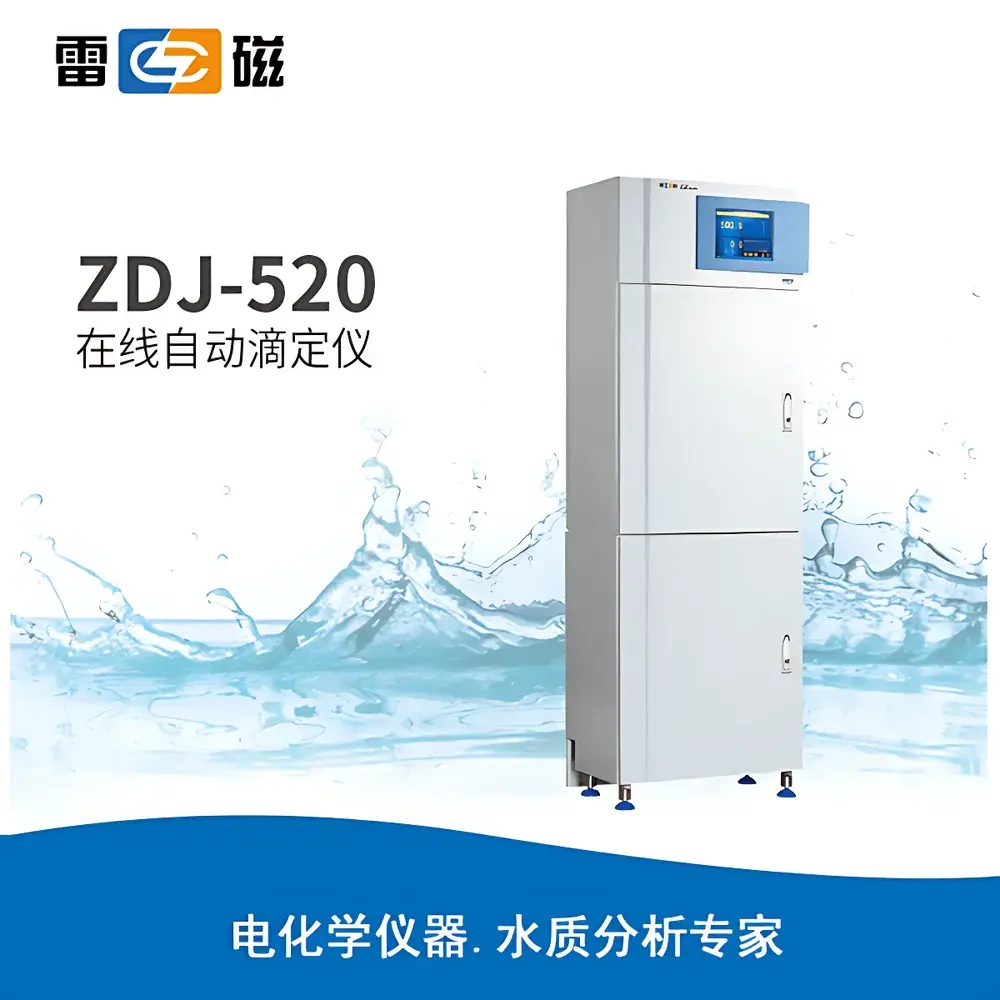
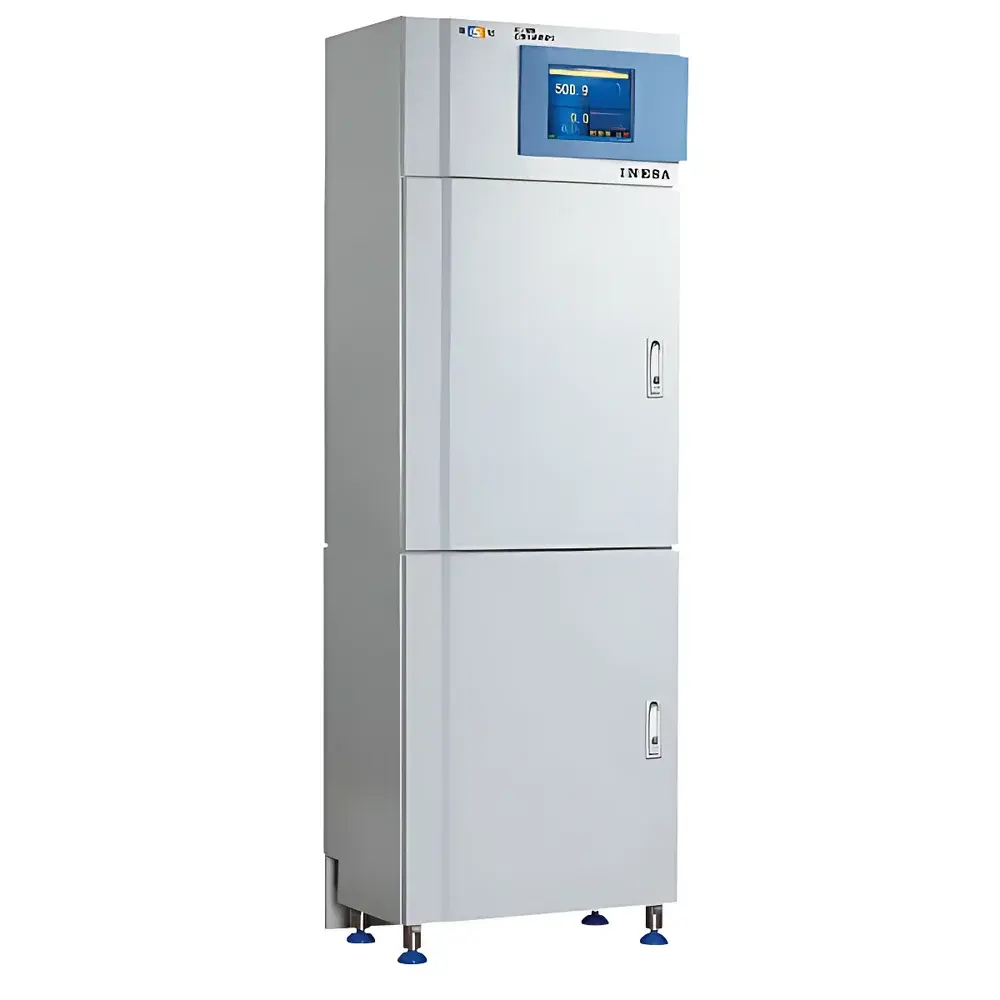
Leici ZDJ-520 Online Automatic Potentiometric Titrator
| Brand | Leici |
|---|---|
| Origin | Shanghai, China |
| Model | ZDJ-520 |
| Instrument Type | General-purpose Potentiometric Titrator |
| Application Scope | Universal |
| Measurement Range | pH (0.00–14.00) |
| Display Range | pH (−2.00–20.00), mV (0.0 to ±1999.9), Temperature (−5.0–105.0)°C |
| Resolution | 0.01 pH, 0.1 mV, 0.1°C |
| Electronic Unit Accuracy | ≤±0.01 pH ±1 digit, ≤±0.03% FS for mV, ≤±0.3°C for temperature |
| Titration Repeatability | ≤1.0% RSD |
| Power Supply | AC (220±22) V, (50±1) Hz |
| Dimensions (W×D×H) | 600×455×720 mm |
| Weight | 50 kg |
| Interface | RS-232 or RS-455 (user-selectable) |
Overview
The Leici ZDJ-520 Online Automatic Potentiometric Titrator is an industrial-grade electrochemical analyzer engineered for high-reliability, unattended potentiometric titration in both laboratory and continuous process environments. It operates on the fundamental principle of potentiometric endpoint detection—measuring the potential difference between a reference electrode and an indicator electrode as titrant is incrementally added—enabling precise quantification of analytes via acid-base, redox, complexometric, and precipitation reactions. Unlike benchtop titrators designed solely for intermittent use, the ZDJ-520 integrates robust mechanical architecture, sealed fluidic pathways, and thermally stabilized electrode interfaces to support long-term deployment in demanding industrial settings including wastewater treatment plants, chemical manufacturing lines, power plant cooling water monitoring, pharmaceutical intermediate synthesis control, and semiconductor wet process baths.
Key Features
- 7-inch full-color capacitive touchscreen with intuitive Chinese-English bilingual GUI, enabling rapid configuration without external PC dependency;
- Real-time graphical display of titration curves (E vs. V or dE/dV vs. V), endpoint volume, calculated concentration, and derivative peak identification;
- Interactive system diagram interface: tap icons representing burette, dosing pump, stirrer, or electrode module to initiate diagnostics, calibration, or manual actuation;
- Multi-mode titration operation: manual titration (for method development), automatic titration (with dynamic step size adjustment), reagent standardization, and standalone pH/mV/temperature measurement;
- Three programmable operational modes: continuous titration (for real-time feedstock analysis), timed titration (at user-defined intervals), and periodic titration (synchronized with process triggers via digital I/O);
- Configurable titration parameters—including equivalence point search algorithm (first/second derivative, fixed ΔE/ΔV, inflection threshold), pre-dose volume, stop criteria, and over-titration recovery logic;
- Embedded formula editor supporting custom calculation expressions (e.g., % purity = (Vt × Cstd × F × Mwt) / Wsample), with unit-aware syntax validation;
- Non-volatile memory storage for ≥100,000 titration records and calibration logs, with timestamp, operator ID, electrode serial number, and environmental metadata;
- Dual communication options: isolated RS-232 (for local PC connection) or RS-485 (for multi-drop integration into DCS/SCADA systems), compliant with Modbus RTU protocol for seamless PLC interfacing.
Sample Compatibility & Compliance
The ZDJ-520 accommodates aqueous and mildly organic samples across pH 0–14 and temperatures from −5°C to +105°C, making it suitable for effluent streams, plating baths, boiler feedwater, fermentation broths, and API reaction mixtures. Its electrode input circuitry supports standard double-junction pH electrodes, redox (Pt or Ag/AgCl) electrodes, and ion-selective sensors (e.g., fluoride, chloride) with BNC or DIN connectors. The instrument complies with IEC 61000-6-2 (EMC immunity) and IEC 61010-1 (safety for electrical equipment for measurement). While not certified for SIL-rated safety loops, its hardware design meets GLP documentation requirements—including audit-trail-enabled event logging, electronic signature support (via optional password-protected user roles), and data integrity safeguards aligned with FDA 21 CFR Part 11 principles for non-clinical laboratory data.
Software & Data Management
No proprietary PC software is required for basic operation; however, Leici provides optional Windows-based TitraLink™ Suite for advanced method library management, remote supervision, and PDF report generation (including ISO/IEC 17025-compliant uncertainty propagation). All measurement data are stored in structured CSV format with embedded metadata headers. The built-in database supports SQL-like queries via serial command set (e.g., “QUERY START=2024-04-01 END=2024-04-30 TYPE=pH”); exported files include raw potential readings, derivative calculations, and user-annotated comments. Firmware updates are delivered via USB flash drive with cryptographic signature verification to prevent unauthorized modification.
Applications
- Environmental Monitoring: Alkalinity, chloride, cyanide, and hardness titrations in municipal wastewater influent/effluent per ASTM D1067 and ISO 9297;
- Chemical Process Control: Acid number (ASTM D974) and base number (ASTM D2896) determination in lubricants and transformer oils;
- Pharmaceutical Manufacturing: Assay of active ingredients (e.g., sulfonamides via diazotization), residual chloride in APIs, and buffer capacity validation;
- Power Generation: Hydrazine and phosphate monitoring in boiler water cycles to prevent corrosion and scaling;
- Food & Beverage: Total acidity (TA) in juices, lactic acid in dairy fermentations, and SO₂ in wine production (AOAC 990.22);
- Electroplating & Surface Treatment: Free acid and metal ion concentration control in nickel, zinc, and copper sulfate baths.
FAQ
Is the ZDJ-520 suitable for hazardous area installation?
It is rated for general industrial environments (IP20 enclosure) and must be installed in non-classified zones; explosion-proof variants require third-party certification and are not offered by default.
Can it interface with LIMS or MES systems?
Yes—via RS-485 Modbus RTU or ASCII command protocol; custom API wrappers are available upon request for Siemens Opcenter, LabVantage, or Thermo Fisher SampleManager integration.
What electrode maintenance protocols does it support?
Automated cleaning cycles (acid rinse, ultrasonic agitation, air purge) can be scheduled; electrode offset and slope tracking are logged per measurement for predictive maintenance alerts.
Does it support differential pH or dual-sensor titration?
No—single-reference electrode architecture is used; differential measurements require external signal conditioning hardware.
How is traceability ensured for regulatory audits?
All user actions, calibration events, and result modifications generate immutable timestamps and operator IDs; audit log export includes SHA-256 hash verification for file integrity validation.






