
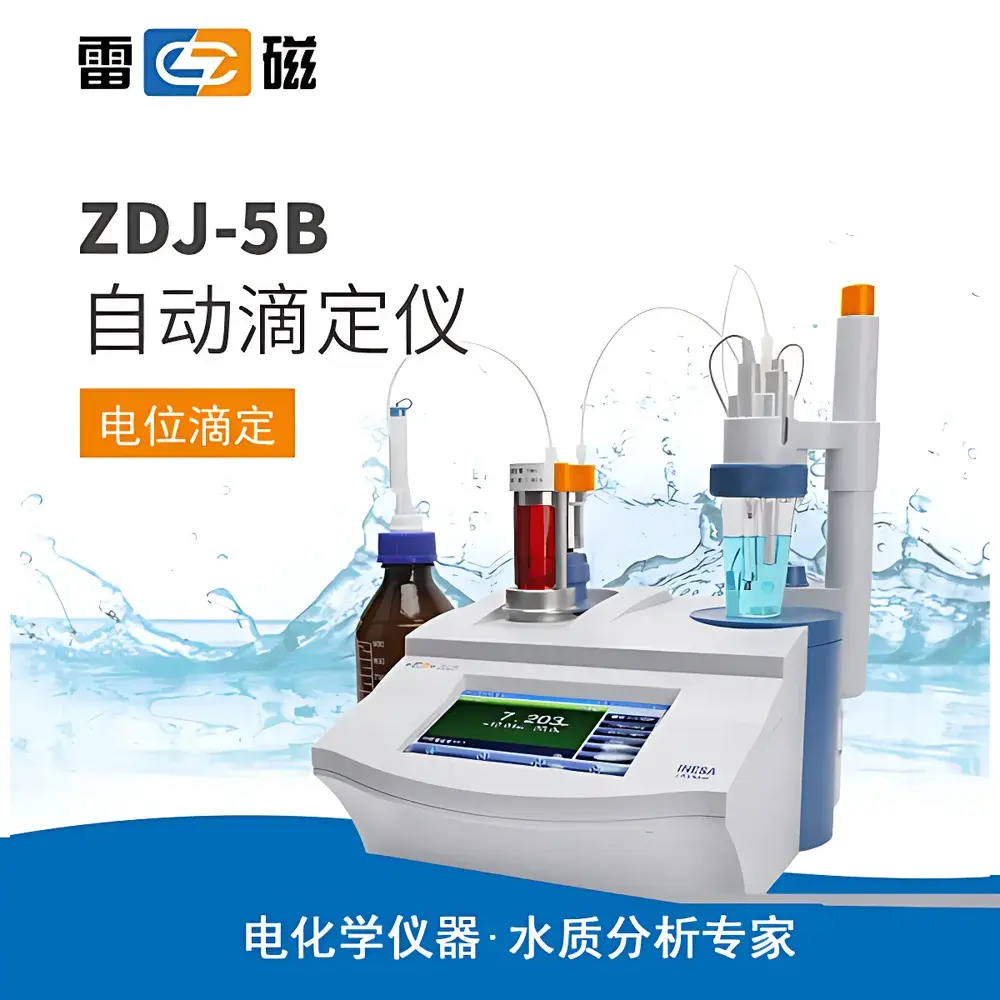
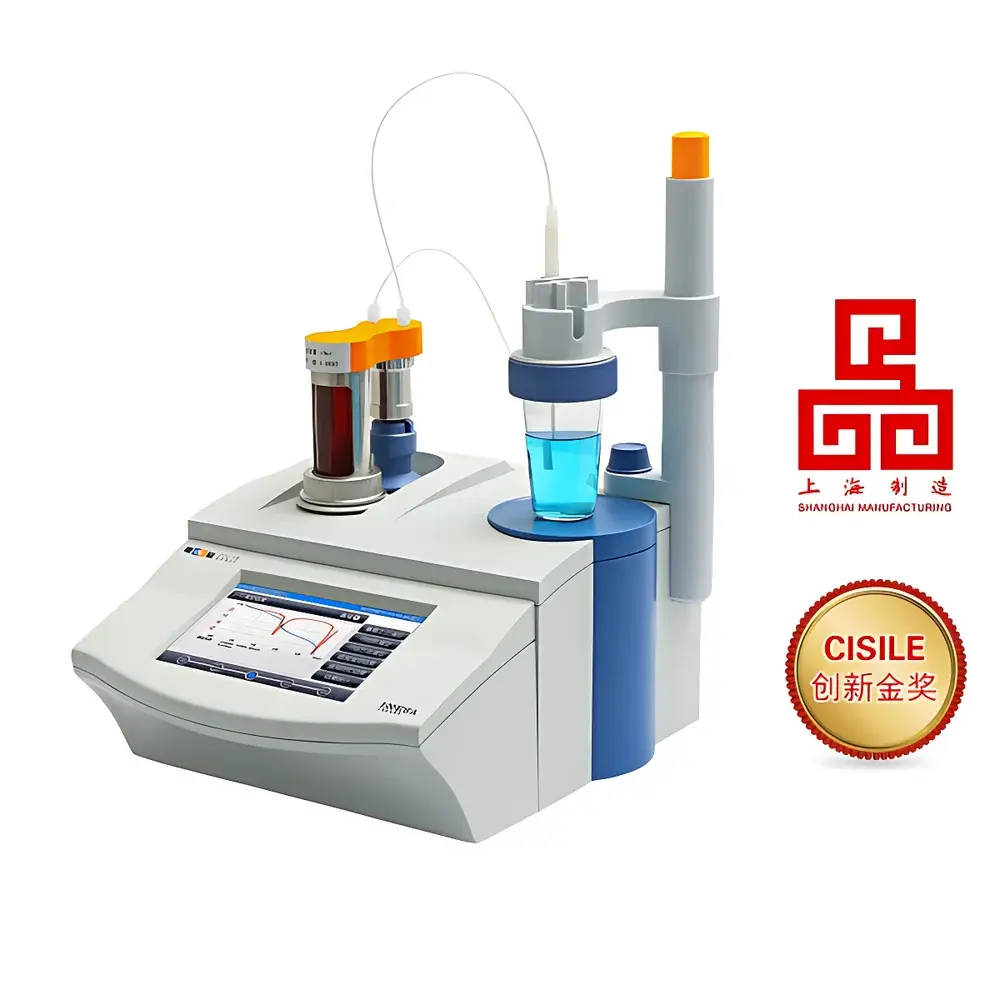
Leici ZDJ-5B Automatic Potentiometric Titrator
| Brand | Leici |
|---|---|
| Origin | Shanghai, China |
| Model | ZDJ-5B |
| Instrument Type | General-purpose Potentiometric Titrator |
| Application Scope | Universal |
| Measurement Range | (−2000.00 to +2000.00) mV |
| Electrode Unit Accuracy | ±0.002 pH |
| Electrode Unit Resolution | 0.001 pH |
| Titration Precision | 0.0003 mL |
| Titration Resolution | 1/30000 |
| Repeatability | ≤0.2% RSD |
| Temperature Compensation Range | −5.0 to 105.0 °C (0.1 °C resolution) |
| Power Supply | AC 220 V ±10%, 50 Hz |
| Dimensions (W×D×H) | 340 × 400 × 400 mm |
| Weight | 8 kg |
Overview
The Leici ZDJ-5B Automatic Potentiometric Titrator is a precision-engineered electrochemical analysis system designed for laboratory-grade quantitative titrimetric analysis across academic, pharmaceutical, environmental, and industrial quality control environments. It operates on the fundamental principle of potentiometric endpoint detection—measuring the potential difference between a reference electrode and an indicator electrode as titrant is incrementally added to the analyte solution. The inflection point in the resulting E–V (potential vs. volume) curve defines the stoichiometric equivalence point with high reproducibility. Unlike manual or semi-automated systems, the ZDJ-5B integrates closed-loop dosing control, real-time curve visualization, and algorithm-driven endpoint recognition—enabling robust, operator-independent determination of acid-base, redox, precipitation, complexometric, and non-aqueous titrations. Its architecture conforms to core metrological requirements for volumetric analysis, including traceable calibration protocols, temperature-compensated electrode response, and GLP-compliant data integrity.
Key Features
- 7-inch capacitive color touchscreen with intuitive navigation interface supporting both English and Chinese languages;
- Dual-dosing capability: one integrated burette module (standard), with optional external second burette unit for sequential or parallel titration workflows;
- Valve-burette monolithic design enabling rapid, contamination-free burette replacement—compatible with 10 mL and 20 mL glass burettes (certified Class A tolerance per ISO 385);
- Five titration modes: dynamic (incremental), fixed-volume, preset-endpoint, constant-dosage, and manual override—each configurable with user-defined step parameters and stop conditions;
- Comprehensive method management: up to 100 stored titration methods, 10 customizable quick-access shortcuts, formula editor for custom calculation (e.g., % purity, mg/L, mmol/g), and post-run result recalculation without re-titration;
- Integrated electrode diagnostics, automatic pH calibration (up to 3-point with NIST-traceable buffers), and real-time stability monitoring of electrode potential drift;
- Robust data governance: 200 GLP-compliant result records with full audit trail—including operator ID, timestamp, method version, raw curve data, final report, and environmental metadata (temperature, ambient humidity if logged);
- Built-in self-diagnostic routines and power-failure recovery—retains active method state and uncommitted data during unexpected shutdowns.
Sample Compatibility & Compliance
The ZDJ-5B accommodates aqueous and non-aqueous matrices, including organic solvents (e.g., glacial acetic acid, methanol, DMF) used in non-aqueous acidimetry and Karl Fischer moisture titration (with compatible electrodes and reagents). Sample volumes range from 5 mL to 100 mL, adjustable via programmable stirring speed and electrode immersion depth. All measurement electronics comply with IEC 61010-1 safety standards for laboratory electrical equipment. Data handling supports FDA 21 CFR Part 11 readiness when paired with validated REX Titration Software—enabling electronic signatures, role-based access control, and immutable record archiving. Instrument performance aligns with ISO 8655-3 (burette accuracy) and ASTM E2087 (potentiometric titration practice), while pH/mV accuracy meets ISO 7027 and USP verification criteria for analytical instrumentation.
Software & Data Management
Controlled via the included REX Titration Software (Windows-compatible, USB/RS232 bidirectional communication), the system enables remote method deployment, real-time multi-instrument monitoring, and batch report generation in PDF or CSV format. Raw titration curves (E vs. V, dE/dV vs. V) are exportable with full metadata. Statistical analysis tools support comparative evaluation across batches—calculating mean, SD, RSD, confidence intervals, and outlier detection per ISO 5725. U disk plug-and-play functionality allows direct transfer of methods and results without host PC dependency. All data files embed digital watermarks and SHA-256 checksums to ensure integrity verification during regulatory audits.
Applications
- Pharmaceutical QC: assay of active pharmaceutical ingredients (APIs) via acid-base titration (e.g., amine HCl salts), redox titration of peroxides, and EDTA complexometry for metal impurities;
- Food & Beverage: titratable acidity (TA) in wines and juices, chloride content by Mohr or Volhard methods, vitamin C (ascorbic acid) quantification;
- Environmental Testing: alkalinity and hardness profiling in wastewater, cyanide determination by silver nitrate titration, free chlorine residual analysis;
- Chemical Manufacturing: concentration verification of NaOH/KOH stock solutions, HNO₃/H₂SO₄ standardization, catalyst metal loading assessment;
- Academic Research: kinetic endpoint studies, pKa determination via Gran plot analysis, and multi-step titration modeling for polyprotic systems.
FAQ
Does the ZDJ-5B support automatic sample introduction?
Yes—it is compatible with third-party automatic samplers (e.g., Leici AS-50 or equivalent ISO 8655-compliant units) via RS232 handshake protocol for unattended batch processing of up to 50 samples.
Can the instrument validate electrode performance before titration?
Yes—the built-in electrode diagnostic mode measures asymmetry potential, slope (%/pH), and zero-point deviation against standard buffer solutions, flagging out-of-spec electrodes prior to analysis.
Is temperature compensation applied automatically during titration?
Yes—integrated Pt1000 sensor continuously monitors solution temperature (−5.0 to 105.0 °C) and applies Nernst equation correction to measured mV values in real time.
How is data security ensured under GLP requirements?
Each result file contains embedded operator credentials, digital signature hash, timestamp from internal RTC (battery-backed), and immutable method configuration snapshot—fully traceable during FDA or EMA inspection.
What maintenance is required for long-term accuracy?
Quarterly verification using certified reference materials (e.g., NIST SRM 3129a for pH, potassium hydrogen phthalate for acid-base), annual burette volumetric calibration, and routine cleaning of valve seats and tubing with ethanol/water rinse cycles.



