
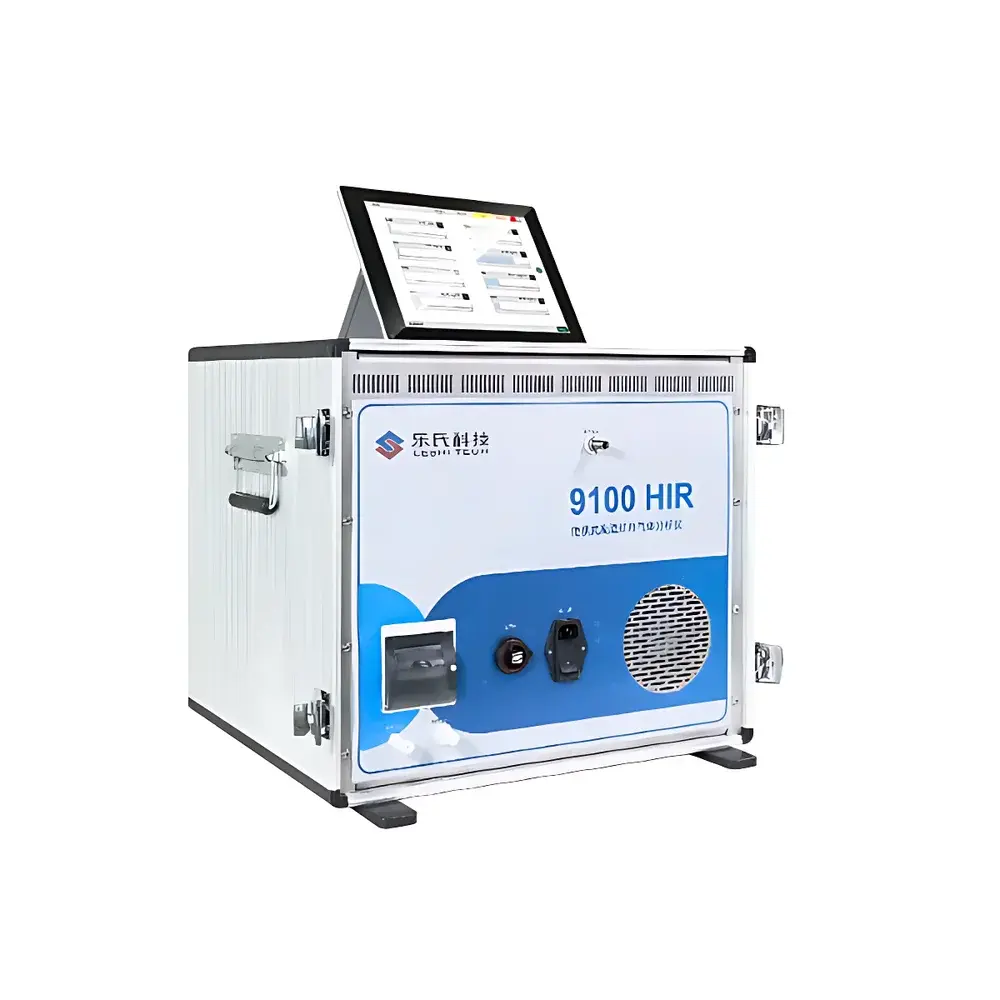
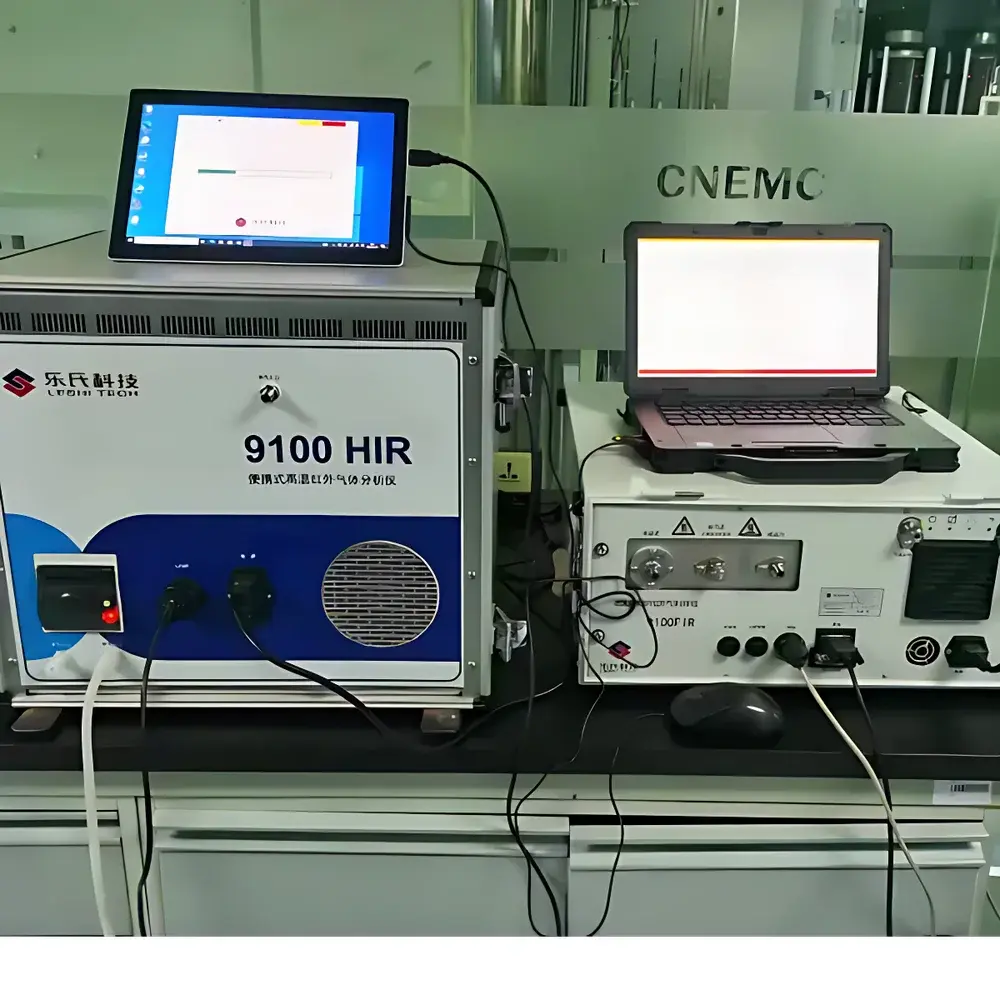
LESHI 9100HIR Portable High-Temperature Infrared Flue Gas Analyzer
| Brand | LESHI |
|---|---|
| Origin | Beijing, China |
| Manufacturer Type | Authorized Distributor |
| Product Category | Domestic |
| Model | 9100HIR |
| Instrument Type | Portable Flue Gas Analyzer |
| Measurement Accuracy | ≤ ±2% FS |
| Repeatability | ≤ 2% FS |
| Response Time | T90 |
| Baseline Stability | ≤ 2% FS over 24 h |
| Measured Gases | >50 Species (O₂, CO, CO₂, NO, NO₂, N₂O, SO₂, CH₄, NH₃, H₂O, HCl, CH₂O, C₃H₈, etc.) |
| Optical Path Length | Up to 16 m |
| Detection Principle | High-Temperature Non-Dispersive Infrared (NDIR) Spectroscopy with Multi-Range Auto-Switching |
Overview
The LESHI 9100HIR Portable High-Temperature Infrared Flue Gas Analyzer is engineered for in-situ, real-time quantitative and qualitative analysis of hot, wet, and corrosive flue gases directly at emission sources. Unlike conventional cooled or diluted sampling systems, the 9100HIR employs a true “hot-wet” measurement architecture—maintaining the entire gas path—including sampling probe, heated filter, transfer line, and multi-gas optical cell—at temperatures up to 180 °C. This eliminates condensation, adsorption, chemical conversion (e.g., NO₂ ↔ N₂O₄, NH₃ loss on surfaces), and dilution-induced bias, thereby preserving sample integrity from stack to detector. The core detection principle relies on high-temperature-stable non-dispersive infrared (NDIR) spectroscopy, where each target gas exhibits unique absorption bands in the mid-infrared region (2–14 µm). The analyzer utilizes precision narrow-band optical filters and thermopile detectors optimized for elevated thermal environments, enabling simultaneous, interference-free quantification of over 50 gas species without chromatographic separation.
Key Features
- True hot-wet sampling and analysis: Full-path heating (probe, filter, line, cell) up to 180 °C ensures representative measurement of reactive and condensable species.
- Multi-range auto-switching optics: Each gas channel features programmable dual- or triple-range detection, dynamically selecting optimal sensitivity based on real-time concentration—enhancing dynamic range and low-end detection limits.
- Corrosion-resistant 16-meter folded optical cell: Mirrors coated with Au/Pd bilayer via ultra-precision polishing withstand aggressive flue gas matrices (e.g., HCl, SO₂, NH₃) while maximizing effective path length for improved signal-to-noise ratio.
- Integrated high-efficiency heated particulate filtration: Ceramic sintered filter (≤1 µm pore size) operates continuously at ≥180 °C, preventing ash fouling and ensuring long-term optical stability.
- Real-time spectral compensation engine: Embedded algorithms apply multi-gradient, multi-component cross-interference correction using reference spectra libraries and dynamic baseline tracking—critical for accurate NH₃, NO₂, and H₂O quantification in complex matrices.
Sample Compatibility & Compliance
The 9100HIR is validated for direct analysis of raw flue gases from combustion sources operating at temperatures between 80 °C and 250 °C and moisture content up to 40% v/v. It meets key regulatory performance criteria per HJ 75-2017 and HJ 76-2017 (China’s Technical Specifications for Continuous Emission Monitoring Systems), and its measurement uncertainty profile aligns with ISO 12039:2000 (Stationary source emissions – Determination of carbon monoxide, carbon dioxide and oxygen — Performance characteristics of automated measuring systems) and EN 15267-3:2017 (Air quality – Approval and certification of air monitoring systems – Part 3: Technical requirements). All firmware and data handling routines support audit-ready GLP/GMP-compliant operation, including full electronic record retention, user access control, and time-stamped calibration logs traceable to NIST-traceable standards.
Software & Data Management
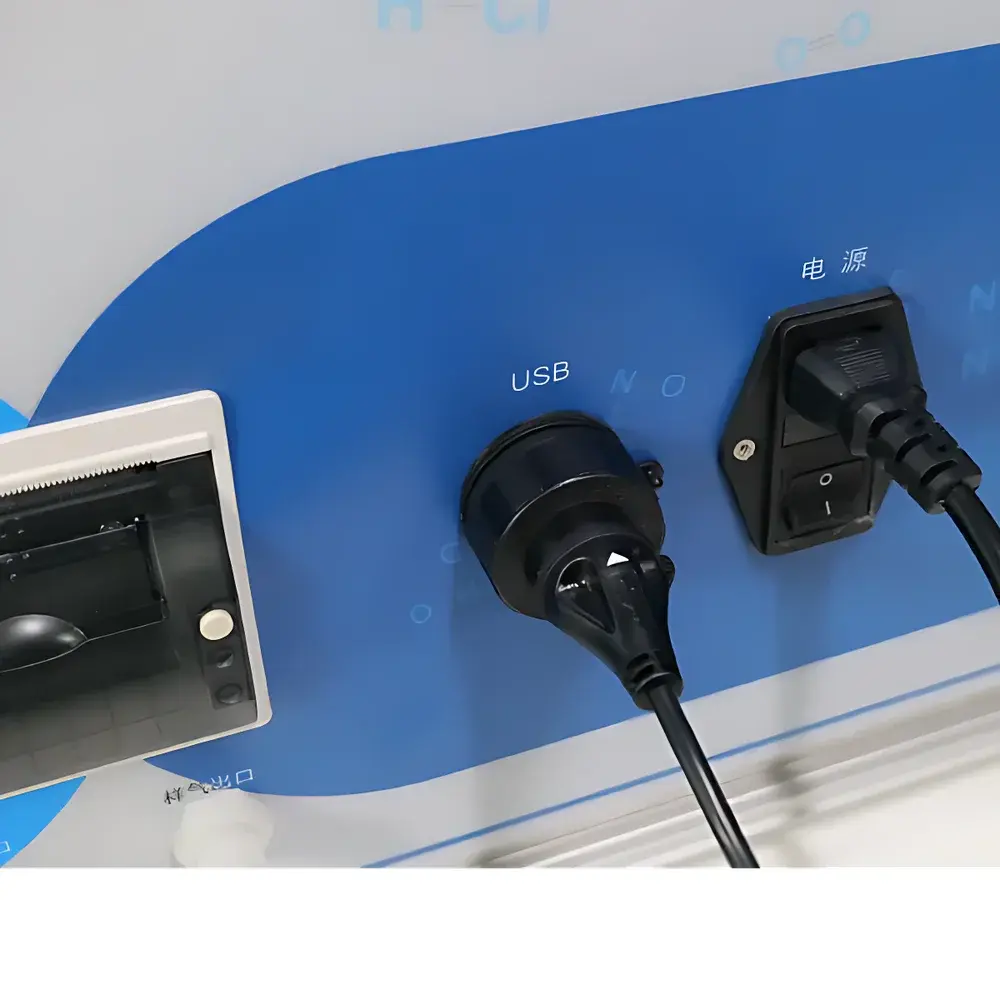
The embedded LESHI Analytical Suite (LAS v4.2) provides intuitive touchscreen operation, configurable measurement protocols, and automated QA/QC workflows—including zero/span validation, leak checks, and drift verification. Raw spectral data, processed concentrations, and diagnostic parameters are stored locally (≥32 GB internal SSD) and exported via USB or Ethernet in CSV, XML, or MODBUS TCP formats. Remote monitoring and configuration are supported through secure HTTPS API endpoints compliant with IEC 62443-3-3 cybersecurity standards. For enterprise integration, the system supports OPC UA connectivity and generates audit trails compliant with FDA 21 CFR Part 11 requirements when deployed with optional digital signature modules.
Applications
The 9100HIR serves as a primary field instrument for regulatory compliance verification, process optimization, and R&D across diverse industrial and institutional sectors. Environmental protection agencies deploy it for stack testing and CEMS validation; power plants and waste incinerators use it for real-time NOₓ/SO₂ control loop feedback; metallurgical and ceramic kilns rely on its robustness for high-dust, high-moisture exhaust characterization. In academic and research settings, it supports kinetic studies of catalytic denitrification, ammonia slip quantification in SCR systems, and speciation of volatile organic compounds (VOCs) such as formaldehyde and propane in thermal oxidation processes. Third-party testing laboratories utilize its metrological traceability and multi-species capability to fulfill ISO/IEC 17025-accredited emission reporting requirements.
FAQ
Does the 9100HIR require gas drying or dilution prior to analysis?
No. Its fully heated sampling and optical path enables direct analysis of hot, humid, undiluted flue gas—eliminating artifacts associated with condensation or chemical alteration.
How is cross-sensitivity between gases like NO₂ and NO addressed?
Through real-time spectral deconvolution using pre-characterized absorption coefficients and multi-component least-squares fitting algorithms embedded in the LAS software.
Can the instrument be calibrated in the field using standard gas cylinders?
Yes. It supports multi-point span calibration with certified gas mixtures traceable to national standards, with automatic pressure/temperature compensation and certificate generation.
What maintenance intervals are recommended for continuous operation?
Heated filter replacement every 3–6 months (depending on dust load); optical cell inspection annually; full system verification per HJ 76-2017 every 90 days.
Is remote firmware update supported?
Yes—via encrypted OTA (Over-The-Air) updates through the LAS web interface, with rollback capability and version-controlled change logs.
Related Products







