
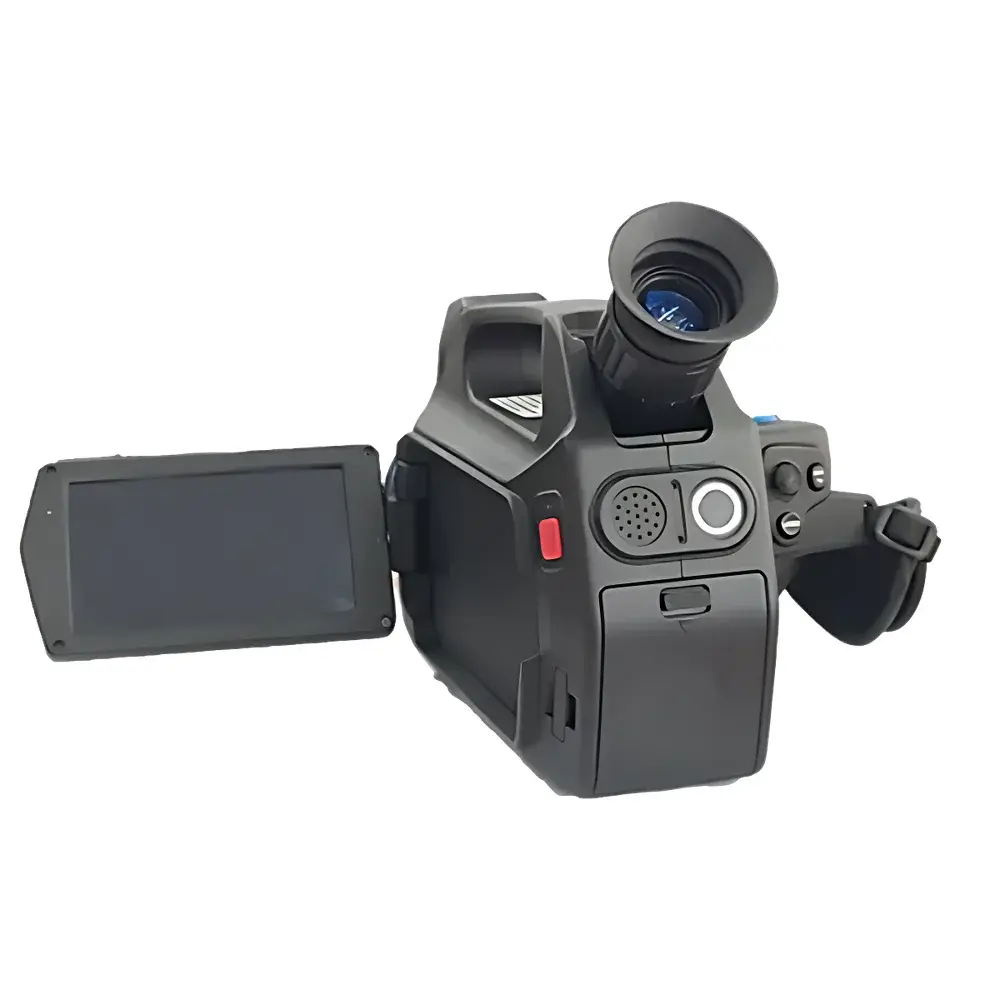
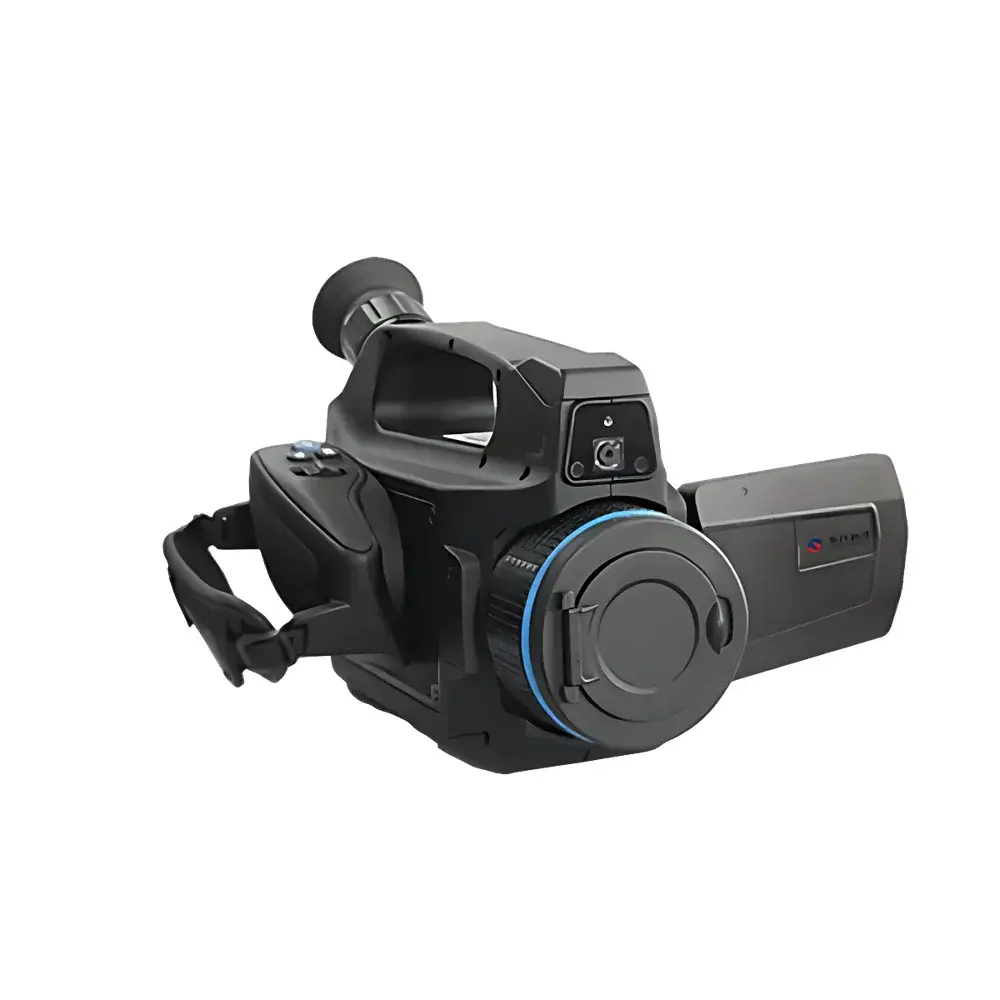
LESHI GIR320Plus VOCs Optical Gas Imaging (OGI) Camera
| Brand | Leshi |
|---|---|
| Origin | Beijing, China |
| Model | GIR320Plus |
| Detector Type | Cooled Type-II Strained-Layer Superlattice (T2SL) |
| Spectral Range | 3.2–3.4 µm (optimized for hydrocarbon VOCs) |
| Image Resolution | 320 × 256 IR pixels |
| Display | Rotatable capacitive touchscreen LCD with eyepiece |
| Focus | Motorized autofocus + manual ring focus + touch-to-focus |
| Connectivity | 4G LTE, Wi-Fi 5 (802.11ac), Bluetooth 5.0 |
| Data Output | Full-radiometric IR video & stills, dual-stream recording (IR + visible + synchronized audio) |
| Compliance | ATEX Category 2G, IECEx Zone 1, IP67 |
| Software Integration | Supports FID/PID real-time overlay via Wi-Fi |
| Security | Fingerprint biometric authentication |
| Operating Temperature | –20 °C to +50 °C |
Overview
The LESHI GIR320Plus VOCs Optical Gas Imaging (OGI) Camera is an industrial-grade, cooled infrared imaging system engineered for passive detection and visualization of volatile organic compounds (VOCs) in real time. It operates on the physical principle of optical gas imaging—leveraging the characteristic mid-wave infrared (MWIR) absorption bands of hydrocarbon-based gases (e.g., methane, ethane, propane, benzene, toluene, xylene) between 3.2–3.4 µm. Using a high-sensitivity, cryogenically cooled Type-II Strained-Layer Superlattice (T2SL) focal plane array, the GIR320Plus detects minute thermal contrast differences caused by gas plumes against background scenes—without requiring external illumination or tracer gases. This enables non-contact, stand-off inspection at distances up to 50 meters (dependent on gas concentration, optics, and atmospheric conditions), delivering immediate visual confirmation of fugitive emissions in complex industrial environments.
Key Features
- Cooled T2SL detector ensures superior signal-to-noise ratio (SNR) and thermal sensitivity (<50 mK NETD), critical for low-concentration VOC detection under ambient thermal clutter.
- Real-time AI-powered gas plume recognition: On-device neural network algorithm automatically identifies, outlines, and labels VOC emission sources in the field of view—reducing operator interpretation bias and accelerating leak verification.
- Dual-stream synchronized recording: Simultaneously captures full-radiometric infrared video, high-resolution visible-light video, and time-aligned audio—enabling robust evidentiary documentation compliant with LDAR (Leak Detection and Repair) program requirements.
- Motorized optical zoom and autofocus system supports single-handed operation; combined with ergonomic handgrip and rotatable 5.5-inch capacitive touchscreen (180° side-rotation), it ensures stable imaging in confined or elevated workspaces.
- Multi-modal imaging suite: Includes pure IR, visible-light, fusion (MSX-enhanced), picture-in-picture (PiP), and dynamic contrast enhancement modes—optimized for varying lighting, emissivity, and background complexity.
- Comprehensive thermographic analysis tools: Spot temperature measurement, isotherm line profiling, user-defined region-of-interest (ROI) statistics, configurable high/low temperature alarms, and emissivity correction—fully accessible during live imaging or post-capture review.
- Integrated biometric security: Fingerprint authentication enforces role-based access control, ensuring audit-trail integrity and data confidentiality per ISO/IEC 27001-aligned workflows.
Sample Compatibility & Compliance
The GIR320Plus is validated for detection of aliphatic and aromatic VOCs commonly encountered in petrochemical, refining, and storage-distribution operations—including but not limited to methane, ethylene, propylene, butadiene, benzene, styrene, and chlorinated solvents. Its optical design avoids spectral interference from water vapor and CO₂, minimizing false positives in humid or variable atmospheric conditions. Certified to ATEX Category 2G (II 2G Ex ib IIB T4 Gb) and IECEx Zone 1 standards, it is approved for use in potentially explosive atmospheres typical of offshore platforms, tank farms, compressor stations, and process units. The device meets IP67 ingress protection for dust and temporary immersion, and operates reliably across –20 °C to +50 °C ambient ranges—supporting year-round deployment in diverse climatic zones.
Software & Data Management
All captured radiometric data—including IR frames, visible frames, and embedded audio—are stored in standard, vendor-neutral formats (e.g., .seq, .jpg, .mp4) compatible with third-party thermographic analysis platforms. The onboard firmware supports over-the-air (OTA) updates and integrates seamlessly with enterprise LDAR management software via encrypted 4G/LTE or Wi-Fi. Optional cloud synchronization enables remote QA/QC review by supervisors and automated report generation aligned with EPA Method 21, ASTM D7925, and ISO 16000-28 compliance frameworks. The companion mobile application (iOS/Android) provides authenticated remote control, live streaming, annotation, and geotagged incident logging—ensuring traceability and alignment with FDA 21 CFR Part 11 electronic record requirements where applicable.
Applications
The GIR320Plus serves as a core instrumentation asset across regulatory and operational domains: environmental compliance monitoring for national and regional air quality agencies; routine LDAR surveys mandated under US EPA 40 CFR Part 60/63 and China’s GB 31571–2015; integrity assessment of flanges, valves, pumps, connectors, and pressure relief devices; inspection of floating roof seals and vapor recovery systems; emergency response screening during spill or release incidents; and baseline emissions quantification prior to carbon accounting initiatives. It is routinely deployed by national environmental inspection teams, accredited third-party testing laboratories, integrated oil & gas operators, chemical manufacturing facilities, LNG terminals, and offshore production platforms—where rapid, repeatable, and defensible leak identification is essential to operational safety and regulatory accountability.
FAQ
What VOCs can the GIR320Plus detect?
It is optimized for hydrocarbons and oxygenated VOCs exhibiting strong absorption in the 3.2–3.4 µm band—including methane, propane, butane, benzene, toluene, xylene, ethanol, and acetone—subject to concentration, path length, and background thermal contrast.
Does it require calibration gas or external excitation?
No. As a passive OGI system, it relies solely on inherent thermal radiation differences and does not require optical excitation sources, calibration gases, or reflective targets.
Can it quantify leak rates?
While not a direct quantification instrument, it supports semi-quantitative estimation when paired with certified FID or PID sensors via Wi-Fi overlay; absolute quantification requires integration with mass balance modeling or correlation to EPA OTM-33A protocols.
Is the device suitable for outdoor use in rain or dust?
Yes. Its IP67-rated enclosure and sealed optical path ensure reliable operation in heavy rain, sandstorms, and high-humidity coastal or desert environments.
How is data integrity maintained during regulatory audits?
Full-radiometric metadata (timestamp, GPS, operator ID, lens settings, emissivity input) is embedded in every image/video file; fingerprint login and encrypted local storage support GLP/GMP-aligned chain-of-custody practices.




