
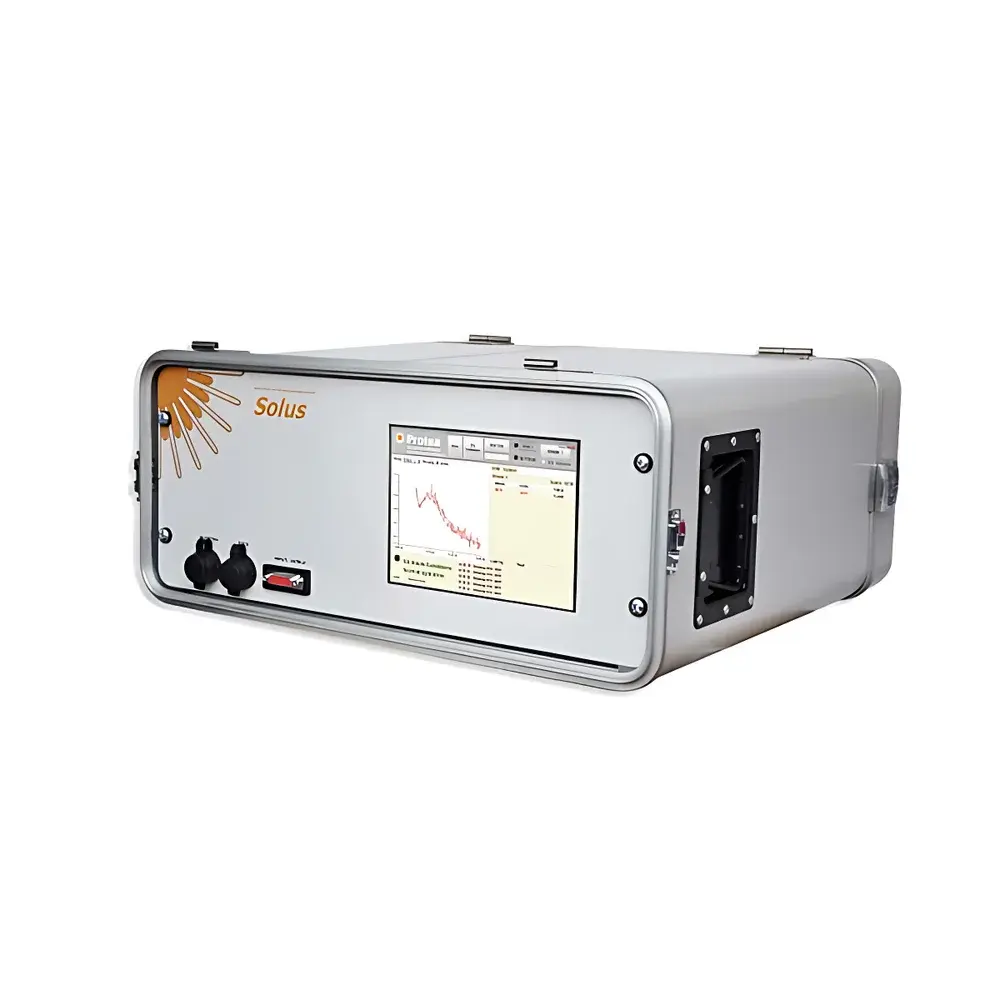
Protea Solus Portable TDLAS-Based HCl and NH₃ Analyzer
| Brand | Protea |
|---|---|
| Origin | United Kingdom |
| Model | Solus |
| Gas Targets | HCl + H₂O, NH₃ + H₂O |
| Detection Principle | Tunable Diode Laser Absorption Spectroscopy (TDLAS) |
| Form Factor | Portable |
| Sample Volume | 15 mL |
| Response Time | < 3 s |
| Optical Path | Near-Infrared (NIR) |
| Construction | Carbon-fiber chassis with thermal insulation |
| Integrated Components | Heated particulate filter, purge valve, mass flow controller, optional zirconia O₂ sensor and embedded PC |
| Calibration | Zero-point drift-free |
| Compliance Context | Designed for EN 15267-3, MCERTS, EPA Method 320, ISO 14956, and WID (2010/75/EU) emission monitoring applications |
Overview
The Protea Solus Portable TDLAS-Based HCl and NH₃ Analyzer is an industrial-grade, field-deployable gas analyzer engineered for real-time, selective quantification of hydrogen chloride (HCl) and ammonia (NH₃) in humid ambient or stack gas streams. Unlike broadband optical analyzers, the Solus employs wavelength-modulated tunable diode laser absorption spectroscopy (TDLAS) in the near-infrared (NIR) region — specifically targeting rovibrational absorption lines unique to HCl and NH₃ molecules in the presence of water vapor (H₂O). This spectral selectivity eliminates cross-sensitivity from CO₂, SO₂, NOₓ, CH₄, and other common interferents found in combustion exhausts or industrial process vents. The system operates on direct absorption principles, delivering high reproducibility without reliance on catalytic conversion, chemical scrubbing, or reference cells. Its compact architecture integrates optical path conditioning, thermal stabilization, and signal processing within a single carbon-fiber enclosure rated for continuous operation in environments up to 50 °C ambient temperature and 95 % RH non-condensing.
Key Features
- Simultaneous dual-gas measurement capability: HCl and NH₃, each quantified independently using dedicated laser wavelengths optimized for line strength and H₂O tolerance
- Sub-3-second response time (T₉₀) with 1 Hz data output rate, enabling dynamic process feedback for SCR ammonia slip control and rapid emission event detection
- Ultra-low sample demand: 15 mL total volume per analysis cycle, minimizing pump load and power consumption
- Fully integrated sampling subsystem: includes heated sintered stainless-steel particulate filter (maintained at 180 °C), pneumatically actuated purge valve, and precision mass flow controller with closed-loop regulation
- Optional built-in zirconia-based oxygen sensor (0–25 vol% O₂, ±0.1 % accuracy) for stoichiometric correction and dilution compensation
- Embedded industrial PC (Intel Celeron, 4 GB RAM, 64 GB SSD) with preloaded Protea Analyze™ firmware for local data logging, alarm management, and remote diagnostics via Ethernet or 4G LTE
- Zero-maintenance optical path: hermetically sealed laser module with >20,000-hour diode lifetime; no moving parts in the optical train
- Passive thermal management architecture: carbon-fiber chassis provides structural rigidity while minimizing conductive heat transfer; no active cooling fans required
- Field-configurable gas ranges: factory-calibrated for 0–10 ppm NH₃ and 0–5 ppm HCl (extendable to 100 ppm with optical attenuation kits)
Sample Compatibility & Compliance
The Solus is validated for use with wet, hot, and particulate-laden gas matrices typical of waste incineration flue gas, marine diesel exhaust, automotive engine test cells, and cement kiln bypass ducts. Its heated inlet train ensures dew point suppression and prevents condensation-induced signal attenuation or corrosion. All wetted materials comply with ASTM B117 salt-spray resistance standards and are compatible with chlorine-containing atmospheres. The analyzer meets the performance requirements of EN 15267-3 (QAL1 certification readiness), UK MCERTS Category 2 specifications for continuous emission monitoring systems (CEMS), and U.S. EPA Method 320 for HCl measurement. It supports audit-ready data integrity through timestamped, digitally signed records aligned with FDA 21 CFR Part 11 electronic record guidelines when paired with Protea’s cloud-based DataHub platform.
Software & Data Management
Protea Analyze™ firmware provides embedded configuration, real-time spectral visualization, and automated baseline correction algorithms that compensate for window fouling and pressure-induced broadening. Data export formats include CSV, XML, and Modbus TCP for integration into DCS, SCADA, or environmental information systems (EIS). Remote access is secured via TLS 1.2 encrypted SSH or HTTPS sessions. Audit logs capture all parameter changes, calibration events (if externally triggered), and user login activity. Firmware updates are delivered over-the-air (OTA) with cryptographic signature verification. Optional DataHub subscription enables long-term trend analysis, alarm correlation across multiple Solus units, and automated regulatory report generation (e.g., WID compliance summaries, quarterly NH₃ slip averages).
Applications
- Ammonia slip monitoring downstream of Selective Catalytic Reduction (SCR) systems in power plants and industrial boilers
- Real-time HCl concentration tracking during waste-to-energy incineration for WID (2010/75/EU) compliance reporting
- On-board emissions testing for marine auxiliary engines under IMO MARPOL Annex VI Tier III requirements
- Development and validation of low-emission combustion strategies in automotive R&D test cells
- Leak detection and fugitive emission surveys in chlor-alkali production facilities and pharmaceutical synthesis lines
- Stack-integrated QA/QC support for continuous emission monitoring systems (CEMS) requiring independent verification
FAQ
Does the Solus require zero or span gas for routine operation?
No. The TDLAS architecture is inherently drift-stable; zero calibration is performed optically using beam blanking, and no consumable gases or reagents are needed for daily operation.
Can the Solus measure HCl and NH₃ simultaneously in the same gas stream?
Yes. Dual-laser configuration enables concurrent, independent quantification with full spectral deconvolution of overlapping H₂O interference bands.
Is the instrument certified for use in hazardous areas?
The standard Solus is rated for Zone 2 / Class I Div 2 environments. AATEX/IECEx-certified variants (Zone 1 / Class I Div 1) are available upon request with modified housing and intrinsically safe barrier integration.
What is the minimum detectable concentration for HCl?
The proven limit of detection (LOD) is 0.12 ppm (3σ) for HCl in 10 % H₂O at atmospheric pressure and 1 m optical path length.
How is data traceability ensured for regulatory submissions?
All measurements include embedded UTC timestamps, instrument serial number, firmware revision, and spectral metadata. When configured with DataHub, full ALCOA+ compliant audit trails are generated per GLP/GMP requirements.







