
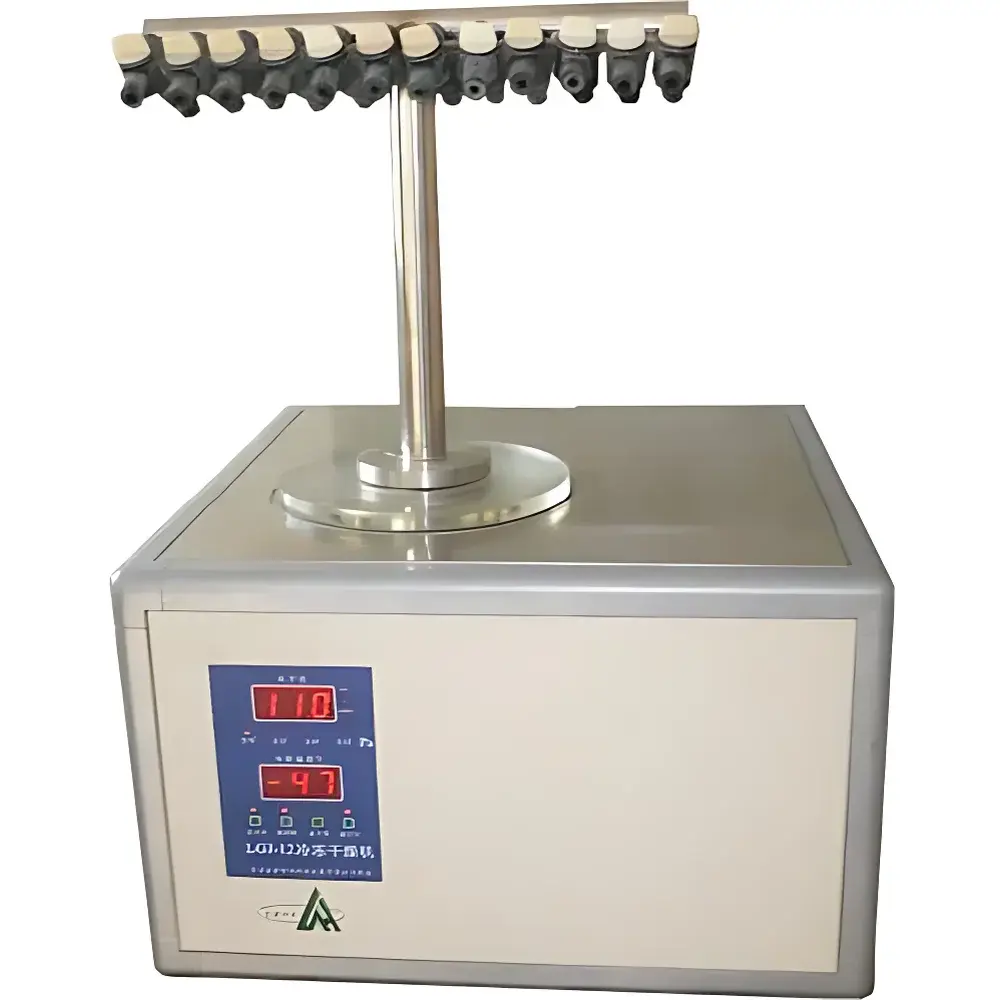
LGJ-12 Multi-Manifold T-Type Laboratory Freeze Dryer
| Origin | Beijing, China |
|---|---|
| Manufacturer Type | Authorized Distributor |
| Origin Category | Domestic (China) |
| Model | LGJ-12 |
| Pricing | Upon Request |
| Cold Trap Coil Temperature | < −50 °C (−80 °C optional) |
| Ultimate Vacuum | < 15 Pa |
| Drying Area | 0.07–0.12 m² |
| Water Capture Capacity | 3 kg/24 h |
| Sample Volume (Bulk Loading) | 0.7–1.2 L |
| Dimensions (W×D×H) | 580 × 560 × 340 mm |
| Manifold Ports | 24 × Standard Rubber-Sealed Valves (custom configurations available) |
Overview
The LGJ-12 Multi-Manifold T-Type Laboratory Freeze Dryer is a compact, benchtop lyophilization system engineered for precise primary drying of heat-sensitive biological and pharmaceutical samples under controlled low-temperature vacuum conditions. Operating on the fundamental principles of sublimation—where ice transitions directly from solid to vapor phase below the triple point of water—the LGJ-12 integrates a high-efficiency refrigeration circuit with a robust vacuum manifold architecture to enable parallel processing of multiple individually sealed vials or ampoules. Its T-type configuration separates the cold trap chamber from the drying chamber via a dedicated manifold bridge, minimizing thermal cross-talk and ensuring stable condensation performance during extended runs. Designed specifically for microbiological preservation, small-batch formulation development, and analytical sample preparation, the unit meets the functional requirements of GLP-compliant laboratories conducting strain banking, vaccine intermediate stabilization, and reference standard drying.
Key Features
- 24-port stainless-steel multi-manifold with integrated rubber-sealed valves—enabling independent control and sequential isolation of individual ampoules without breaking system vacuum.
- High-capacity cold trap featuring an open-top, coil-free stainless-steel interior—optimized for rapid frost deposition and easy cleaning; compatible with pre-freezing of samples directly on the cold surface prior to manifold connection.
- Imported hermetic refrigeration compressor delivering sustained cold trap temperatures down to −80 °C (optional), ensuring efficient water vapor capture across diverse solute matrices including aqueous buffers, glycerol-based suspensions, and low-conductivity formulations.
- Transparent polycarbonate bell jar drying chamber—providing full visual monitoring of sublimation progress, cake morphology, and potential collapse events while maintaining Class I containment integrity.
- Adjustable stainless-steel sample shelf with configurable spacing—accommodating standard 2–10 mL ampoules, serum vials, and custom glassware up to 120 mm height.
- Space-efficient footprint (0.58 m wide × 0.34 m tall) designed for integration into shared lab environments, laminar flow hoods, or cold room installations without requiring floor-standing infrastructure.
Sample Compatibility & Compliance
The LGJ-12 supports lyophilization of bacterial and fungal cultures, viral vectors, enzyme preparations, diagnostic reagents, and sterile drug intermediates. Its ampoule-centric manifold design aligns with ISO 11133:2014 (microbiological culture media preparation) and USP (sterile product preservation). The absence of internal cooling coils eliminates crevices that could retain residual moisture or biofilm—enhancing cleanability and supporting routine validation per ASTM E2500-13 (good manufacturing practice for equipment qualification). All wetted surfaces are electropolished 316L stainless steel, compliant with FDA 21 CFR Part 11 traceability requirements when paired with validated data logging software.
Software & Data Management
While the base LGJ-12 operates via analog vacuum gauge and mechanical temperature indicators, it is fully compatible with third-party digital vacuum controllers (e.g., Pfeiffer DuoLine series) and thermocouple-based shelf temperature monitors. When integrated with compliant data acquisition systems, the unit supports audit-trail generation, electronic signature workflows, and export of time-stamped pressure/temperature logs in CSV or PDF format—facilitating compliance with 21 CFR Part 11 Annex 11 and EU GMP Annex 11 documentation standards. Optional RS485/Modbus RTU interface enables centralized monitoring within laboratory information management systems (LIMS).
Applications
- Microbial strain preservation: Long-term storage of ATCC-type cultures in sealed ampoules with <1% residual moisture content and minimal genetic drift over 10+ years.
- Diagnostic assay development: Stabilization of IgG conjugates, PCR master mixes, and lateral flow reagents without excipient optimization.
- Academic research: Rapid prototyping of lyophilized nanoparticle suspensions, hydrogels, and peptide formulations prior to scale-up.
- Quality control laboratories: Preparation of certified reference materials (CRMs) requiring matrix-matched physical state stability under ambient shipping conditions.
- Teaching laboratories: Hands-on demonstration of phase diagrams, mass transfer kinetics, and critical product temperature determination using thermocouple-equipped vials.
FAQ
Can the LGJ-12 be used for freeze-drying non-ampoule formats such as scintillation vials or microcentrifuge tubes?
Yes—custom manifold adapters and silicone gasket inserts are available to accommodate 12–20 mm diameter vials; however, optimal drying uniformity is achieved with vertically oriented, narrow-neck containers.
Is pre-freezing required before connecting samples to the manifold?
Pre-freezing is strongly recommended to ensure complete solidification of the eutectic phase; the cold trap surface may be used for direct freezing, but dedicated −80 °C freezer pre-treatment yields superior cake homogeneity.
What vacuum pump compatibility does the LGJ-12 support?
The unit interfaces with dual-stage rotary vane pumps (≥4 m³/h capacity) meeting ISO 8573-1 Class 2 oil contamination limits; dry scroll pumps are also suitable for solvent-laden applications.
Does the system include validation documentation or IQ/OQ protocols?
Factory-installed instrumentation is supplied with calibration certificates traceable to NIST standards; site-specific IQ/OQ templates aligned with ASTM E2500-13 are provided upon request for qualified purchasers.
How frequently must the cold trap be defrosted during continuous operation?
Defrosting intervals depend on total ice load and condenser temperature; at −50 °C and 3 kg/24 h capture rate, full defrost is typically required every 48–72 hours under nominal loading conditions.



