
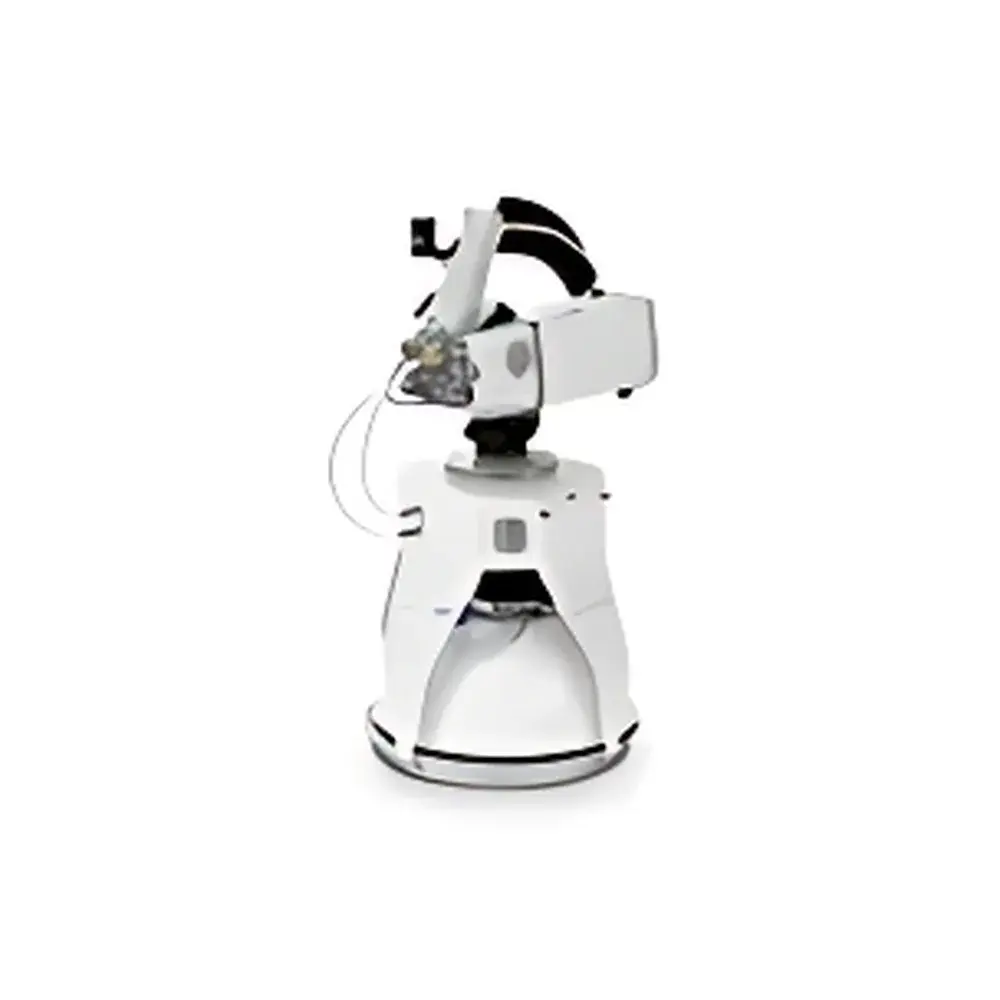
LI-COR 8200-01 Smart Chamber for Soil Gas Flux Measurement
| Brand | LI-COR |
|---|---|
| Origin | USA |
| Model | 8200-01 |
| Chamber Diameter | 20 cm |
| Soil Area | 317.8 cm² |
| Chamber Volume | 4244.1 cm³ |
| Air Temperature Sensor Range | −20 to 70 °C, Accuracy: ±0.5 °C (0–70 °C) |
| Pressure Sensor Range | 50–110 kPa, Accuracy: ±0.4 kPa, Resolution: 1.5 Pa (typ.) |
| Operating Temperature | −20 to 50 °C |
| Power Supply | 10–17 VDC |
| Battery | 4S Li-ion, 98 Wh, built-in protection |
| Battery Life | 34 h (standalone), 20 h (with LI-870 CO₂/H₂O analyzer) |
| Soil Thermocouple Port | compatible with 6000-09TC, cable length: 1.2 or 2 m |
| Weight | 4.3 kg (incl. battery) |
| Onboard Memory | 8 GB (OS + data) |
| GPS Accuracy | 2.5 m CEP |
| Wi-Fi | 2.4 GHz, IEEE 802.11a/b/g/n/ac |
| SDI-12 Interface | for Stevens HydraProbe (optional) |
| Connectivity | USB-A (LI-870), USB-B (non-LI-COR analyzers), RJ-45 Ethernet (LI-COR trace gas analyzers), USB-A (external Wi-Fi adapter) |
Overview
The LI-COR 8200-01 Smart Chamber is a field-deployable, self-powered soil gas flux measurement system engineered for high-precision, real-time quantification of greenhouse gas exchange—including CO₂, CH₄, N₂O, and other trace gases—between soil and atmosphere. Based on the closed-chamber accumulation method, it integrates dynamic pressure compensation, active air mixing, and chamber-driven motion to minimize artifacts induced by pressure differentials, boundary-layer disruption, or thermal gradients. Its bowl-shaped geometry and patented vented pressure-equalization ports ensure stable headspace conditions during enclosure, while the integrated drive mechanism enables repeatable, low-disturbance chamber deployment across heterogeneous terrain. Designed as a modular node in LI-COR’s ecosystem of environmental monitoring instrumentation, the 8200-01 serves as both a standalone flux calculator and a synchronized controller for external gas analyzers—particularly LI-COR’s LI-870 CO₂/H₂O analyzer and trace-gas-specific platforms such as the LI-7810 CH₄/CO₂ and LI-7820 N₂O analyzers.
Key Features
- Self-contained operation: Integrated 4S lithium-ion battery (98 Wh) supports up to 34 hours of continuous measurement; runtime extends to 20 hours when paired with the LI-870 analyzer under typical field conditions.
- Real-time flux computation: Onboard processor executes automated linear and nonlinear regression algorithms (e.g., HMR, LMR, exponential models) to derive instantaneous flux rates directly from concentration-time series, eliminating post-hoc calculation delays.
- Multi-sensor environmental monitoring: Simultaneous acquisition of air temperature (±0.5 °C), barometric pressure (±0.4 kPa), and optional soil temperature (via 6000-09TC thermocouple) and volumetric water content (via SDI-12–enabled HydraProbe).
- Robust connectivity architecture: Dual USB ports (USB-A for LI-870, USB-B for third-party analyzers), RJ-45 Ethernet for LI-COR trace gas analyzers, and configurable Wi-Fi (2.4 GHz, 802.11ac) enable flexible integration into distributed sensor networks.
- GPS georeferencing: Embedded GNSS module provides 2.5 m CEP positional accuracy, enabling spatially explicit flux mapping and GIS-compatible data export.
- Pressure-stabilized chamber design: Patented venting system and internal air-mixing fan mitigate pressure-induced advective flux errors—a critical requirement for accurate CH₄ and N₂O measurements in low-permeability soils.
Sample Compatibility & Compliance
The 8200-01 is validated for use across diverse edaphic conditions—from sandy loams to clay-rich hydromorphic soils—and accommodates surface irregularities via its adaptive chamber base and low-profile deployment profile. It complies with widely cited methodological standards for soil respiration and trace gas flux assessment, including ASTM D6573 (standard test method for soil respiration), ISO 16634-2 (soil carbon determination), and USDA ARS protocols for chamber-based GHG monitoring. Data provenance meets GLP-aligned requirements: all raw sensor outputs, regression parameters, timestamps, GPS coordinates, and instrument metadata are logged with immutable file-level timestamps. When used with LI-COR’s SoilFluxPro™ software suite, audit trails, user authentication, and electronic signature support align with FDA 21 CFR Part 11 readiness for regulated environmental reporting.
Software & Data Management
Data acquisition, configuration, and analysis are managed through SoilFluxPro™—a dual-component application comprising an embedded firmware interface (running on the chamber’s Linux-based OS) and a desktop client (Windows/macOS). The onboard interface allows full parameter control—including chamber closure duration, sampling interval, regression model selection, and QA/QC thresholds—via touchscreen or remote Wi-Fi access. All processed flux values, along with raw time-series data (gas concentration, Tair, P, RH, soil T), are stored locally on the 8 GB eMMC memory partition. Export formats include CSV (for spreadsheet analysis), NetCDF (CF-compliant for climate modeling), and SQLite (for relational database integration). SoilFluxPro™ also supports batch processing, outlier detection based on residual standard error, and automated report generation compliant with IPCC Tier 1–2 reporting templates.
Applications
- Soil carbon cycling studies: Quantifying heterotrophic and autotrophic respiration components across land-use gradients (forest, cropland, pasture, restored wetlands).
- Climate change mitigation research: Evaluating biochar amendment effects, cover crop impacts, and no-till management on net soil CO₂ and CH₄ balance.
- Wetland biogeochemistry: High-temporal-resolution CH₄ flux monitoring under fluctuating water table conditions.
- Landfill and agricultural emission inventories: Spatially dense flux surveys supporting Tier 2 inventory reporting per UNFCCC guidelines.
- Ecosystem model validation: Providing ground-truthed, high-frequency flux observations for calibration of DNDC, DayCent, and APSIM-SoilN modules.
- Regulatory compliance monitoring: Supporting EPA Method TO-11A–aligned ambient air quality assessments and state-level GHG reporting programs.
FAQ
Can the 8200-01 operate without an external gas analyzer?
Yes—the chamber includes internal CO₂ and H₂O sensing capability only when connected to the LI-870; otherwise, it functions as a controller and environmental logger, requiring an external analyzer for gas concentration input.
Is the pressure sensor calibrated traceable to NIST standards?
All factory-installed pressure sensors undergo NIST-traceable calibration prior to shipment, with calibration certificates available upon request.
Does the system support automatic diurnal flux campaigns?
Yes—programmable measurement schedules (including sunrise/sunset triggers via GPS-derived solar position) enable unattended multi-day diel cycles.
What is the maximum allowable soil surface slope for reliable sealing?
The chamber maintains effective seal integrity on slopes up to 15°, verified via differential pressure leak testing per ISO 5167 Annex F protocols.
How is data security handled during Wi-Fi transmission?
Wi-Fi communication uses WPA2-Enterprise encryption; local data storage employs AES-256 full-disk encryption, and firmware updates require signed package verification.







