
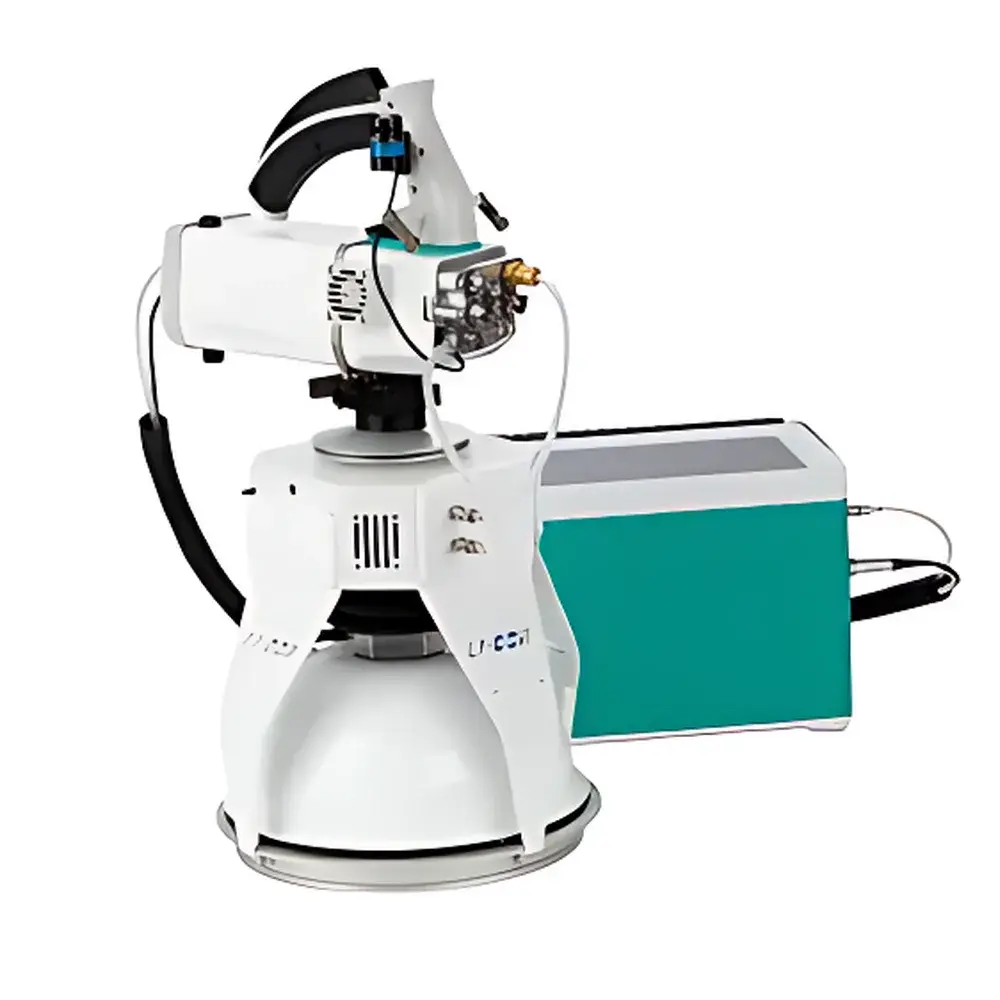
LI-COR LI-6800 Advanced Photosynthesis & Fluorescence Measurement System with Modular Leaf Chambers
| Brand | LI-COR |
|---|---|
| Origin | USA |
| Model | LI-6800 Advanced Photosynthesis & Fluorescence Measurement System with Multiple Leaf Chambers |
| CO₂ Analyzer Principle | Non-Dispersive Infrared (NDIR) |
| CO₂ Precision | ≤0.1 µmol/mol RMS @ 4 s average at 400 µmol/mol |
| CO₂ Range | 0–3100 µmol/mol |
| CO₂ Control Range | 0–2000 µmol/mol |
| Fluorescence Excitation | Pulsed-Amplitude Modulation (PAM) + Continuous Actinic Light |
| Saturating Pulse Intensity | 0–16,000 µmol m⁻² s⁻¹ |
| Actinic Light Range (Red/Blue) | 0–3000 µmol m⁻² s⁻¹ |
| Far-Red Light Range | 0–20 µmol m⁻² s⁻¹ |
| Red LED Peak | 625 nm |
| Blue LED Peak | 475 nm |
| Far-Red LED Peak | 735 nm |
| OJIP Kinetics Capability | Yes |
| ETR, ΦPSII, NPQ, Fᵥ/Fₘ, 1−qL Calculation | Integrated in Firmware |
| Leaf Chamber Options | 6800-01A (Fluorescence Chamber), 6800-02 (3×3 cm Red/Blue LED Source), 6800-03 (RGBW Large Area Source), 6800-09 (Soil CO₂/H₂O Flux Chamber), 6800-12A (3×3 cm Transparent Chamber), 6800-13 (36 cm² Large Leaf Chamber), 6800-17 (Whole-Plant Chamber for Arabidopsis & Turf), 6800-18 (Suspended Algal Culture Chamber), 6800-19 (Custom Chamber Adapter), 6800-24 (Bryophyte & Lichen Chamber), 6800-89 (Insect & Small Animal Respirometry Chamber) |
Overview
The LI-COR LI-6800 Advanced Photosynthesis & Fluorescence Measurement System is a dual-mode, closed-path gas exchange and chlorophyll fluorescence platform engineered for high-fidelity, simultaneous quantification of net CO₂ assimilation (A), transpiration (E), stomatal conductance (gₛ), and photosystem II (PSII) biophysics under controlled or ambient light conditions. Its core measurement architecture integrates a high-stability non-dispersive infrared (NDIR) CO₂/H₂O analyzer with real-time differential concentration detection, enabling precise calculation of gas fluxes across leaf, soil, algal, or small-animal interfaces. The system operates on the principle of coupled photosynthetic gas exchange and pulse-amplitude modulated (PAM) fluorescence kinetics — allowing concurrent, spatially co-registered acquisition of A, E, ΦPSII, NPQ, ETR, Fᵥ/Fₘ, and OJIP transient parameters from the same leaf area. This integration eliminates temporal misalignment and inter-chamber variability inherent in sequential or multi-instrument setups, thereby supporting rigorous physiological inference in plant ecophysiology, stress biology, breeding programs, and ecosystem carbon modeling.
Key Features
- Modular chamber architecture supporting 12+ application-specific configurations — including fluorescence-enabled leaf chambers (6800-01A), RGBW spectral tuning sources (6800-03), whole-plant enclosures (6800-17), suspended algal cuvettes (6800-18), bryophyte/lower-plant chambers (6800-24), soil surface flux collars (6800-09), and insect respirometry modules (6800-89).
- Industry-leading saturating pulse intensity up to 16,000 µmol m⁻² s⁻¹ — enabling robust Fₘ′ determination under high-light acclimation and accurate derivation of dynamic quenching parameters (e.g., qP, qN, NPQ, 1−qL) across diverse photobiological conditions.
- Integrated actinic illumination with independently controllable red (625 nm), blue (475 nm), and far-red (735 nm) LEDs; spectral composition programmable via firmware to emulate natural PAR gradients or test wavelength-specific photoresponses.
- On-board GaAsP quantum sensors provide real-time PAR monitoring within each chamber, ensuring irradiance feedback control and eliminating calibration drift between light source output and incident leaf irradiance.
- Thermally stabilized IRGA with RMS precision ≤0.1 µmol/mol at 400 µmol/mol CO₂ (4 s averaging); extended linear range (0–3100 µmol/mol) supports both ambient and elevated CO₂ experimental designs.
- Custom chamber adapter (6800-19) includes mechanical interface specifications and tubing fittings — facilitating GLP-compliant integration of user-designed sample holders into the LI-6800’s pressure-regulated, mass-flow-controlled gas circuit.
Sample Compatibility & Compliance
The LI-6800 accommodates morphologically heterogeneous biological samples without compromising analytical integrity: flat monocot/dicot leaves (via 6800-12A or 6800-13 chambers), conifer needles (with 6800-13 needle insert), intact rosette plants (6800-17), hydrated bryophytes/lichens (6800-24), liquid-phase microalgal suspensions (6800-18), soil cores (6800-09), and arthropods or fruit tissue (6800-89). All chambers are constructed from low-adsorption polymers (e.g., coated anodized aluminum, Propafilm™ film) to minimize H₂O and CO₂ wall effects. The system complies with ISO 17025 traceability requirements for gas concentration measurement and supports audit-ready data logging aligned with FDA 21 CFR Part 11 when used with validated software workflows. Chamber temperature control is compatible with external recirculating chillers or water baths (10-32 UNF port), enabling stable thermal management across 0–50 °C operating range.
Software & Data Management
Acquisition and analysis are managed through LI-COR’s proprietary Pro Edition software — a Windows-based application providing real-time visualization, automated protocol sequencing (e.g., A/Ci curves, light-response curves, dark-adapted fluorescence induction), and embedded calculation engines for standardized photosynthetic metrics per ASTM E2913-13 and ISO 18433-2. Raw sensor outputs (CO₂, H₂O, PAR, temperature, fluorescence decay waveforms) are stored in HDF5 format with embedded metadata (chamber ID, firmware version, calibration timestamps, operator notes). Export options include CSV, MATLAB (.mat), and NetCDF for downstream statistical modeling in R or Python. Audit trails record all parameter modifications, user logins, and instrument state transitions — satisfying GLP/GMP documentation requirements for regulatory submissions.
Applications
- Photosynthetic acclimation studies under variable light quality, intensity, and CO₂ concentration.
- Stress physiology: drought, salinity, heavy metal, and pathogen-induced alterations in electron transport efficiency and carbon fixation capacity.
- Ecophysiological screening of crop germplasm for improved water-use efficiency (WUE) and intrinsic quantum yield.
- In situ soil CO₂ efflux mapping using 6800-09 in conjunction with SoilFlux Pro™ for spatial autocorrelation analysis.
- Non-invasive assessment of PSII repair dynamics via OJIP transient analysis in field-collected mosses and lichens.
- Respiratory metabolism profiling of insects and post-harvest horticultural commodities under controlled atmospheres.
FAQ
Can the LI-6800 measure both gas exchange and fluorescence simultaneously from the same leaf area?
Yes. The 6800-01A fluorescence chamber integrates PAM and continuous actinic illumination optics with integrated CO₂/H₂O sampling ports — enabling fully synchronized acquisition of A, gₛ, ΦPSII, NPQ, and ETR at sub-second temporal resolution.
Is spectral customization of the 6800-03 RGBW source possible during measurement?
Yes. Red (660 nm), green (523 nm), blue (453 nm), and white (4000 K) LED channels are independently programmable in real time via Pro software — allowing dynamic spectral shifts to simulate canopy shade or test photoreceptor-specific responses.
Does the system support automated A/Ci or light-response curve generation?
Yes. Built-in protocol templates execute stepwise CO₂ concentration ramps (0–2000 µmol/mol) or PPFD gradients (0–3000 µmol m⁻² s⁻¹) with automatic data capture, QA/QC flagging, and on-the-fly parameter derivation (Vcmax, Jmax, Rd, TPU).
Are calibration records and maintenance logs retained within the software?
Yes. Each measurement file contains embedded calibration history (zero/span dates, NDIR zero-gas lot numbers, flowmeter verification timestamps), and the software maintains a separate maintenance logbook with user-entered service entries and firmware update records.
Can third-party environmental sensors (e.g., soil moisture, air temperature) be integrated?
Yes. Analog and digital inputs (0–5 V, RS-232, SDI-12) are supported via optional I/O expansion module — enabling synchronized logging of ancillary variables alongside core gas exchange and fluorescence data.
Related Products




