
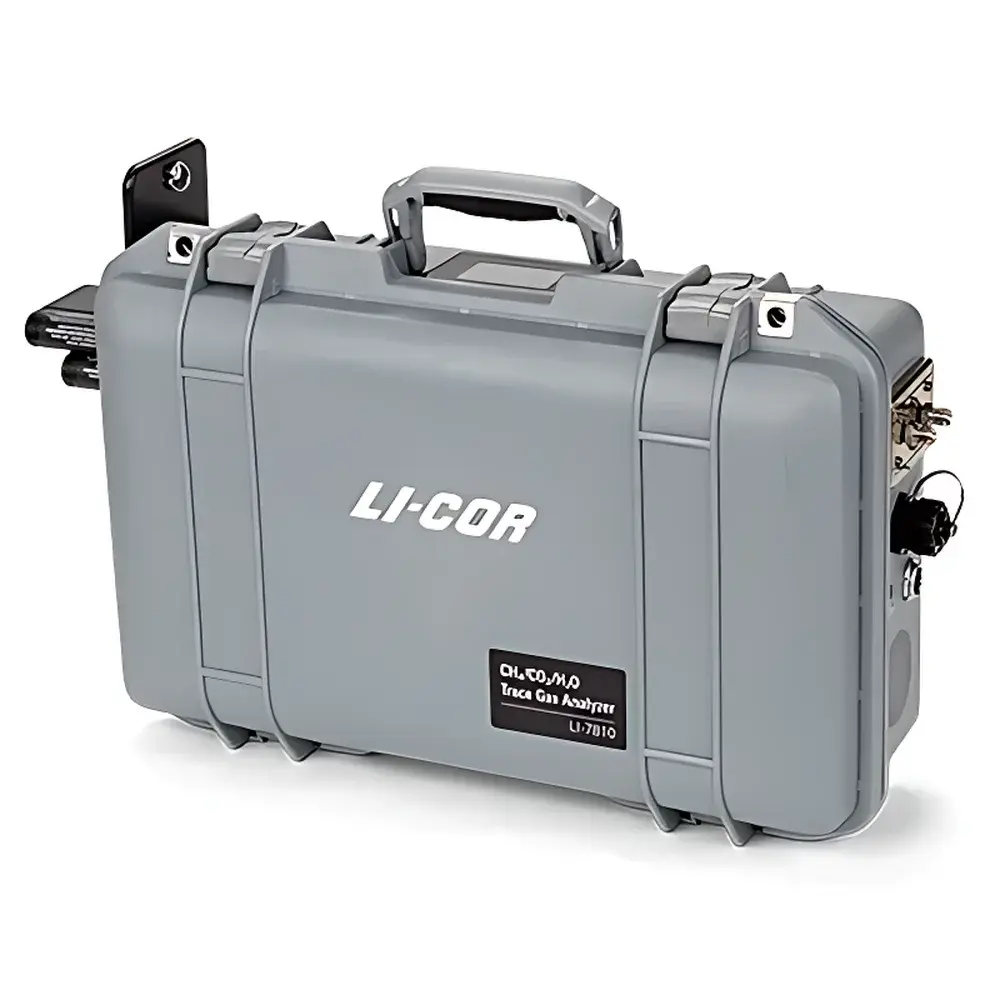
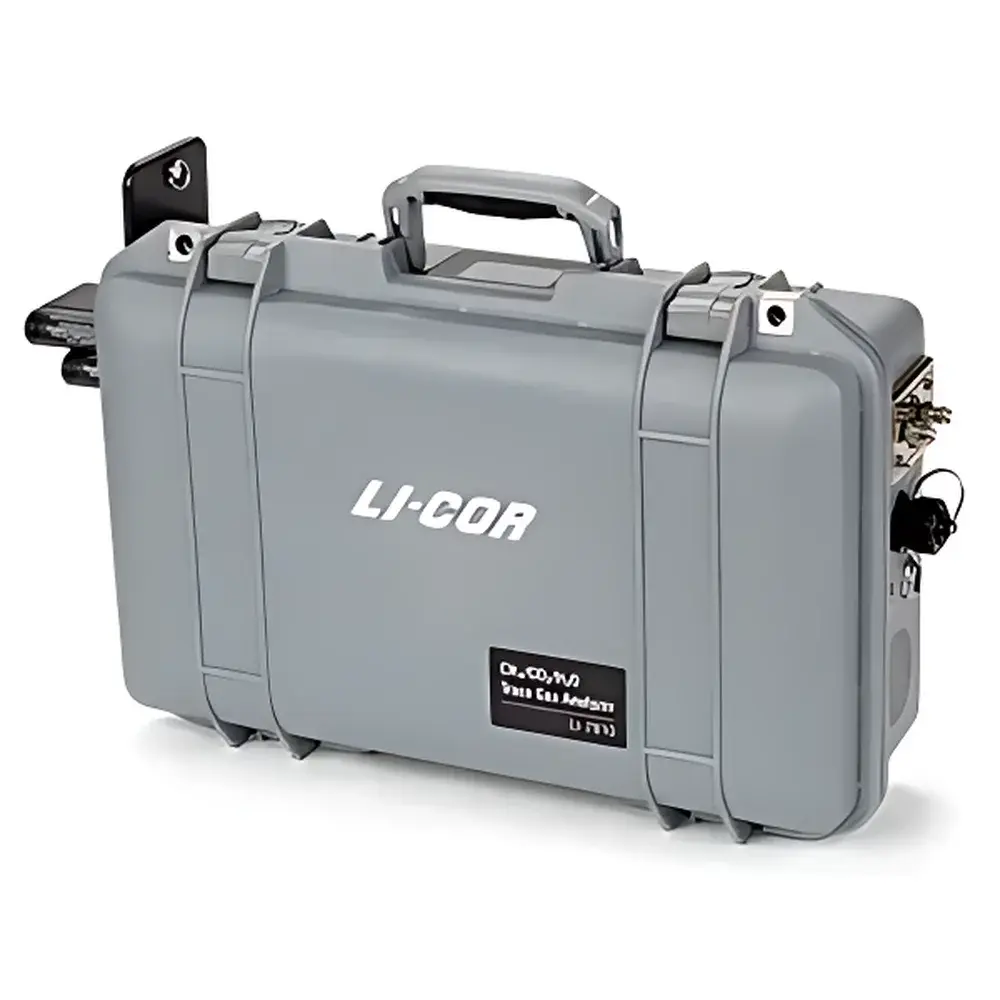
LI-COR LI-7810 High-Precision CH₄/CO₂/H₂O Gas Analyzer
| Brand | LI-COR |
|---|---|
| Origin | USA |
| Model | LI-7810 |
| Instrument Type | Portable |
| Measurement Principle | Optical Feedback–Cavity Enhanced Absorption Spectroscopy (OF-CEAS) |
| Measurement Frequency | 1 Hz |
| Optical Cavity Volume | 6.41 cm³ |
| Sample Flow Rate | 250 sccm (standard mL/min) |
| Weight | 10.5 kg (including batteries) |
| Dimensions (L×H×W) | 51 × 33 × 18 cm |
| Operating Temperature | −25 °C to +45 °C (non-direct-sunlight ambient) |
| Relative Humidity Range (Operation) | 0–85 % RH (non-condensing, no direct sunlight) |
| Sample Line Humidity Range | 0–99.9 % RH (non-condensing) |
| Pressure Range | 70–110 kPa (high-altitude mode: 50–110 kPa) |
| Connectivity | Ethernet and Wi-Fi (2.4 GHz, IEEE 802.11 a/b/g/n/ac) |
| Power Consumption | 22 W @ 25 °C (steady state) |
| AC Input | 100–240 VAC, 50–60 Hz |
| DC Output | 24 VDC |
| Battery Runtime | ~8 hours with two standard batteries |
| CH₄ Range | 0–100 μmol/mol |
| CH₄ Precision (1σ) | 0.25 ppb (5-sec avg), 0.60 ppb (1-sec avg) |
| CH₄ Drift | <1 ppb per 24 h |
| CO₂ Range | 0–10,000 μmol/mol |
| CO₂ Precision (1σ) | 1.5 μmol/mol (5-sec avg), 3.5 μmol/mol (1-sec avg) |
| H₂O Range | 0–60,000 μmol/mol |
| H₂O Precision (1σ) | 20 μmol/mol (5-sec avg), 45 μmol/mol (1-sec avg) |
| CH₄ T₉₀ Response Time | ≤2 s (0 → 2 μmol/mol) |
Overview
The LI-COR LI-7810 High-Precision CH₄/CO₂/H₂O Gas Analyzer is an advanced, field-deployable trace gas measurement system engineered for quantitative, long-term environmental monitoring and eddy covariance–compatible flux research. At its core, the instrument employs Optical Feedback–Cavity Enhanced Absorption Spectroscopy (OF-CEAS), a quantum-limited detection technique that combines ultra-stable high-finesse optical cavities with real-time laser frequency stabilization. This architecture delivers exceptional sensitivity—sub-part-per-trillion (ppt) level detection limits for methane—while maintaining robustness against thermal drift, vibration, and pressure fluctuations commonly encountered in unsheltered field deployments. Unlike conventional non-dispersive infrared (NDIR) or tunable diode laser absorption spectroscopy (TDLAS) systems, OF-CEAS enables simultaneous, interference-free quantification of CH₄, CO₂, and H₂O at 1 Hz temporal resolution without cross-sensitivity artifacts or frequent calibration requirements. The LI-7810 is not merely a concentration analyzer; it is a metrologically traceable component designed for integration into standardized greenhouse gas monitoring frameworks, including those aligned with the World Meteorological Organization (WMO) Global Atmosphere Watch (GAW) program specifications.
Key Features
- Zero-Calibration Architecture: Factory-characterized optical path and spectral response eliminate routine span or zero gas injections; drift compensation is embedded in firmware via continuous cavity-length monitoring and reference line tracking.
- Integrated Environmental Resilience: Ruggedized aluminum chassis rated for IP54 ingress protection; conformal-coated electronics; passive thermal management enabling stable operation across −25 °C to +45 °C without active cooling or heating.
- Field-Optimized Data Handling: Onboard 32 GB microSD storage supports >3 months of 1 Hz data logging (CH₄, CO₂, H₂O, temperature, pressure, diagnostics); automatic file rotation and timestamping compliant with ISO 8601.
- Dual-Mode Connectivity: Native Ethernet interface for deterministic data streaming to dataloggers (e.g., Campbell Scientific CR6, LI-COR 8100A); concurrent Wi-Fi (2.4 GHz) access enables remote configuration, live diagnostics, and web-based visualization via built-in HTTP server.
- Low-Power Field Operation: Optimized power architecture draws only 22 W at steady state; compatible with solar-charged battery banks (12–28 VDC input accepted) or universal AC adapters; dual-battery configuration extends autonomous deployment to ≥8 hours.
- Modular Integration Ready: Standardized 6-pin M12 analog/digital I/O port supports synchronization with external devices—including LI-COR 8200-01 Smart Chamber, 8100/8150 Automated Soil Flux Systems, GPS time sources (PPS/NMEA), and third-party multiplexers—enabling precise temporal alignment for eddy covariance or chamber-based flux calculations.
Sample Compatibility & Compliance
The LI-7810 accepts sample air across a wide humidity spectrum (0–99.9 % RH in the sampling line; 0–85 % RH in the instrument enclosure), eliminating the need for aggressive drying that compromises H₂O co-measurement integrity. Its pressure-compensated flow control maintains consistent cavity residence time from 50 to 110 kPa, ensuring accuracy at altitudes up to 5,500 m ASL. All measurements adhere to ASTM D6348–21 (Standard Test Method for Determination of Gaseous Compounds by Multi-Gas Analyzers) for multi-component gas analysis validation protocols. Firmware implements audit-trail logging per FDA 21 CFR Part 11 requirements when connected to validated data acquisition platforms. Raw spectral data and processed concentration outputs are exportable in netCDF-4 format, supporting FAIR (Findable, Accessible, Interoperable, Reusable) data principles mandated by NSF, ERC, and Horizon Europe grant programs.
Software & Data Management
Instrument control and data visualization are managed through LI-COR’s proprietary LI-7810 Utility Software, a cross-platform application supporting Windows, macOS, and Linux. The software provides real-time spectral view, cavity health diagnostics (mirror reflectivity decay rate, laser lock status), and configurable alarm thresholds for out-of-spec conditions. All data files include embedded metadata (instrument serial number, firmware version, GPS coordinates if synced, operator ID), satisfying GLP-compliant record-keeping. For automated networked deployments, the onboard web server serves JSON and CSV endpoints over HTTP/HTTPS, enabling ingestion into time-series databases (e.g., InfluxDB, TimescaleDB) or cloud platforms (AWS IoT Core, Azure IoT Hub). Optional Python SDK (li7810py) allows custom scripting for adaptive sampling, outlier rejection, and on-device QA/QC flagging per ICOS Carbon Portal Level 2 processing guidelines.
Applications
- Soil-atmosphere CH₄ and CO₂ flux quantification using static or dynamic closed chambers (e.g., LI-COR 8200-01) with automated venting and pressure compensation.
- Multi-node soil carbon monitoring networks integrated with LI-8100A/8150 systems for spatially distributed, year-round greenhouse gas emission profiling.
- Mobile atmospheric surveys via vehicle-mounted or backpack configurations, synchronized with GNSS for georeferenced concentration mapping (e.g., urban fugitive methane leak detection).
- Controlled-environment respiration studies: fruit postharvest physiology, small-mammal metabolic chambers, microbial incubation assays—where simultaneous H₂O correction is critical for stoichiometric accuracy.
- Tower-based micrometeorological monitoring as a component of FLUXNET, AmeriFlux, or ICOS infrastructure, providing high-frequency, low-drift inputs for EC flux partitioning algorithms.
- Calibration transfer validation between central reference labs and field instruments under ISO/IEC 17025-accredited quality management systems.
FAQ
Does the LI-7810 require daily zero/span calibration?
No. The OF-CEAS optical design and factory spectral characterization eliminate routine calibration. Long-term stability is verified annually using NIST-traceable gas standards.
Can the LI-7810 operate unattended for extended periods?
Yes. With solar charging and external data logger integration, deployments exceeding 6 months have been documented in Arctic tundra and tropical forest sites.
Is H₂O measurement affected by condensation in the sample line?
The sample inlet accepts fully humidified air (up to 99.9 % RH), but liquid water must be excluded via Nafion™ dryer or particle filter to prevent optical cavity contamination.
How is synchronization achieved with external devices like GPS or chambers?
Via TTL-level pulse-per-second (PPS) input and programmable digital I/O triggers; time alignment precision is ±10 µs relative to UTC when using GPS-disciplined oscillators.
What data formats are supported for export and interoperability?
CSV (tabular), netCDF-4 (self-describing, metadata-rich), and JSON (API-driven streaming); all include CF-1.8-compliant variable naming and units.







