
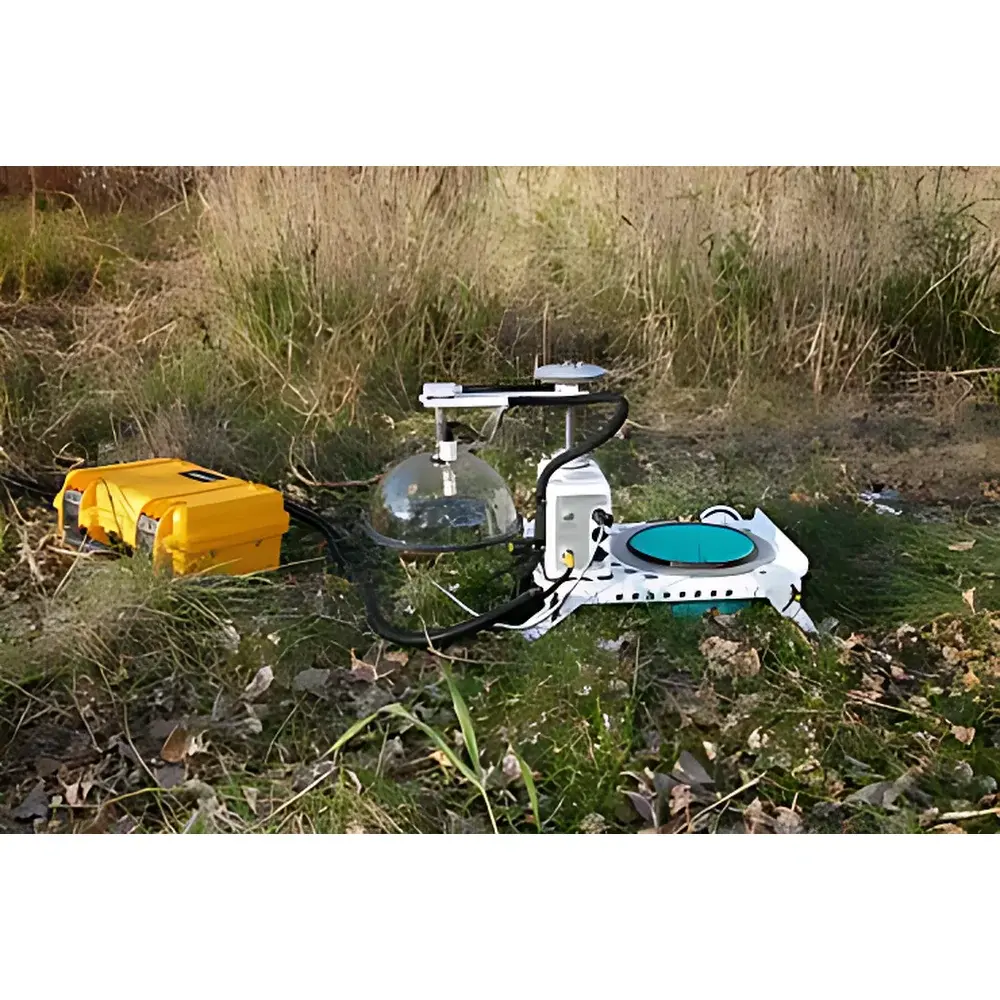
LI-COR LI-8100A Automated Soil Carbon Flux Measurement System
| Brand | LI-COR |
|---|---|
| Origin | USA |
| Model | LI-8100A |
| Status | Discontinued (Replaced by LI-870 Portable Soil CO₂ Flux System) |
| Regulatory Compliance | ASTM D6573, ISO 16634-2, USDA-NRCS Soil Gas Flux Protocols |
Overview
The LI-COR LI-8100A Automated Soil Carbon Flux Measurement System was a field-deployable, closed-path, non-steady-state chamber-based instrument engineered for high-temporal-resolution quantification of soil CO₂ efflux—the primary component of ecosystem-scale carbon exchange at the soil–atmosphere interface. Operating on the principle of infrared gas analysis (IRGA) coupled with automated chamber deployment and real-time concentration gradient modeling, the LI-8100A measured net CO₂ flux by monitoring the rate of CO₂ accumulation within a sealed, temperature-controlled chamber placed on the soil surface. Its design incorporated a dual-beam, single-detector IRGA optimized for CO₂ detection in the 4.26 µm absorption band, delivering sub-ppm precision under variable ambient conditions. Though discontinued, the LI-8100A established foundational methodology adopted across long-term ecological research networks—including the US LTER and AmeriFlux—where reproducible, autonomous, multi-point soil flux monitoring was required over seasonal to annual timescales.
Key Features
- Automated, programmable chamber deployment with up to 16 permanently installed collars per system, enabling unattended operation for weeks without manual intervention.
- Integrated environmental sensors: On-chamber air temperature, soil temperature (at multiple depths), and soil water content (via time-domain reflectometry or capacitance probes) synchronized with flux measurements.
- Real-time flux calculation using the Hsieh non-steady-state algorithm, with automatic correction for chamber-induced pressure differentials and boundary layer effects.
- Robust architecture designed for continuous outdoor operation across temperate, arid, and boreal biomes—rated IP65 for dust and water resistance.
- Onboard data logging with 2 GB internal memory and SD card expansion; timestamped binary output compatible with LI-COR’s EddyPro and FluxSuite software ecosystems.
- Modular design supporting optional integration with LI-840A CO₂/H₂O analyzer for enhanced cross-calibration and diagnostic validation.
Sample Compatibility & Compliance
The LI-8100A was validated for use across mineral soils, organic peats, agricultural fields, forest floors, and restored wetland substrates. Chamber sealing performance was verified per ASTM D6573 (Standard Test Method for Determining Soil Carbon Dioxide Efflux Using Closed Dynamic Chambers) and aligned with ISO 16634-2 protocols for greenhouse gas flux measurement in terrestrial ecosystems. Data acquisition met GLP-aligned metadata requirements—including full audit trails for chamber deployment timing, sensor calibration history, and environmental context—supporting traceability in regulatory reporting and peer-reviewed publication workflows. While not FDA-regulated, its architecture supported 21 CFR Part 11-compliant data handling when deployed with validated third-party software and electronic signature modules.
Software & Data Management
Data acquisition and post-processing were managed via LI-COR’s proprietary CO₂ Flux Analysis Software (v5.x), which performed automated quality control including outlier rejection based on R² thresholds (<0.95), slope instability detection, and moisture-driven artifact filtering. Raw voltage outputs from the IRGA, thermistors, and soil moisture sensors were stored with microsecond-level time stamps. Export formats included CSV, NetCDF, and Eddy Covariance-compatible BMR files. The system supported remote diagnostics via Ethernet or cellular modem (optional), enabling firmware updates and parameter reconfiguration without site visits. All metadata—including collar ID, GPS coordinates, vegetation cover notes, and maintenance logs—were embedded in header records to satisfy FAIR (Findable, Accessible, Interoperable, Reusable) data principles.
Applications
- Long-term carbon budgeting in climate change mitigation studies, particularly in afforestation/reforestation and soil carbon sequestration verification projects.
- Process-level investigation of microbial respiration responses to freeze-thaw cycles, drought stress, nitrogen fertilization, and land-use transitions.
- Validation of eddy covariance tower measurements through spatial upscaling of point-source flux data.
- Soil health assessment in agronomic trials evaluating cover cropping, no-till practices, and biochar amendment efficacy.
- Regulatory compliance monitoring for voluntary carbon markets (e.g., Verra VM0042, Climate Action Reserve protocols) requiring Tier 2 or Tier 3 flux quantification methods.
FAQ
Is the LI-8100A still supported by LI-COR?
No—LI-COR officially discontinued the LI-8100A in 2021. Hardware service contracts expired in 2023, and spare parts are no longer stocked. Technical documentation remains accessible via the LI-COR legacy support portal.
What is the recommended replacement platform?
The LI-870 Portable Soil CO₂ Flux System is the designated successor, offering comparable accuracy with reduced weight, integrated GPS, Bluetooth connectivity, and simplified field deployment—though it lacks the LI-8100A’s fully automated multi-collar capability.
Can LI-8100A data be processed with current software versions?
Yes—FluxSuite v3.2+ maintains backward compatibility with LI-8100A binary files, including legacy calibration coefficients and chamber geometry definitions.
Does the system meet ISO/IEC 17025 requirements for accredited testing labs?
While the LI-8100A itself is not ISO/IEC 17025-certified as a measuring instrument, laboratories may validate its measurement uncertainty per ISO/IEC 17025:2017 Clause 7.6.3 using documented calibration procedures, reference gas standards (NIST-traceable CO₂ mixtures), and inter-laboratory comparison studies.
Related Products







