
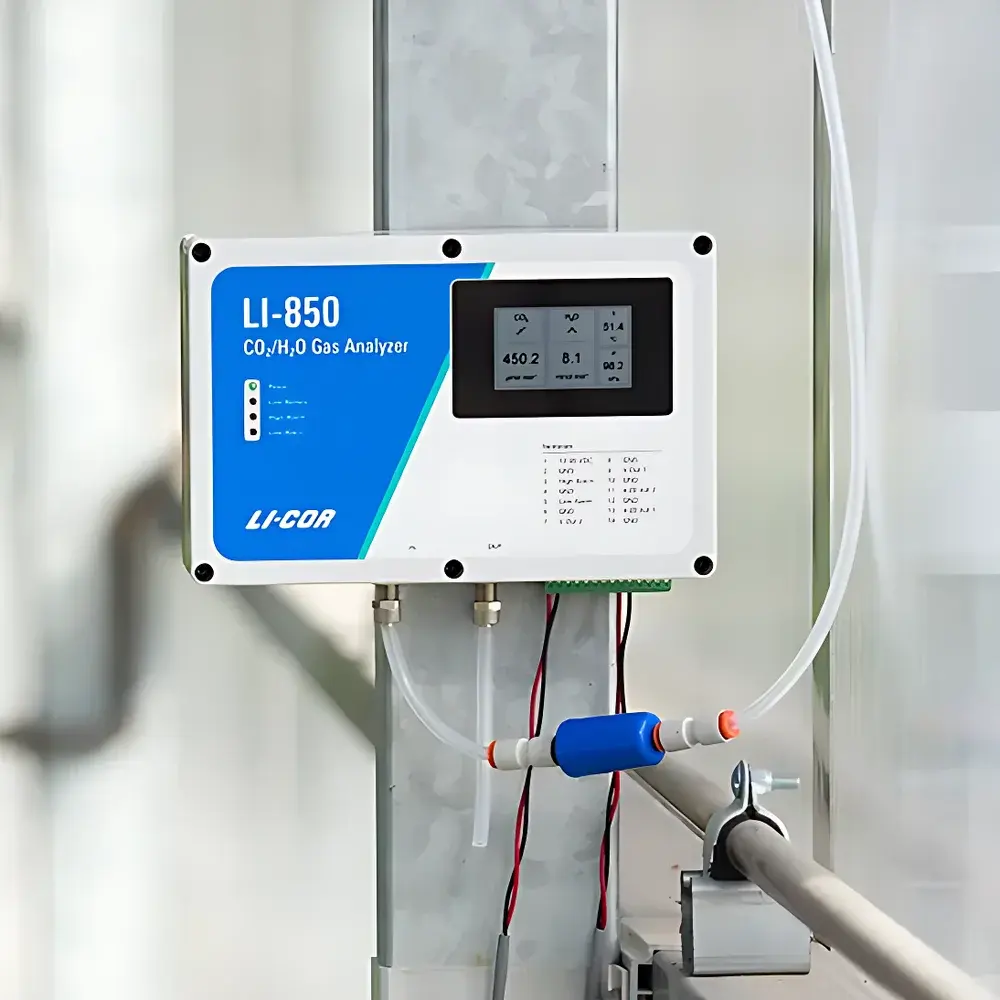
LI-COR LI-830 CO₂ Analyzer and LI-850 CO₂/H₂O Gas Analyzer
| Brand | LI-COR |
|---|---|
| Origin | USA |
| Model | LI-830 / LI-850 |
| CO₂ Range | 0–20,000 µmol/mol |
| CO₂ Accuracy | ±3% of reading (LI-830) |
| H₂O Range (LI-850 only) | 0–60 mmol/mol |
| H₂O Accuracy | ±1.5% of reading |
| Zero Drift (CO₂) | <0.15 µmol/mol/°C |
| Span Drift (CO₂) | <0.03%/°C |
| RMS Noise (CO₂) | <1 µmol/mol @ 370 µmol/mol (1-s avg) |
| H₂O Cross-Sensitivity (LI-850) | <0.1 µmol/mol CO₂ per mmol/mol H₂O |
| CO₂ Cross-Sensitivity (LI-850) | <0.0001 mmol/mol H₂O per µmol/mol CO₂ |
| Response Time (T90) | <3.5 s (CO₂ and H₂O) |
| Measurement Principle | Non-Dispersive Infrared (NDIR) |
| Pressure Compensation Range | 50–110 kPa |
| Output | Dual analog (0–2.5 V or 0–5 V |
| Power | 12–30 VDC |
| Operating Temp | –20 to +45 °C |
| Dimensions | 22.23 × 15.25 × 7.62 cm |
| Mass | 1.0 kg (base unit) |
Overview
The LI-COR LI-830 CO₂ Analyzer and LI-850 CO₂/H₂O Gas Analyzer are high-precision, field-deployable NDIR (non-dispersive infrared) gas analyzers engineered for continuous, stable, and traceable measurements of carbon dioxide and—on the LI-850—water vapor concentrations in ambient air, enclosed environments, and controlled gas streams. Designed around a thermally stabilized optical bench with integrated temperature and pressure compensation, both instruments deliver laboratory-grade accuracy under variable environmental conditions. The LI-830 is optimized for dedicated CO₂ quantification across ecological, agricultural, and industrial applications, while the LI-850 extends capability with simultaneous, cross-sensitivity-corrected CO₂ and H₂O measurement—critical for eddy covariance flux studies, chamber-based gas exchange, and atmospheric profiling where water vapor interference must be rigorously minimized. Each analyzer employs dual-wavelength NDIR detection with long-life infrared sources and low-noise detectors, enabling sub-ppm-level resolution and minimal drift over extended deployments. Calibration traceability follows internationally recognized protocols: CO₂ measurements from 0–3000 µmol/mol are traceable to WMO standards; higher ranges (3000–20,000 µmol/mol) comply with U.S. EPA reference methods. H₂O calibration on the LI-850 is performed using the NIST-traceable LI-610 Portable Dew Point Generator.
Key Features
- Thermally regulated optical path with active temperature control (±0.05 °C stability) to eliminate thermal drift and vibration-induced signal noise
- Integrated absolute pressure sensor and high-accuracy thermistor for real-time, on-the-fly density and mole fraction correction
- Low-power, high-reliability IR source with >10,000-hour operational lifetime and reduced thermal load on internal optics
- User-accessible optical window cleaning—no factory recalibration required after routine maintenance
- Configurable output options: dual analog voltage (0–2.5 V or 0–5 V), dual 4–20 mA current loops, and TTL-level digital output with 16-bit DAC resolution
- Optional built-in sampling pump delivering stable flow at 0.75 L/min (±2%) with 8000-hour mean time between failures
- Optional monochrome LCD display (6.7″ diagonal, 400×200 pixels) showing real-time CO₂, H₂O (LI-850), pressure, and optical path temperature without external computing hardware
- Rugged aluminum chassis (22.23 × 15.25 × 7.62 cm), IP54-rated enclosure, and operating range spanning –20 to +45 °C at 0–95% RH (non-condensing)
Sample Compatibility & Compliance
The LI-830 and LI-850 support direct sampling of ambient air, headspace gases, chamber effluent, and ducted ventilation streams without chemical scrubbing or conditioning—provided gas is particle-free and non-corrosive. Both analyzers meet key regulatory and methodological requirements for environmental monitoring: CO₂ measurements align with ASTM D6348–22 (standard test method for determination of gaseous compounds by GC/NDIR), ISO 14040 life cycle assessment boundary definitions for carbon flux, and US EPA Method TO-11A for ambient CO₂. For research conducted under GLP or GMP frameworks, data integrity is supported via timestamped analog/digital outputs compatible with validated data acquisition systems. While the analyzers themselves do not include 21 CFR Part 11-compliant audit trails, their deterministic output architecture enables seamless integration into compliant SCADA or LabArchives workflows when paired with appropriate middleware.
Software & Data Management
LI-COR provides free, cross-platform software (compatible with Windows and macOS) for configuration, real-time visualization, and diagnostic logging. The interface supports user-defined averaging intervals (1–60 s), alarm thresholds, and automatic zero/span verification scheduling. Raw data export is available in CSV and HDF5 formats, preserving native 2 Hz temporal resolution. All firmware updates and calibration coefficients are digitally signed and version-controlled. For networked deployments, optional Ethernet or RS-232 modules enable remote polling via Modbus RTU or custom ASCII protocols. No proprietary drivers or cloud dependencies are required—data streams integrate natively with MATLAB, Python (via PySerial or NIDAQmx), and LabVIEW.
Applications
- Ecosystem carbon flux measurements using static or dynamic closed/open chambers
- Continuous CO₂ and H₂O monitoring in growth chambers, greenhouses, and bioreactors for climate control feedback
- Vertical atmospheric profiling via mast-mounted or UAV-integrated installations
- Indoor air quality (IAQ) assessment in commercial buildings and cleanrooms per ASHRAE Standard 62.1
- Verification of carbon capture and storage (CCS) site integrity through perimeter fence-line monitoring
- Volcanic CO₂ degassing surveys and soil gas efflux mapping
- TOC combustion system off-gas analysis and dissolved CO₂ quantification in aquatic systems (when coupled with membrane equilibrators)
- Validation of HVAC ventilation efficiency via tracer gas decay methodology (ASTM E741)
FAQ
What is the difference between the LI-830 and LI-850 models?
The LI-830 measures CO₂ only; the LI-850 adds simultaneous, cross-compensated H₂O measurement with <0.1 µmol/mol CO₂ sensitivity to water vapor changes.
Can these analyzers operate unattended for long-term field deployments?
Yes—both units support continuous operation for >12 months with periodic zero checks; battery-backed clock and non-volatile memory retain settings during power interruption.
Is factory recalibration required after cleaning the optical path?
No—user cleaning of the sapphire windows does not invalidate calibration; only full optical alignment or detector replacement necessitates factory service.
How is pressure compensation implemented?
An integrated piezoresistive pressure transducer continuously feeds ambient pressure data to the embedded microcontroller, which applies real-time ideal gas law corrections to raw absorbance signals.
Are the analog outputs isolated?
Yes—both voltage and current outputs are galvanically isolated to prevent ground loops in multi-instrument networks.
What is the minimum detectable CO₂ change with 1-second averaging?
RMS noise is <1 µmol/mol at 370 µmol/mol CO₂ under 1-second signal averaging, corresponding to a detection limit of ~3 µmol/mol (3σ) in typical ambient conditions.







