
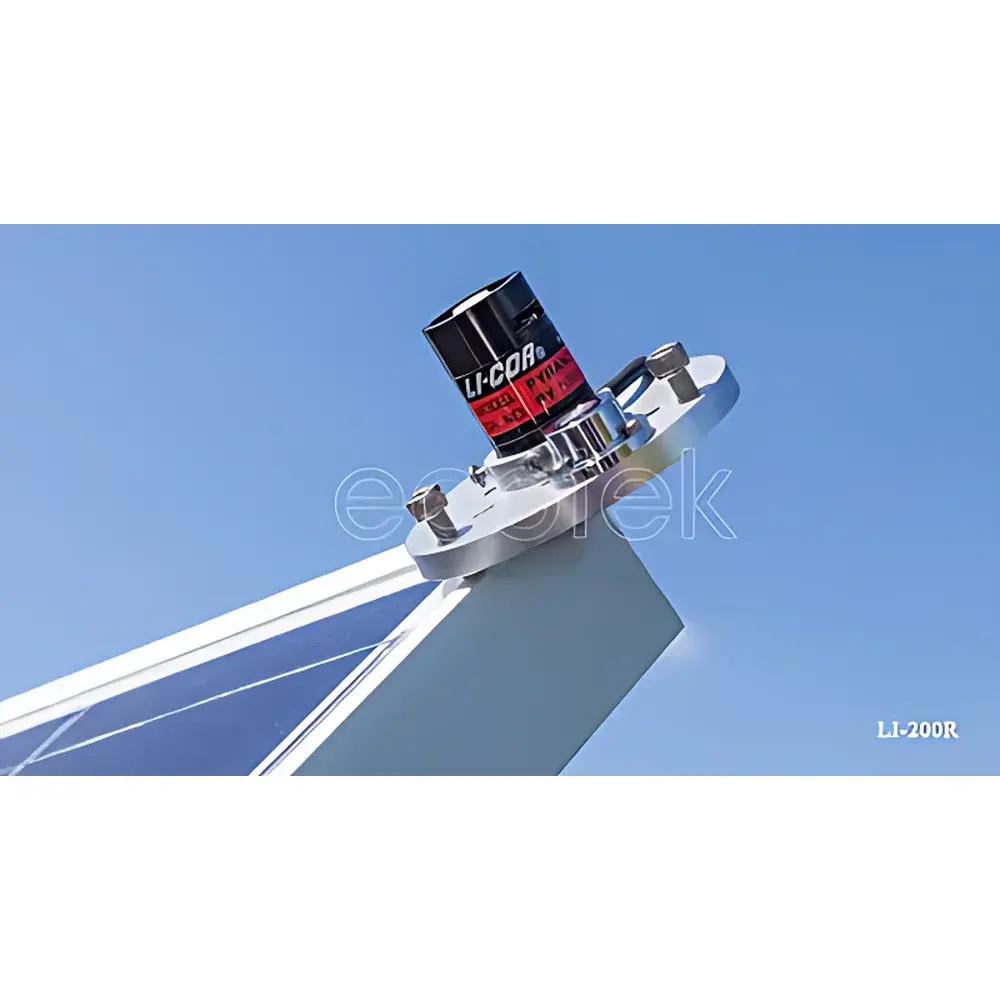
LI-COR Radiation Sensor Series
| Brand | LI-COR |
|---|---|
| Origin | USA |
| Manufacturer Type | Authorized Distributor |
| Product Category | Imported Instrument |
| Model Series | LI-COR Radiation Sensor Series |
| Instrument Type | Pyranometer / PAR Quantum Sensor / Illuminance Sensor / Underwater PAR Sensor |
| Compliance | ISO 9070, ASTM E892, WMO Guide to Meteorological Instruments and Methods of Observation |
Overview
The LI-COR Radiation Sensor Series comprises a family of high-accuracy, field-deployable optical sensors engineered for quantitative measurement of solar and photosynthetically active radiation across terrestrial, aquatic, and controlled-environment applications. Rooted in over four decades of radiometric metrology expertise, these sensors operate on fundamental principles of thermopile-based broadband detection (LI-200R), silicon photodiode-based quantum counting with spectral correction (LI-190R, LI-210R, LI-191R), and submersible cosine-corrected quantum sensing (LI-192, LI-193). Each sensor is calibrated traceably to NIST standards and conforms to internationally recognized performance criteria—including ISO 9070 for spectral responsivity characterization and ASTM E892 for pyranometer calibration protocols. Designed for long-term stability in outdoor and underwater deployments, the series supports critical measurements in micrometeorology, ecosystem flux studies, agronomic modeling, photovoltaic system performance validation, and aquatic photobiology.
Key Features
- Enhanced cosine response: Acrylic diffuser optics maintain ≤5% deviation from ideal cosine projection up to 82° zenith angle—critical for low-sun-angle accuracy in high-latitude or dawn/dusk measurements.
- Robust environmental sealing: Redesigned drainage channels prevent condensate accumulation around detector elements, minimizing thermal drift and extending operational lifetime in humid, coastal, or rain-prone environments.
- Modular mechanical architecture: Interchangeable sensor head and base assembly enables independent recalibration, replacement, or reconfiguration—reducing downtime and total cost of ownership.
- Submersible durability: LI-192 and LI-193 models feature titanium housings, epoxy-sealed electronics, and pressure-rated construction validated to 5.6 MPa (560 m seawater depth), with corrosion resistance certified per ASTM B117 salt-spray testing.
- Field-serviceable optics: Removable diffusers and cleanable quartz windows support on-site maintenance without return-to-factory servicing.
Sample Compatibility & Compliance
The LI-COR Radiation Sensor Series is compatible with standard data loggers (e.g., Campbell Scientific CR series, Onset HOBO, LI-COR’s own LI-1500) via analog voltage (0–2.5 V) or digital SDI-12 output. All sensors meet WMO Class C specifications for routine meteorological monitoring and are referenced in NOAA/NWS operational guidance for surface radiation network deployment. LI-200R complies with ISO 9060:2018 Class C for pyranometers; LI-190R and LI-191R adhere to ASTM E259-22 for quantum sensors; LI-192/LI-193 conform to ISO 14508-2 for underwater irradiance instrumentation. Calibration certificates include uncertainty budgets per ISO/IEC 17025 and are valid for 2 years under recommended field use conditions.
Software & Data Management
Sensor output integrates natively with LI-COR’s proprietary LI-1500 Smart Sensor Interface and third-party platforms supporting SDI-12 or analog input protocols. Raw voltage signals are converted using factory-provided sensitivity coefficients (µmol·s⁻¹·m⁻² per mV or W·m⁻² per mV) embedded in sensor firmware. For regulatory-compliant workflows, data acquisition systems employing LI-COR sensors may be configured to meet FDA 21 CFR Part 11 requirements when paired with audit-trail-enabled logging software (e.g., LoggerNet with electronic signature modules). All calibration history, serial-number-matched coefficients, and drift-correction recommendations are stored in LI-COR’s cloud-accessible Sensor Management Portal.
Applications
- Micrometeorology & energy balance studies: Continuous total solar irradiance (LI-200R) and PAR (LI-190R) measurements inform Bowen ratio calculations, evapotranspiration modeling, and eddy covariance system ancillary inputs.
- Agricultural & horticultural research: LI-191R’s linear array design enables spatially resolved PAR profiling within plant canopies; LI-210R quantifies visible-light uniformity in greenhouse supplemental lighting and vertical farming installations.
- Aquatic ecology & biogeochemistry: LI-192 (point quantum sensor) and LI-193 (spherical quantum sensor) provide depth-resolved PPFD and scalar irradiance profiles essential for primary productivity estimation, light attenuation modeling, and coral reef photophysiology studies.
- Renewable energy optimization: LI-200R serves as reference standard in PV performance ratio analysis and soiling loss quantification per IEC 61724-1.
- Building science & daylighting: LI-210R supports LEED daylight credit verification and EN 17037 compliance assessments through lux-to-PPFD conversion algorithms.
FAQ
What is the recommended recalibration interval for LI-COR radiation sensors?
LI-COR recommends recalibration every 2 years for terrestrial sensors and annually for submerged units (LI-192/LI-193), based on accelerated aging studies and field drift analysis across 150,000+ deployed units.
Can LI-192 be used in air, and if so, what precautions are required?
Yes, but the sensor must be fully dried prior to atmospheric use; residual moisture alters the refractive index at the detector interface and introduces systematic bias in quantum yield calculation.
How does the LI-193 spherical sensor differ from the LI-192 point sensor in underwater deployment?
LI-193 measures scalar irradiance (4π steradian integration) and derives PPFFR (Photosynthetic Photon Flux Fluence Rate), while LI-192 reports planar irradiance (2π steradian) and is optimized for directional light field characterization in stratified water columns.
Are LI-COR radiation sensors compatible with non-LI-COR data loggers?
Yes—all models provide standardized analog (0–2.5 V) or SDI-12 outputs, with full electrical interface specifications published in the LI-COR Sensor Integration Handbook v4.2.
Does LI-COR provide traceable calibration documentation for regulatory submissions?
Yes: each sensor ships with an ISO/IEC 17025-accredited calibration certificate, including measurement uncertainty, reference standard traceability (NIST SRM 2253), and environmental test conditions.







