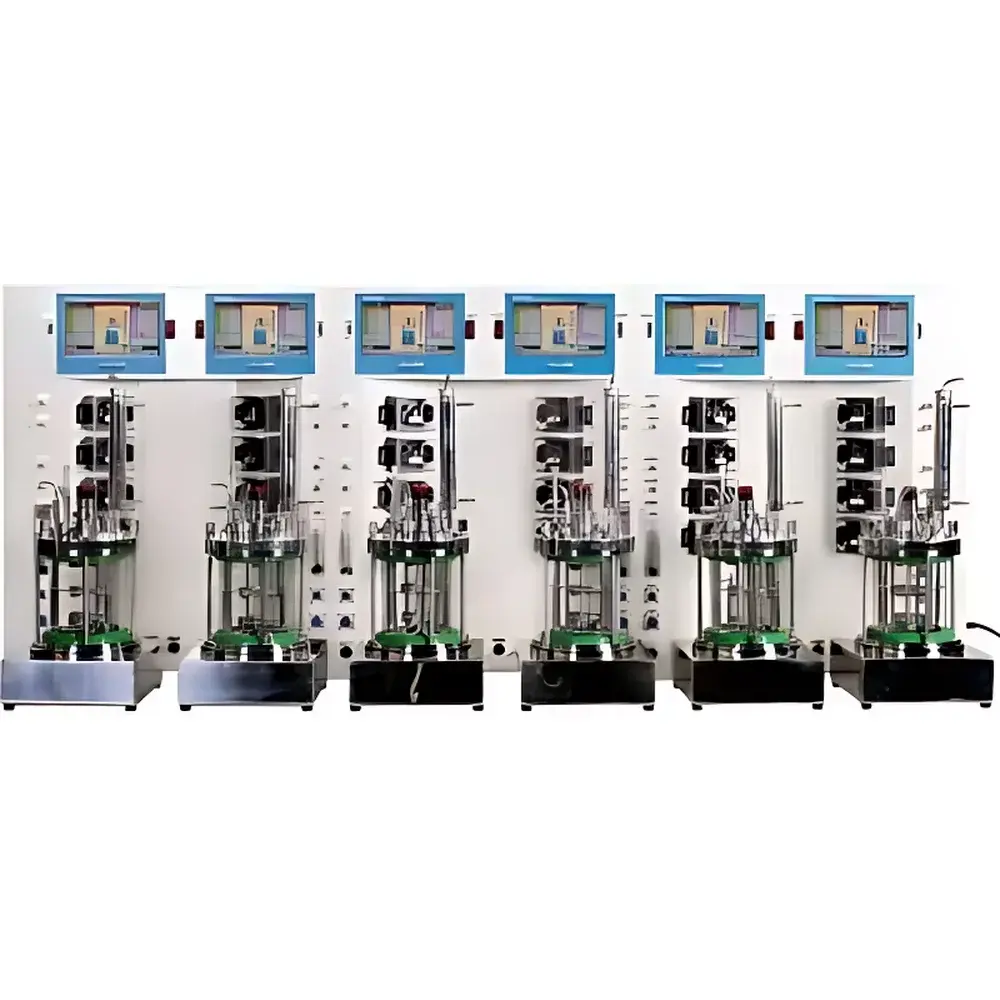
LiFlus GM Six-Vessel Parallel Bioreactor System
| Origin | South Korea |
|---|---|
| Manufacturer Type | Authorized Distributor |
| Origin Category | Imported |
| Model | GM |
| Pricing | Available Upon Request |
Overview
The LiFlus GM Six-Vessel Parallel Bioreactor System is an integrated, laboratory-scale fermentation platform engineered for reproducible, scalable bioprocess development in upstream biomanufacturing. Designed around a robust mechanical upper-drive architecture with DC servo motors, the system enables precise, independent control of six 1.5 L single-wall glass vessels—each equipped with jacketless heating via PID-regulated stainless-steel heating plates and cooled by ambient or external chilled water. Its core measurement and control paradigm relies on real-time electrochemical (pH, DO) and physical (temperature, agitation speed, gas flow) parameter acquisition, processed through a centralized digital control unit with full PID algorithm implementation. The system operates on fundamental bioreactor principles: pH is regulated via acid/base dosing using built-in peristaltic pumps; dissolved oxygen (DO) is maintained either through cascade control (agitation speed modulation relative to DO setpoint) or fixed-speed agitation with variable air/O₂ blending; temperature is stabilized via proportional-integral-derivative feedback using PT-100 sensors (±0.1 °C accuracy); and sterility is preserved through 0.2 µm absolute filtration on both inlet and exhaust gas lines, coupled with a 316L stainless-steel reflux condenser.
Key Features
- Parallel operation of six independent 1.5 L vessels with identical sensor suites and actuation capabilities—enabling statistically valid comparative studies (e.g., media optimization, strain screening, feeding strategy evaluation)
- Upper-mounted DC servo motor drive (50–1,200 rpm range) with dual Rushton turbine impellers and one mechanical foam breaker—ensuring high torque transmission, minimal shaft deflection, and low maintenance
- Dual-mode DO control: direct agitation-speed setpoint linkage or closed-loop PID-driven speed adjustment based on real-time DO feedback (0–200% saturation, ±0.1% resolution)
- Integrated peristaltic pump module (six channels, speed-adjustable) housed within the main control cabinet—dedicated to acid, base, antifoam, and feed solution delivery with programmable dosing profiles
- 14-inch color LCD touchscreen interface per vessel—displaying live trends for pH (2.0–12.0, auto-compensated), DO (0–200%), temperature (3 °C above coolant to 80 °C), agitation speed, and pump status
- Full RS-232C serial communication support for external data logging, remote monitoring, and integration into LIMS or SCADA environments—compliant with basic audit trail requirements for GLP-aligned workflows
Sample Compatibility & Compliance
The LiFlus GM system supports microbial (E. coli, yeast, bacilli), mammalian (CHO, HEK293), and fungal cultures under aerobic or microaerobic conditions. Vessel geometry and impeller configuration ensure adequate mass transfer (kLa > 100 h⁻¹ at 1,000 rpm, air sparging) and shear-sensitive cell viability retention. All wetted parts—including gas distributors, filters, pH/DO electrodes (Mettler Toledo or Hamilton certified), and condensers—are constructed from USP Class VI-certified materials or ASTM A276 316L stainless steel. The system adheres to ISO 13485 design controls for medical device-related bioprocess validation and meets essential electrical safety requirements per IEC 61010-1. While not pre-certified for GMP manufacturing, its architecture—including PID repeatability, calibration traceability, and parameter logging—supports qualification protocols aligned with FDA 21 CFR Part 11 Annex 11 expectations when deployed with validated software extensions.
Software & Data Management
Data acquisition occurs at 1 Hz sampling frequency across all primary parameters (pH, DO, T, RPM, pump duty cycle). Raw values are buffered internally and transmitted via RS-232C to host PCs running Windows-compatible terminal software or third-party SCADA platforms (e.g., Ignition, LabVIEW). The embedded controller stores up to 30 days of compressed time-series data per vessel. Export formats include CSV and Excel-compatible .xls—enabling post-run kinetic analysis (e.g., µₘₐₓ, qₚ, Yₓ/ₛ calculation). Optional firmware upgrades support timestamped event logging (e.g., “pH adjustment initiated at 14:22:08”), facilitating root-cause analysis during process deviations. Audit trails record operator login, setpoint changes, and manual overrides—meeting minimum documentation standards for academic grant reporting and early-stage regulatory submissions.
Applications
- High-throughput strain selection and media optimization across six parallel conditions
- Scale-down modeling for bioreactor process transfer (e.g., from 50 L to 2,000 L production trains)
- Dynamic feeding strategy development—pulse, exponential, or DO-stat triggered nutrient addition
- Real-time metabolic profiling via online pH/DO correlation with off-gas O₂/CO₂ analysis (when interfaced with external analyzers)
- Training platform for bioprocess engineering curricula—demonstrating feedback control theory, mass transfer limitations, and sterilization validation principles
- Regulatory filing support: generation of representative batch records for IND/IMPD dossiers under ICH Q5D guidelines
FAQ
Is the GM system suitable for anaerobic cultivation?
No—the standard configuration provides only Air and O₂ supply via 0.2 µm filtered ring spargers. Nitrogen or CO₂ gas blending requires optional retrofitting of a multi-gas mass flow controller module.
Can pH and DO probes be calibrated automatically?
Probe calibration is manual per IUPAC-compliant two-point (pH) or air-saturation/water-saturation (DO) procedures. No onboard auto-calibration routine is included.
What is the maximum allowable operating pressure?
The vessels are rated for atmospheric operation only (0 gauge pressure). Positive pressure capability is not supported.
Are spare parts and electrode replacements available globally?
Yes—authorized distributors maintain inventory of 316L fittings, PT-100 sensors, Mettler/Hamilton electrode cartridges, and peristaltic pump tubing compatible with Masterflex L/S series specifications.
Does the system support Ethernet or USB connectivity?
RS-232C is the sole native communication interface. Ethernet or USB conversion requires externally mounted protocol gateways (e.g., Moxa NPort) configured at the host PC level.