LiFlus Series Pilot-Scale Automated In-Situ Sterilizable Fermenter
| Origin | South Korea |
|---|---|
| Manufacturer Type | Authorized Distributor |
| Origin Category | Imported |
| Model | LiFlus |
| Pricing | Available Upon Request |
Overview
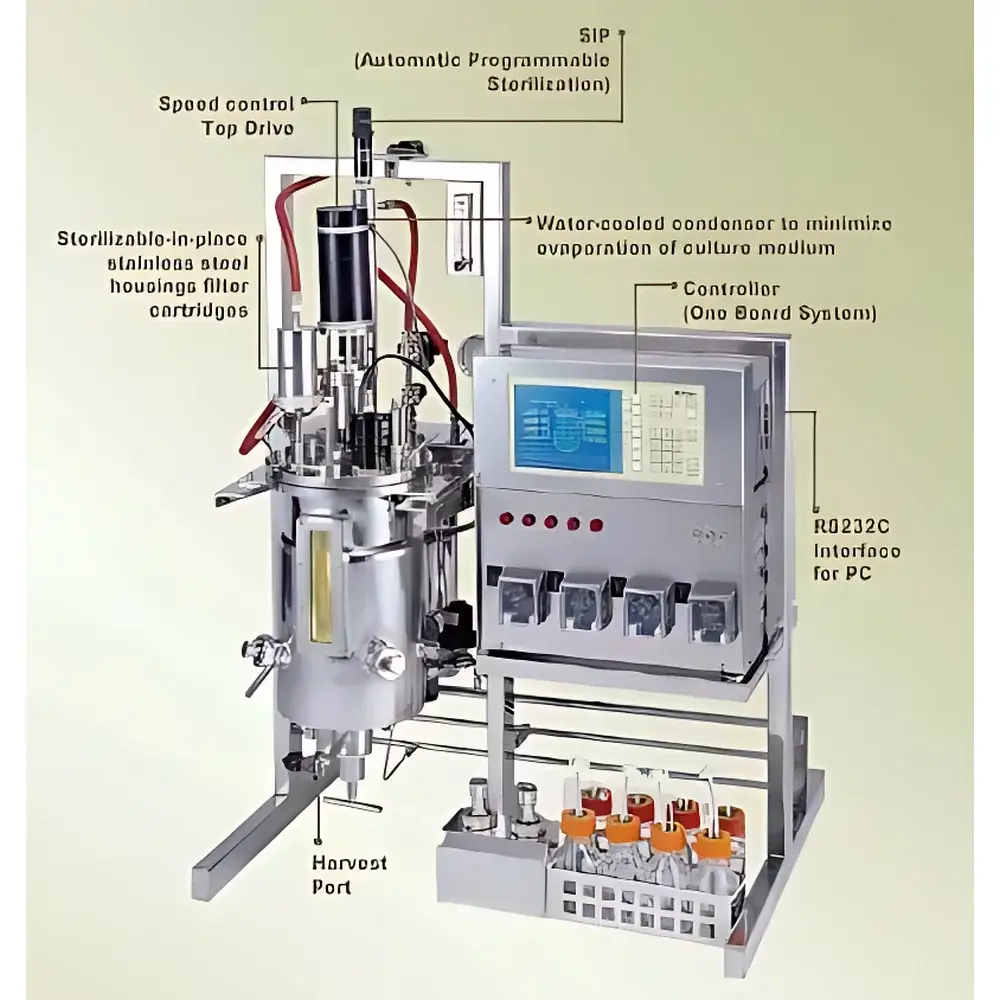
The LiFlus Series Pilot-Scale Fermenter is a fully automated, in-situ sterilizable bioreactor engineered for seamless technology transfer from lab-scale discovery to pilot-scale process development. Designed according to GMP-aligned engineering principles used in commercial manufacturing systems, it bridges the critical gap between academic research and industrial bioprocess validation. Its core architecture employs a jacketed 316L stainless steel vessel with integrated electric heating elements—eliminating reliance on external autoclaves—and precision-controlled cooling via recirculating water circuits. The system operates on Couette-type mixing dynamics driven by a top-mounted DC servo motor (150 W), delivering consistent shear profiles across scalable working volumes. It supports both aerobic microbial fermentation (e.g., E. coli, S. cerevisiae, P. pastoris) and advanced mammalian/insect cell culture when equipped with optional gas-permeable membranes, sparged headspace control, and low-shear impeller configurations. Temperature, pH, dissolved oxygen (DO), agitation speed, and pressure are continuously monitored and regulated in real time using closed-loop digital PID algorithms.
Key Features
- Top-driven 150 W DC servo motor with tungsten carbide mechanical seal—ensures long-term sterility integrity and zero lubricant contamination
- Agitation range: 50–1500 rpm, controlled to ±1 rpm accuracy via gear-reduced transmission
- Double-jacketed 316L stainless steel vessel with electropolished interior (Ra ≤ 0.4 µm) and mechanically polished exterior
- In-situ sterilization capability: automated thermal cycle (105–130°C) applied to vessel, vent filter, inlet/outlet lines, and sensor housings
- 8.5-inch color TFT LCD touchscreen interface with membrane keypad—designed for glove-compatible operation in ISO Class 5–7 environments
- Integrated sanitary piping: 316L tubing with EPDM gaskets and silicone O-rings compliant with USP Class VI and FDA 21 CFR Part 11 requirements
- Standard instrumentation: Pt-100 RTD (±0.1°C accuracy), polarographic DO probe, solid-state pH electrode with auto-compensation, and differential pressure transducer
- Gas delivery system featuring sterile 0.2 µm absolute-rated cylindrical filters (inlet and exhaust), ring-type sparger, and pneumatically actuated aseptic diaphragm valves
- Modular sensor ports: six standardized 1/2″ NPT threaded openings on vessel headplate; three additional ports on lower sidewall for auxiliary probes (e.g., capacitance-based biomass, exhaust CO₂/O₂)
Sample Compatibility & Compliance
The LiFlus fermenter accommodates diverse biological systems including prokaryotic cultures (bacteria, actinomycetes), eukaryotic microorganisms (yeast, filamentous fungi), suspension-adapted mammalian cells (CHO, HEK293), and insect cell lines (Sf9, Sf21). Its materials of construction conform to ASTM A240/A240M for 316L stainless steel and ASME BPE-2022 surface finish standards. All wetted components meet ISO 13485:2016 design controls for medical device manufacturing environments. The control system supports audit trails, electronic signatures, and data integrity protocols aligned with FDA 21 CFR Part 11 and EU Annex 11 requirements. Optional IQ/OQ documentation packages are available for GLP and GMP-regulated laboratories.
Software & Data Management
The embedded BioG-α control firmware runs on an MC68EC020 microprocessor platform and enables synchronized acquisition of up to five primary parameters (temperature, pH, DO, RPM, pressure) at 1 Hz resolution. Process data is stored internally on removable SD cards (FAT32 formatted) with timestamped CSV export capability. RS-232C serial interface allows direct connection to laboratory PCs for remote monitoring, historical trend analysis, and integration into enterprise LIMS or MES platforms. Real-time graphing, alarm logging, and recipe-based batch sequencing are supported. All parameter setpoints, calibration records, and sterilization logs are digitally signed and version-controlled to satisfy ALCOA+ data governance criteria.
Applications
- Strain selection and media optimization under controlled physiological conditions
- Scale-down modeling for upstream process characterization and DoE studies
- Production of recombinant proteins, monoclonal antibodies, viral vectors, and plasmid DNA
- Metabolic engineering validation and biocatalyst performance assessment
- Bioprocess training and workforce development in academic and contract development organizations (CDOs)
- Regulatory filing support—including comparability studies for phase-appropriate process validation
FAQ
Is the LiFlus fermenter suitable for cGMP-compliant manufacturing?
Yes—when configured with full documentation packages (IQ/OQ/PQ), 21 CFR Part 11-compliant software, and validated sterilization cycles, it meets cGMP expectations for early-phase clinical material production.
Can I integrate third-party sensors (e.g., Raman, NIR) into the system?
Absolutely—the standardized NPT ports and open RS-232/RS-485 communication protocol support integration of external analyzers via analog 4–20 mA or Modbus RTU interfaces.
What is the maximum working volume for the standard LiFlus configuration?
Standard models support working volumes from 5 L to 50 L, with custom configurations available up to 200 L upon request.
Does the system include validation support for sterilization cycles?
Yes—thermal mapping templates, thermocouple placement guides, and cycle verification reports are included in the optional Validation Support Kit.
How is maintenance access designed for routine cleaning and inspection?
The open-frame structural design provides unobstructed 360° access to all valves, fittings, and instrumentation; all sanitary connections use tri-clamp couplings for rapid disassembly without tools.
Related Products