
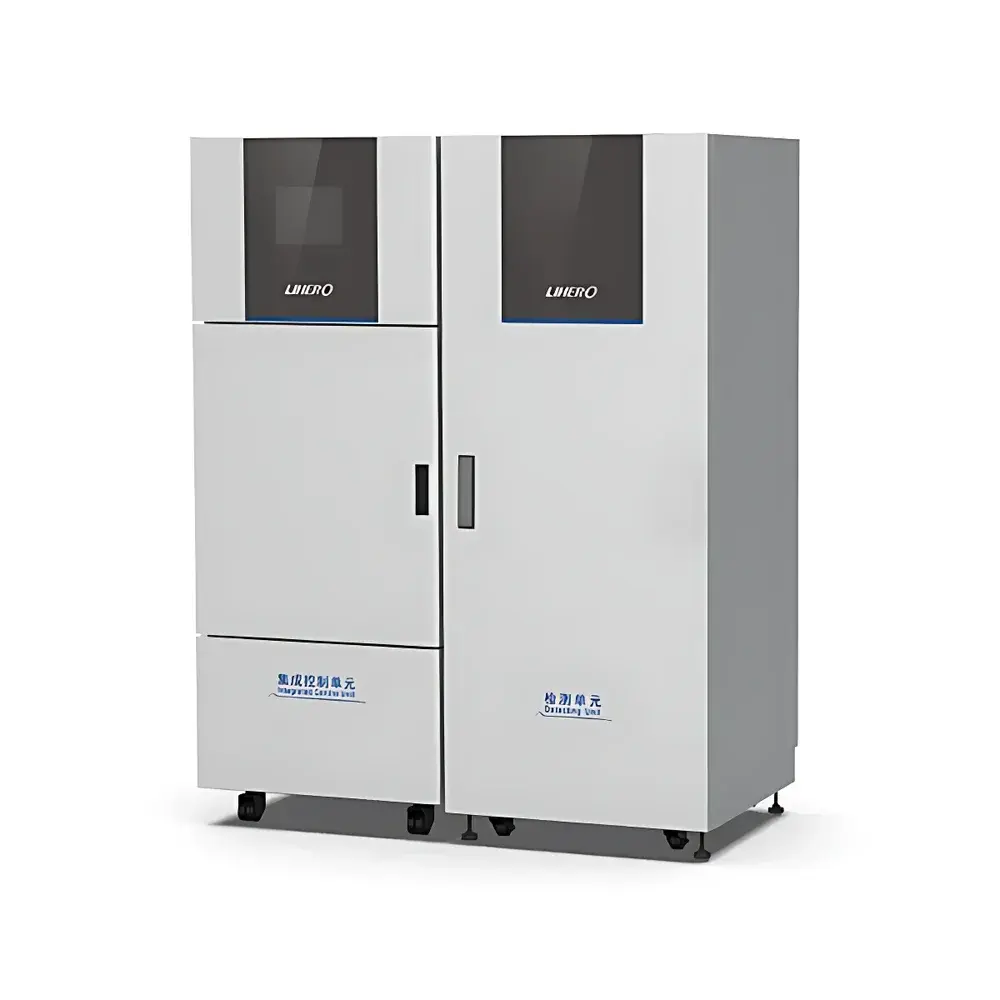
Lihero IM Series Online Pollution Source Monitoring System
| Brand | Lihero |
|---|---|
| Origin | Hunan, China |
| Manufacturer Type | Authorized Distributor |
| Origin Category | Domestic |
| Model | IM Series |
| Pricing | Available Upon Request |
Overview
The Lihero IM Series Online Pollution Source Monitoring System is an integrated, modular environmental monitoring platform engineered for continuous, unattended operation at industrial wastewater discharge points and municipal effluent outlets. It operates on a multi-layered architecture grounded in regulatory-compliant automated sampling, real-time analytical measurement, and traceable data governance. The system implements standardized physicochemical detection principles—including dichromate digestion UV-Vis spectrophotometry for CODCr, Nesslerization or ion-selective electrode (ISE) methods for NH3-N, molybdenum blue colorimetry for total phosphorus (TP), and high-temperature catalytic oxidation with chemiluminescence or UV digestion–TN analyzer coupling for total nitrogen (TN). All analytical modules conform to the metrological and procedural requirements of HJ/T 353–2019 (Technical Specifications for Automatic Monitoring of Water Pollution Sources) and HJ/T 354–2019 (Acceptance and Operational Management Specifications), ensuring alignment with China’s Ministry of Ecology and Environment (MEE) enforcement frameworks.
Key Features
- Modular hardware architecture enabling rapid field deployment, component-level maintenance, and scalable expansion—each functional unit (sampling, QC, analysis, flow sensing, control logic) operates as an independent yet interoperable subsystem.
- Intelligent self-diagnostic engine continuously monitors instrument health parameters—including reagent level, optical path integrity, pump performance, temperature stability, and sensor calibration drift—generating actionable status reports via embedded diagnostics dashboard.
- Multi-mode automated sampling logic supporting time-proportional, flow-proportional, rain-event-triggered, and event-based (e.g., exceedance-triggered) collection protocols; compliant with HJ/T 353–2019 sampling frequency and retention rules.
- Standardized reagent production and logistics pipeline: all consumables manufactured under controlled GMP-like conditions, batch-coded, and distributed centrally to ensure lot-to-lot consistency and documented shelf-life traceability.
- Remote valve actuation interface for real-time discharge control—enabling regulatory authorities to initiate/terminate effluent release based on live water quality thresholds or operational alerts.
- Extensible analytical capability: base configuration supports CODCr, NH3-N, TP, and TN; optional modules integrate ICP-MS, AAS, GC-MS, or electrochemical sensors for up to 90+ additional parameters including heavy metals (Cd, Pb, Hg, As), cyanide, phenol, fluoride, and organic micropollutants.
Sample Compatibility & Compliance
The IM Series accommodates heterogeneous influent matrices—including mixed industrial wastewater, municipal sewage, leachate, and cooling water—with adaptive filtration, pH adjustment, and particulate removal pre-treatment stages. All wetted components comply with ISO 15223-1 for medical device labeling conventions and GB/T 19001–2016 (equivalent to ISO 9001:2015) for quality management system certification. Data integrity meets GLP-aligned audit trail requirements: every sample ID, analysis timestamp, calibration event, QC spike result, and maintenance log is cryptographically timestamped and immutably stored. System design supports future alignment with ISO/IEC 17025:2017 laboratory accreditation criteria for field-deployed analyzers.
Software & Data Management
The base station control software provides a secure, role-based web interface (HTTPS/TLS 1.2+) for remote configuration, firmware updates, alarm management, and historical data retrieval. It implements full 21 CFR Part 11–compliant electronic signatures, user access logs, and change-control workflows. Data acquisition follows HJ 212–2017 communication protocol standards for seamless integration with provincial and national MEE environmental monitoring platforms (e.g., National Supervision Platform for Pollution Sources). Raw spectra, chromatograms, calibration curves, and QC charts are exportable in CSV, PDF, and XML formats—retained locally for ≥18 months per regulatory retention mandates.
Applications
- Continuous compliance verification for enterprises subject to discharge permits under China’s “Discharge Permit Management Regulation” (Decree No. 736).
- Real-time early warning for toxicant breakthrough events in industrial park centralized treatment plants.
- Supporting environmental impact assessments (EIA) and post-construction environmental monitoring (PCEM) programs.
- Enabling dynamic water balance modeling by correlating flowmeter data, effluent composition, and intake metering from smart water meters.
- Facilitating third-party运维 (O&M) service delivery with SLA-defined uptime reporting, preventive maintenance scheduling, and remote troubleshooting dashboards.
FAQ
Does the IM Series support integration with existing SCADA or DCS systems?
Yes—via Modbus RTU/TCP, OPC UA, and custom API endpoints, enabling bidirectional data exchange with plant-level control infrastructure.
How is data authenticity verified during regulatory audits?
Each measurement includes embedded digital signatures, hardware-generated timestamps, and chain-of-custody metadata; audit logs are write-once/read-many (WORM) archived.
Can the system operate reliably in high-humidity or corrosive industrial environments?
Enclosures meet IP66 ingress protection rating; critical electronics are conformally coated; sampling manifolds use PTFE-lined stainless steel or PVDF piping.
Is remote firmware upgrade supported without on-site technician intervention?
Yes—over-the-air (OTA) updates are delivered through encrypted channels with rollback capability and pre-deployment validation checks.
What documentation is provided for regulatory submission?
Factory acceptance test (FAT) reports, calibration certificates (traceable to NIM China), HJ/T 353–2019 conformance statements, and cybersecurity assessment summaries are included.







