
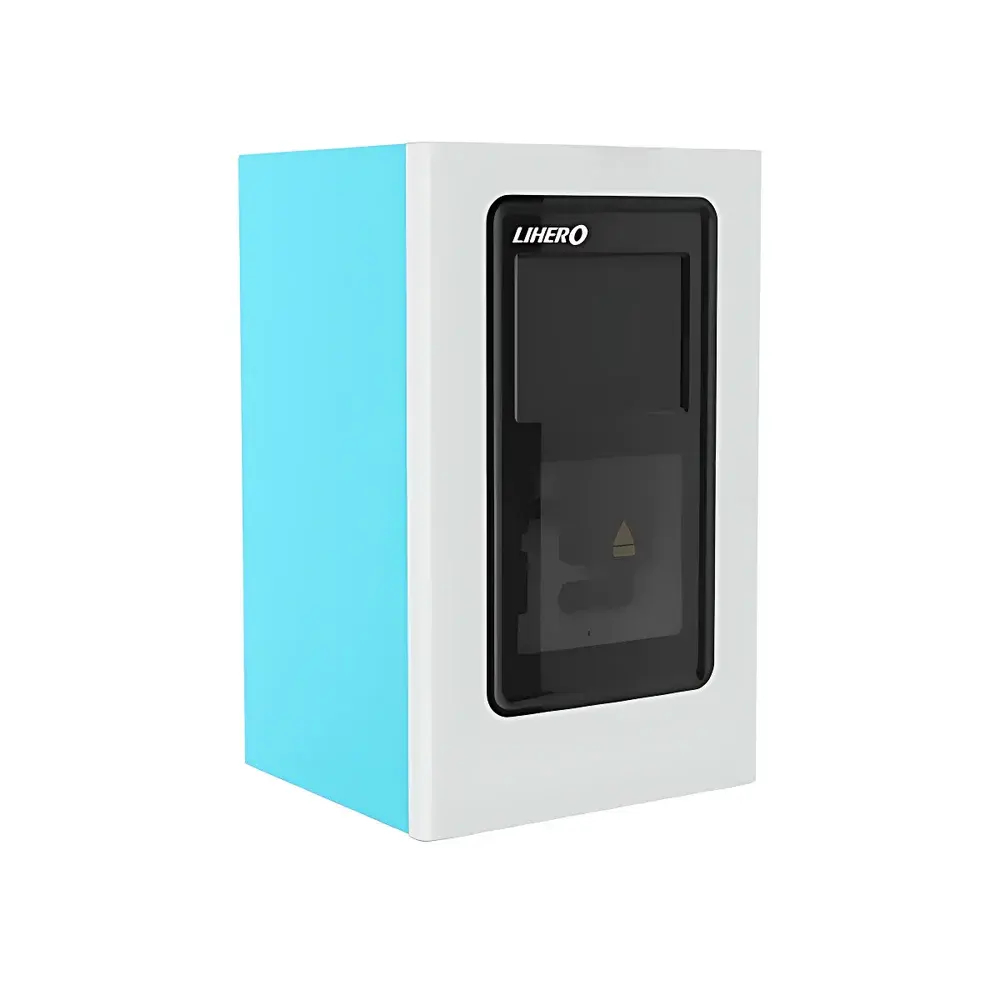
Lihero LFEC-2006 Fluoride and Chloride Water Quality Analyzer
| Brand | Lihero |
|---|---|
| Model | LFEC-2006 |
| Measurement Principle | Ion-Selective Electrode (ISE) Method |
| Analytes | Fluoride (F⁻), Chloride (Cl⁻) |
| Compliance | HJ/T 212–2017 (China Environmental Monitoring Data Transmission Protocol) |
| Electrical Safety | Insulation Resistance ≥20 MΩ (between power input and chassis) |
| Communication Interfaces | RS-232, RS-485, RJ-45 Ethernet |
| Calibration Modes | Zero Check, Span Check, Standard Calibration, Curve Auto-Standardization, Spike Recovery Test |
| Maintenance Features | Automatic Electrode Cleaning, Auto-Calibration, Auto-Range Switching |
| Remote Control | Yes |
| Fault Diagnostics | Component Failure, Over-Range, Abnormal Data, Reagent/Water Depletion Alarms |
| Operating System | Embedded Real-Time OS |
| Sensor Architecture | Modular ISE Probe Design (Interchangeable F⁻/Cl⁻ Electrodes) |
Overview
The Lihero LFEC-2006 Fluoride and Chloride Water Quality Analyzer is a fixed-installation, on-line monitoring instrument engineered for continuous, reliable quantification of fluoride (F⁻) and chloride (Cl⁻) ions in surface water, groundwater, drinking water treatment plants, wastewater effluents, and industrial process streams. It operates on the potentiometric principle using ion-selective electrode (ISE) technology: a solid-state or crystalline membrane electrode generates a Nernstian potential shift proportional to the logarithm of the target ion’s thermodynamic activity in solution. Paired with a stable Ag/AgCl reference electrode, the measured potential difference is converted into concentration values (mg/L or ppm) via factory-calibrated or field-established calibration curves. Unlike optical or colorimetric methods, ISE-based detection offers real-time response, minimal reagent consumption, and immunity to turbidity, color, or suspended solids—critical advantages in raw or partially treated water matrices. The analyzer is designed for unattended operation in ambient outdoor enclosures or indoor control rooms, meeting the mechanical robustness and environmental tolerance requirements of long-term environmental monitoring networks.
Key Features
- Modular dual-analyte architecture: Single instrument platform supports sequential or independent measurement of F⁻ and Cl⁻ via quick-swap, pre-conditioned ISE sensor cartridges—no hardware modification required.
- High-selectivity electrodes: Fluoride electrode utilizes lanthanum fluoride (LaF₃) single-crystal membrane; chloride electrode employs silver chloride (AgCl)-based polymeric membrane—both optimized for low detection limits (<0.02 mg/L F⁻, <0.5 mg/L Cl⁻) and minimal cross-sensitivity to common interferents (e.g., OH⁻, NO₃⁻, SO₄²⁻).
- Dynamic calibration methodology: Implements multi-point curve fitting with automatic slope verification and drift compensation, ensuring measurement reproducibility across variable temperature and ionic strength conditions.
- Comprehensive quality assurance suite: Integrated QA/QC routines include zero-point verification (using deionized water), span-check with certified standard solutions, automatic calibration curve generation, and quantitative spike recovery testing per EPA Method 300.1 guidelines.
- Autonomous operational integrity: Scheduled electrode cleaning cycles (via ultrasonic or pneumatic purge), auto-ranging capability (switching between low/high concentration ranges without manual intervention), and real-time fault logging with event-tagged timestamps.
Sample Compatibility & Compliance
The LFEC-2006 accepts liquid samples with pH 4–9 and temperature range 5–40 °C, accommodating typical municipal and industrial water matrices without pretreatment. It complies with China’s HJ/T 212–2017 data transmission protocol for environmental monitoring instruments, enabling seamless integration into provincial and national environmental information platforms. While not certified to ISO/IEC 17025 or EPA certification programs, its measurement methodology aligns with ASTM D3869–22 (Standard Test Methods for Fluoride and Chloride in Water) and ISO 10304-1:2012 (Determination of dissolved anions by liquid chromatography). The embedded diagnostics system logs all maintenance events, calibration records, and alarm triggers—supporting GLP-aligned record retention for internal audit trails.
Software & Data Management
The analyzer runs a deterministic embedded Linux OS with a dedicated communication daemon supporting TCP/IP, Modbus RTU/ASCII over RS-485, and ASCII protocol over RS-232. Data output includes primary concentration values, electrode mV readings, temperature-compensated slope (%Nernst), calibration status flags, and diagnostic codes. All data packets are timestamped with millisecond precision and support bidirectional remote command execution (e.g., initiate calibration, trigger cleaning, request log export). Local storage retains ≥30 days of 15-minute interval data; external SCADA systems may retrieve historical records via FTP or HTTP GET requests. Audit logs meet basic traceability requirements—though native 21 CFR Part 11 electronic signature functionality is not implemented.
Applications
- Drinking water safety monitoring: Continuous verification of fluoride levels against WHO guideline values (1.5 mg/L) and national regulatory limits (e.g., GB 5749–2022).
- Wastewater discharge compliance: Real-time tracking of chloride ingress from industrial discharges (e.g., chemical manufacturing, metal plating) to ensure adherence to local effluent standards.
- Groundwater contamination assessment: Field-deployable detection of fluoride anomalies linked to geogenic leaching or anthropogenic pollution sources.
- Process control in desalination and ion exchange facilities: Monitoring breakthrough of Cl⁻ in resin beds or post-treatment F⁻ residuals after bone char or activated alumina filtration.
- Environmental monitoring networks: Integration into automated water quality stations where low-power, low-maintenance, and reagent-free operation is prioritized.
FAQ
What measurement principle does the LFEC-2006 employ?
It uses potentiometric ion-selective electrode (ISE) detection based on the Nernst equation, measuring the voltage difference between a selective sensing electrode and a reference electrode.
Can the instrument measure fluoride and chloride simultaneously?
No—it measures one ion at a time; switching between F⁻ and Cl⁻ requires physical replacement of the respective ISE sensor cartridge.
Does it support automatic temperature compensation?
Yes—integrated Pt1000 RTD sensor provides real-time temperature feedback for Nernst slope correction.
Is the calibration procedure traceable to national standards?
Calibration relies on user-provided NIST-traceable standard solutions; the instrument itself does not hold metrological certification.
What is the minimum detectable concentration for fluoride?
Typical detection limit is 0.02 mg/L under optimal laboratory conditions; field performance may vary depending on sample matrix and electrode conditioning.
How often does the electrode require replacement?
Manufacturer recommends replacement every 6–12 months under continuous operation, depending on exposure to high-ion-strength or abrasive samples.
Related Products







