
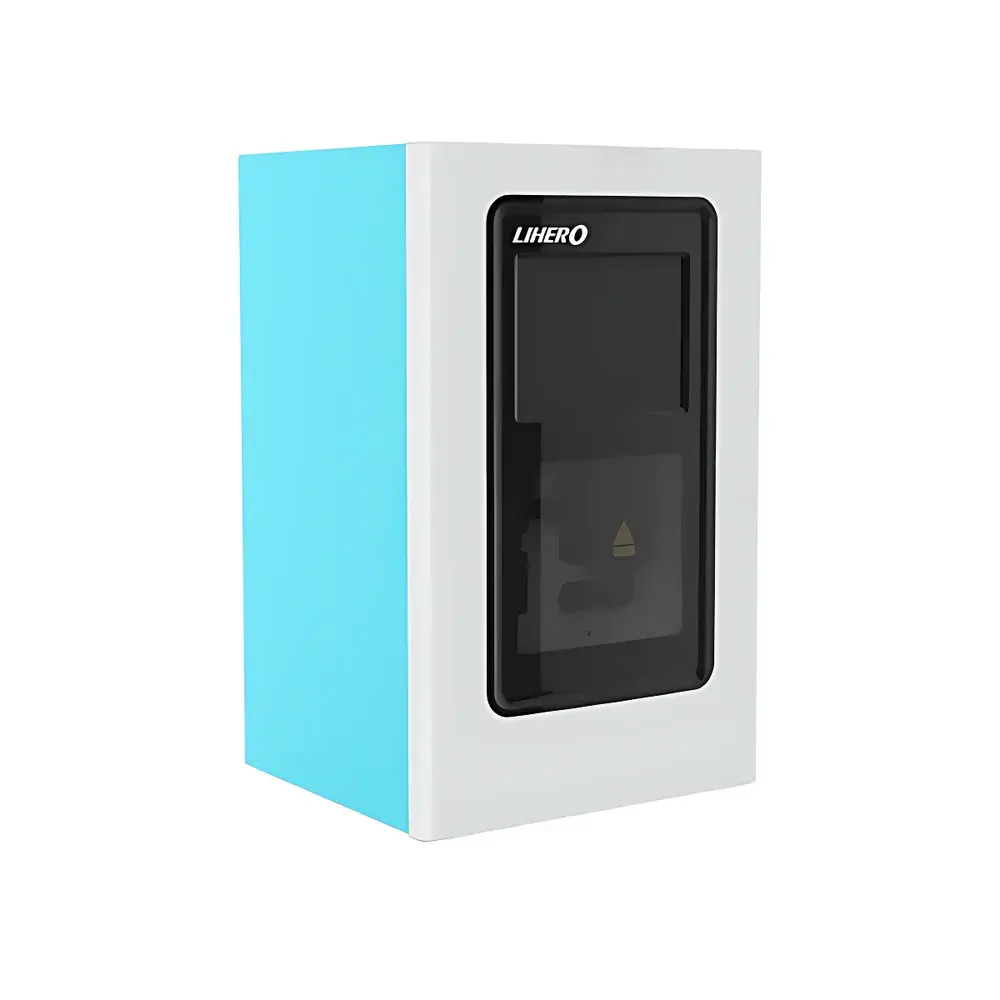
Lihero LFS-2002(NH) Online Ammonia Nitrogen Analyzer
| Brand | Lihero |
|---|---|
| Model | LFS-2002(NH) |
| Measurement Principle | Spectrophotometric Method (Salicylate) |
| Detection Limit | 0.02 mg/L NH₃-N |
| Sample Handling | Online Continuous Monitoring with Optional Steam Distillation Pretreatment |
| Compliance | HJ/T 212–2017 |
| Communication Interface | RS-232 / RS-485 / RJ-45 |
| Power Insulation Resistance | ≥20 MΩ |
| Operating System | Embedded Real-Time OS |
| Auto-Cleaning & Auto-Calibration | Yes |
| Range Switching | Automatic |
| Safety Certification | CE-marked Design per IEC 61010-1 |
Overview
The Lihero LFS-2002(NH) Online Ammonia Nitrogen Analyzer is an industrial-grade, fully automated water quality monitoring instrument engineered for continuous, unattended measurement of ammonia nitrogen (NH₃-N) in surface water, wastewater effluent, drinking water treatment plants, and industrial discharge streams. It implements the standardized salicylate spectrophotometric method—per HJ 535–2009 and ISO 7150-1:1984—where ammonium ions react with salicylate and hypochlorite in the presence of sodium nitroprusside (sodium nitroferricyanide) to form a stable indophenol blue complex. Absorbance is measured at 655 nm using a high-stability LED light source and precision photodetector, enabling quantitative determination across a dynamically adjustable concentration range. The system integrates optical interference compensation algorithms to correct for sample turbidity, color, and matrix effects, ensuring metrological integrity without manual intervention.
Key Features
- Two operational modes: direct colorimetric analysis for low-turbidity samples and steam distillation pretreatment for complex matrices (e.g., high organic load, suspended solids, or chloride interference), enhancing analytical specificity and compliance with regulatory validation requirements.
- Comprehensive quality control architecture: automated zero-point verification, span verification, standard calibration, calibration curve auto-generation, spike recovery testing, and reagent blank assessment—all executed on configurable schedules and logged with timestamped metadata.
- Intelligent fault diagnostics: real-time monitoring of critical subsystems—including peristaltic pump status, reagent level sensors, heater temperature stability, optical path cleanliness, and flow rate consistency—with event-triggered alerts transmitted via Modbus TCP or serial protocol.
- Self-maintaining operation: scheduled ultrasonic-assisted cleaning of reaction cuvettes and fluidic pathways; automatic optical zero adjustment prior to each measurement cycle; adaptive range switching between low-range (0–2 mg/L) and extended-range (0–20 mg/L) configurations based on historical trend analysis.
- Robust electrical safety design: reinforced insulation between mains input and chassis (≥20 MΩ at 500 VDC), double-insulated power supply, and overcurrent/overvoltage protection aligned with IEC 61010-1 for Class I equipment deployed in wet industrial environments.
Sample Compatibility & Compliance
The LFS-2002(NH) accepts raw water, clarified effluent, or filtered influent with pH 6.0–9.0 and total suspended solids ≤100 mg/L (for direct mode) or ≤500 mg/L (with distillation). It complies with China’s HJ/T 212–2017 data transmission standard for environmental monitoring instruments, supporting bi-directional communication for remote parameter configuration, firmware updates, and alarm acknowledgment. While not certified to US EPA Method 350.1 or ASTM D1426, its analytical methodology is technically equivalent to these reference procedures and suitable for use in facilities operating under GB/T 32203–2015 (Water Quality Monitoring System Requirements) and ISO/IEC 17025–2017–accredited laboratories performing routine surveillance.
Software & Data Management
The embedded Linux-based controller runs deterministic real-time firmware with non-volatile storage for ≥12 months of second-resolution measurement logs, QC records, maintenance events, and diagnostic snapshots. Data export supports CSV and XML formats via FTP, HTTP POST, or local USB mass storage. Audit trails record all user-initiated actions—including calibration edits, range changes, and alarm acknowledgments—with immutable timestamps and operator ID binding. The system satisfies foundational requirements for GLP-compliant operations, including electronic signature readiness and configurable data retention policies. Remote access is enabled through secure SSH or TLS-encrypted web interface (HTTPS), with role-based permissions (admin/operator/viewer) enforced at the application layer.
Applications
- Real-time compliance monitoring at municipal wastewater treatment plant outfalls subject to discharge permits (e.g., China’s GB 18918–2002 Tier I limits).
- Process control in biological nutrient removal (BNR) systems, where rapid NH₃-N feedback informs aeration basin DO setpoints and return activated sludge (RAS) rates.
- Early-warning detection in source water intakes for drinking water utilities, particularly during algal bloom events or agricultural runoff episodes.
- Industrial pretreatment verification for electroplating, semiconductor fabrication, and food processing facilities discharging to centralized sewers.
- Long-term trend analysis in ecological monitoring networks, integrated with SCADA platforms via Modbus RTU/TCP or OPC UA gateways.
FAQ
What is the minimum detectable concentration for ammonia nitrogen using this analyzer?
The instrument achieves a method detection limit (MDL) of 0.02 mg/L NH₃-N under optimized conditions, verified per HJ 168–2020 guidelines using replicate spiked samples and standard deviation calculation.
Does the system support integration with third-party SCADA or DCS platforms?
Yes—it provides native Modbus RTU (RS-485), Modbus TCP (Ethernet), and ASCII-based serial protocols compliant with HJ/T 212–2017, enabling seamless interoperability with Siemens Desigo, Honeywell Experion, or ABB 800xA systems.
How frequently does the analyzer perform automatic calibration?
Zero and span calibrations are user-scheduled (e.g., daily, weekly) or triggered by concentration drift thresholds; full multi-point curve regeneration occurs automatically after reagent batch replacement or upon operator command.
Is distilled water required for operation?
Yes—distilled or deionized water (conductivity ≤1 µS/cm) is mandatory for both dilution and steam distillation stages to prevent background interference and ensure reagent stability.
Can the instrument operate continuously without on-site technician intervention?
Designed for unattended deployment, it supports ≥30 days of operation between reagent refills (standard configuration) and includes predictive maintenance alerts for consumables such as tubing, filters, and distillation cartridges.







