
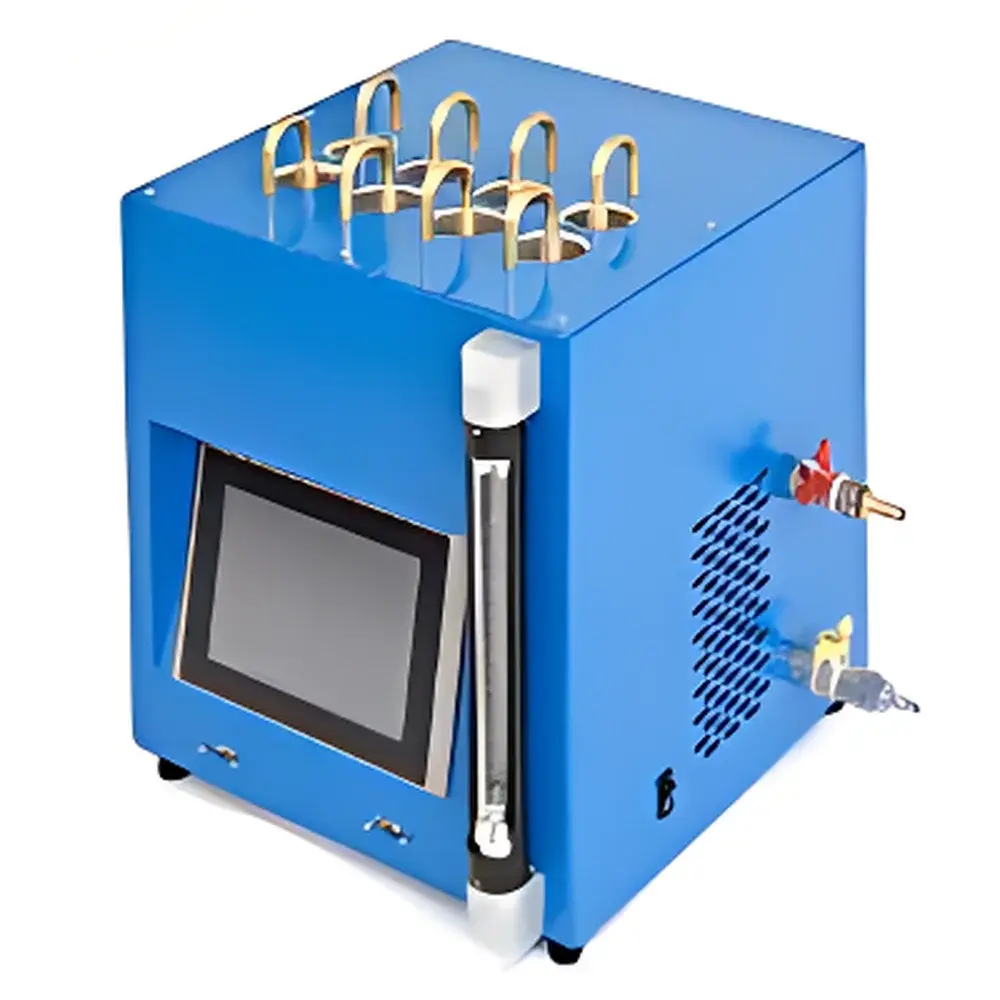
Linetechnic 560 Automated Gasoline Actual Gum Analyzer (Air–Steam Jet Method)
| Brand | Linetechnic |
|---|---|
| Origin | Switzerland |
| Model | 560 |
| Power Consumption | 2300 W |
| Compliance | ASTM D381, IP 131, DIN 51784 |
| Heating Block | 8-position aluminum block with steam outlet |
| Temperature Range | Ambient to 300 °C (adjustable in 1 °C increments, stability ±0.5 °C) |
| Air Flow Control | 0–12 m³/h (high-precision mass flow meter) |
| Steam Pressure Control | 0–6 psi (stainless steel pressure gauge) |
| Heating System | Four 575 W heaters (total 2300 W) |
| Safety | Overheat protection, CE-certified, automatic standby mode |
| Interface | Touchscreen LCD with embedded control software |
| Construction | Ceramic-coated stainless steel housing with integrated steam generator and removable stainless steel steam tubing |
Overview
The Linetechnic 560 Automated Gasoline Actual Gum Analyzer is an engineered solution for precise, repeatable determination of actual gum content in gasoline and other light distillate fuels according to standardized air–steam jet evaporation methodology. Based on the fundamental principle of controlled thermal evaporation under defined airflow or steam-assisted conditions, the instrument quantifies non-volatile residue—commonly referred to as “actual gum”—that remains after volatile components are removed from a fixed sample volume under strictly regulated temperature, time, and gas flow parameters. This measurement serves as a critical quality indicator for fuel stability, oxidation resistance, and storage suitability. The 560 model is designed specifically for compliance with ASTM D381 (Standard Test Method for Gum Content in Fuels by Jet Evaporation), IP 131 (Institute of Petroleum), and DIN 51784 (German Institute for Standardization), making it suitable for routine testing in refinery QC laboratories, independent fuel testing facilities, and regulatory compliance centers operating under GLP or ISO/IEC 17025 frameworks.
Key Features
- Full automation with intuitive touchscreen interface and embedded microprocessor-based control software—eliminates manual timing, flow adjustment, and temperature monitoring errors.
- Programmable dual-mode operation: selectable air-only jet configuration for standard gasoline testing, or air–steam co-injection mode for enhanced volatility assessment of oxygenated or reformulated fuels.
- Eight-position aluminum heating block with precision-machined wells and integrated steam outlet ports; all steam pathways constructed from corrosion-resistant stainless steel with quick-release couplings.
- Dual-stage heating architecture: four high-power (575 W each) heaters rapidly elevate block temperature from ambient to 240 °C in approximately 8 minutes; once setpoint is reached, two low-power (350 W each) heaters maintain thermal stability with PID feedback via Pt100 RTD sensors (±0.5 °C accuracy).
- High-fidelity fluidic control: calibrated mass flow meter (0–12 m³/h range) for air delivery; stainless steel pressure gauge (0–6 psi) for steam regulation—both digitally monitored and logged in real time.
- CE-marked safety system featuring redundant overtemperature cutoff, automatic standby activation upon test completion, and fail-safe power management to reduce energy consumption without compromising operational readiness.
- Ceramic-coated stainless steel chassis ensures long-term resistance to solvent exposure, thermal cycling fatigue, and laboratory environmental contaminants.
Sample Compatibility & Compliance
The Linetechnic 560 is validated for use with gasoline, motor fuel blends (including ethanol-gasoline mixtures up to E25), and aviation turbine fuels meeting ASTM D1655 specifications. Its design accommodates standard 50 mL Pyrex glass beakers (ASTM D381-compliant geometry) and supports optional accessories including certified reference thermometers (ASTM 3C / IP 73C), analytical balances (0.1 mg readability), and forced-air ovens for post-evaporation residue conditioning. All operational protocols adhere to the procedural requirements of ASTM D381 Sections 7–10, including specified air flow rates (900 ± 90 mL/min), evaporation duration (30 ± 0.5 min), and final drying conditions. Instrument validation documentation—including factory calibration certificates traceable to NIST standards—is provided with each unit. The system supports audit-ready data integrity through timestamped test logs and user-accessible configuration history.
Software & Data Management
The embedded firmware enables fully automated sequence execution, including pre-heating ramping, flow stabilization, timed evaporation, and cooldown phases. All process variables—block temperature, air flow rate, steam pressure, elapsed time, and user ID—are recorded at 1-second intervals and stored internally for ≥1,000 test cycles. Data export is supported via USB port in CSV format for integration into LIMS environments or statistical process control platforms. While the base system does not include 21 CFR Part 11-compliant electronic signatures or audit trail functionality, optional firmware upgrades and external PC-based control modules are available to meet FDA-regulated or pharmaceutical-grade fuel excipient testing requirements. Raw data files retain full metadata (test date/time, operator ID, method version, calibration status) to support ISO/IEC 17025 clause 7.7 traceability mandates.
Applications
- Routine quality control of finished gasoline at refineries and blending terminals.
- Evaluation of antioxidant package efficacy during fuel formulation development.
- Stability assessment of biofuel blends exposed to accelerated aging protocols.
- Third-party verification testing for regulatory submissions (e.g., EPA Tier 3, EU Fuel Quality Directive 98/70/EC).
- Research into deposit formation mechanisms in direct-injection engines using gum residue morphology analysis.
- Supplier qualification programs requiring documented adherence to IP 131 or DIN 51784 test conditions.
FAQ
What standards does the Linetechnic 560 comply with?
ASTM D381, IP 131, and DIN 51784—covering both air-jet and air–steam jet methodologies for actual gum determination in petroleum distillates.
Can the instrument be used for diesel or jet fuel testing?
No—the 560 is optimized for gasoline-range volatility; diesel and aviation turbine fuels require alternative methods (e.g., ASTM D2274 for oxidation stability) and are outside its validated operating envelope.
Is steam generation internal or external?
The 560 includes an integrated stainless steel steam generator with adjustable output and digital pressure regulation; no external boiler is required.
How is temperature uniformity across the 8-position block verified?
Each well is individually monitored via dedicated Pt100 RTD sensors; block homogeneity is validated during factory calibration to ensure ≤±1.0 °C deviation across all positions at 250 °C.
Does the system support multi-user access with role-based permissions?
The standard firmware supports user login but lacks granular permission tiers; advanced access control requires integration with external LIMS or optional enterprise software modules.






