
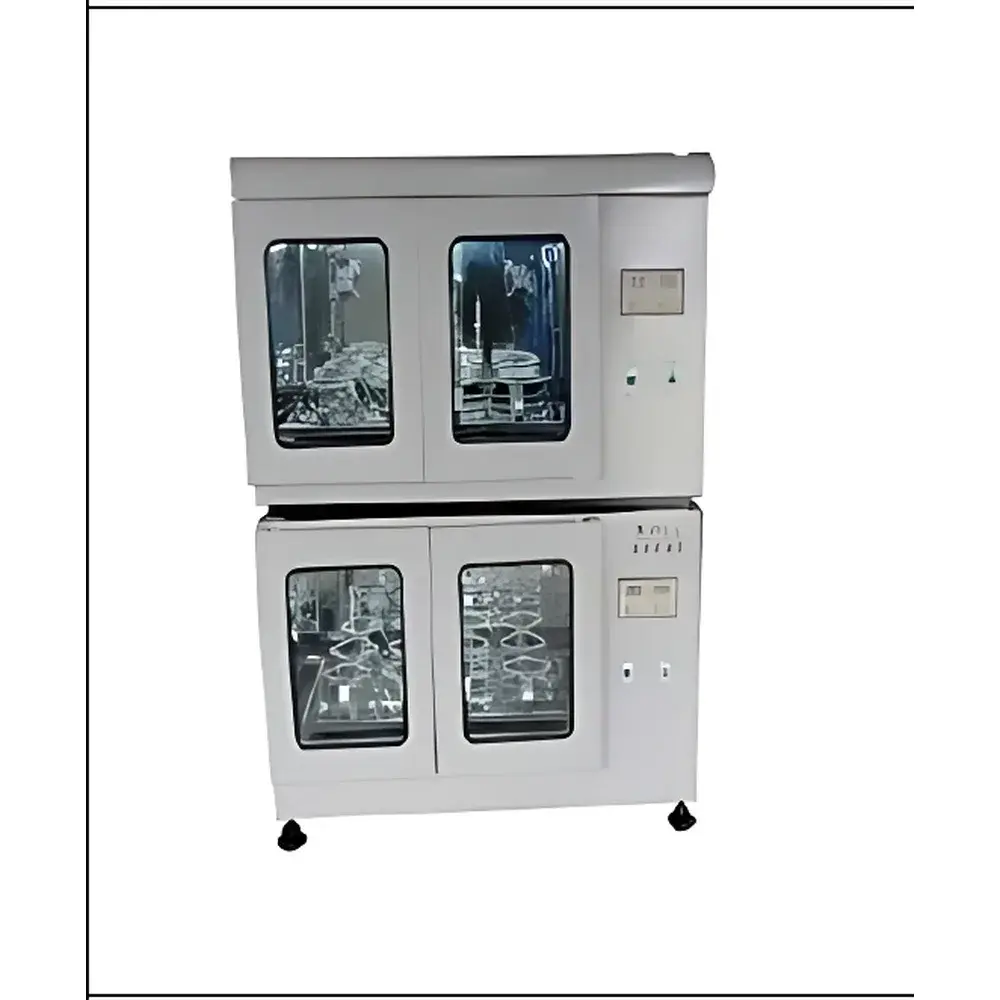
Qile Taicang – HYL-C Dual-Layer Multifunctional Incubator Shaker
| Origin | Jiangsu, China |
|---|---|
| Manufacturer Type | Authorized Distributor |
| Product Origin | Domestic (China) |
| Model | HYL-C Dual-Layer Multifunctional Incubator Shaker |
| Price | USD 7,000 (approx.) |
| Instrument Category | General-Purpose Orbital/Reciprocal Shaker |
| Timer Range | 0–999 min |
| Oscillation Frequency | 40–280 rpm |
| Amplitude Options | 26 mm, 35 mm, or 50 mm (user-selectable per layer) |
| Temperature Control Range | 5–60 °C (ambient 20 °C) |
| Number of Shaking Platforms | 2 |
| Power Supply | 220 V, 50 Hz |
| Total Power Consumption | 3000 W |
| Dimensions (W×D×H) | 1100 × 750 × 1800 mm |
| Platform Capacity | 15 × 1000 mL flasks per layer |
| Construction | Interior—polished stainless steel (mirror-finish) |
| Door Configuration | Dual front-access doors with internal LED illumination |
| Operational Mode | Stackable modular design—layers operate independently with separate temperature and speed control |
Overview
The Qile Taicang HYL-C Dual-Layer Multifunctional Incubator Shaker is an engineered platform for simultaneous, independent cultivation and agitation of biological samples under precisely controlled thermal and mechanical conditions. Based on orbital shaking dynamics, the system employs a balanced eccentric drive mechanism to generate uniform circular motion across two vertically stacked platforms—each equipped with dedicated PID-controlled heating, digital speed regulation, and user-configurable amplitude selection. Designed for high-density laboratory environments, the modular stackable architecture enables spatial efficiency without compromising operational autonomy: each layer maintains isolated temperature zones and independent speed profiles, supporting heterogeneous experimental protocols within a single footprint. The unit operates within a validated thermal range of 5–60 °C (at 20 °C ambient), with stability maintained at ±0.3 °C under steady-state conditions, meeting baseline requirements for microbial growth, cell suspension culture, and enzymatic reaction kinetics studies.
Key Features
- Dual-layer independent control: Separate microprocessor-based controllers manage temperature, speed, and timer functions for each platform—eliminating cross-layer interference and enabling parallel experiments with divergent parameters.
- User-selectable amplitude options (26 mm, 35 mm, 50 mm): Mechanically fixed cam-driven offset allows reproducible shear profile selection, critical for optimizing oxygen transfer in aerobic cultures or minimizing shear stress in sensitive mammalian cell lines.
- High-capacity platform design: Each layer accommodates up to fifteen 1000 mL Erlenmeyer flasks or equivalent vessel configurations, supporting scalable bioprocess development from screening to pilot-scale inoculum preparation.
- Robust chamber construction: Interior chamber lined with electropolished stainless steel (AISI 304) ensures corrosion resistance, ease of decontamination, and compliance with basic GLP cleaning validation requirements; exterior housing utilizes cold-rolled steel with industrial-grade epoxy-polyester powder coating for long-term durability.
- Integrated safety architecture: Over-temperature cutoff, motor overload protection, door-open interlock, and real-time fault diagnostics are embedded in firmware—supporting audit-ready operation in regulated academic and contract research settings.
- Modular disassembly capability: Units can be physically separated into standalone single-layer shakers without tooling, permitting future configuration flexibility or maintenance isolation.
Sample Compatibility & Compliance
The HYL-C accommodates standard microbiological and cell culture vessels—including baffled flasks, serum bottles, multi-well plates (with adapter trays), and custom bioreactor sleeves—across its 26–50 mm amplitude range. Its temperature uniformity (±0.5 °C across platform surface, per ASTM E2207-19 methodology) and speed accuracy (±1 rpm at setpoint) support applications aligned with ISO 20387:2018 (biobanking), USP (cell culture performance qualification), and CLSI M22-A3 (microbial susceptibility testing agitation standards). While not certified for GMP manufacturing, the system’s traceable calibration points, password-protected parameter locking, and non-volatile timer memory facilitate alignment with GLP documentation practices and internal SOP enforcement.
Software & Data Management
The HYL-C operates via an embedded 4.3-inch TFT LCD interface with capacitive touch navigation and multilingual menu support (English, German, Spanish, Chinese). All operational parameters—including real-time temperature/speed traces, elapsed time, and alarm history—are logged internally for up to 30 days (cyclic buffer). Data export is supported via USB 2.0 port (CSV format), enabling integration with LIMS or Excel-based trending analysis. Optional RS-485 Modbus RTU communication allows centralized monitoring in multi-unit lab environments. Though no cloud or FDA 21 CFR Part 11-compliant electronic signature module is included, the system supports manual audit trail generation through timestamped printouts or exported logs—sufficient for academic, teaching, and early-stage R&D workflows.
Applications
- Microbial cultivation (E. coli, yeast, actinomycetes) under varied aeration and thermal regimes
- Suspension cell line expansion (CHO, HEK293, insect cells) with amplitude-tuned shear management
- Enzyme assay optimization requiring precise kinetic agitation control
- Biochemical oxygen demand (BOD) and wastewater treatment simulation studies
- Antibiotic susceptibility testing (AST) per CLSI guidelines using standardized flask agitation
- Media preparation and reagent homogenization across dual thermal zones
FAQ
Can both layers operate at different temperatures simultaneously?
Yes—the HYL-C features two independent PID temperature control circuits, allowing Layer A and Layer B to maintain distinct setpoints within the 5–60 °C range without thermal crosstalk.
Is amplitude adjustable during operation?
No—amplitude is selected at installation via mechanical cam positioning and must be configured prior to startup; it is not dynamically variable during runtime.
What is the maximum load capacity per platform?
Each platform supports up to 15 × 1000 mL flasks (total mass ≤ 25 kg), provided vessel distribution maintains center-of-gravity balance within ±15 mm of platform center.
Does the unit include validation documentation?
Factory calibration certificates for temperature and speed sensors are provided; IQ/OQ protocol templates are available upon request for customer-led qualification under ISO/IEC 17025-aligned procedures.
Is remote monitoring supported?
Basic remote status interrogation (on/off, setpoint, current reading) is possible via optional RS-485 gateway; full SCADA integration requires third-party middleware and is not natively supported.





