
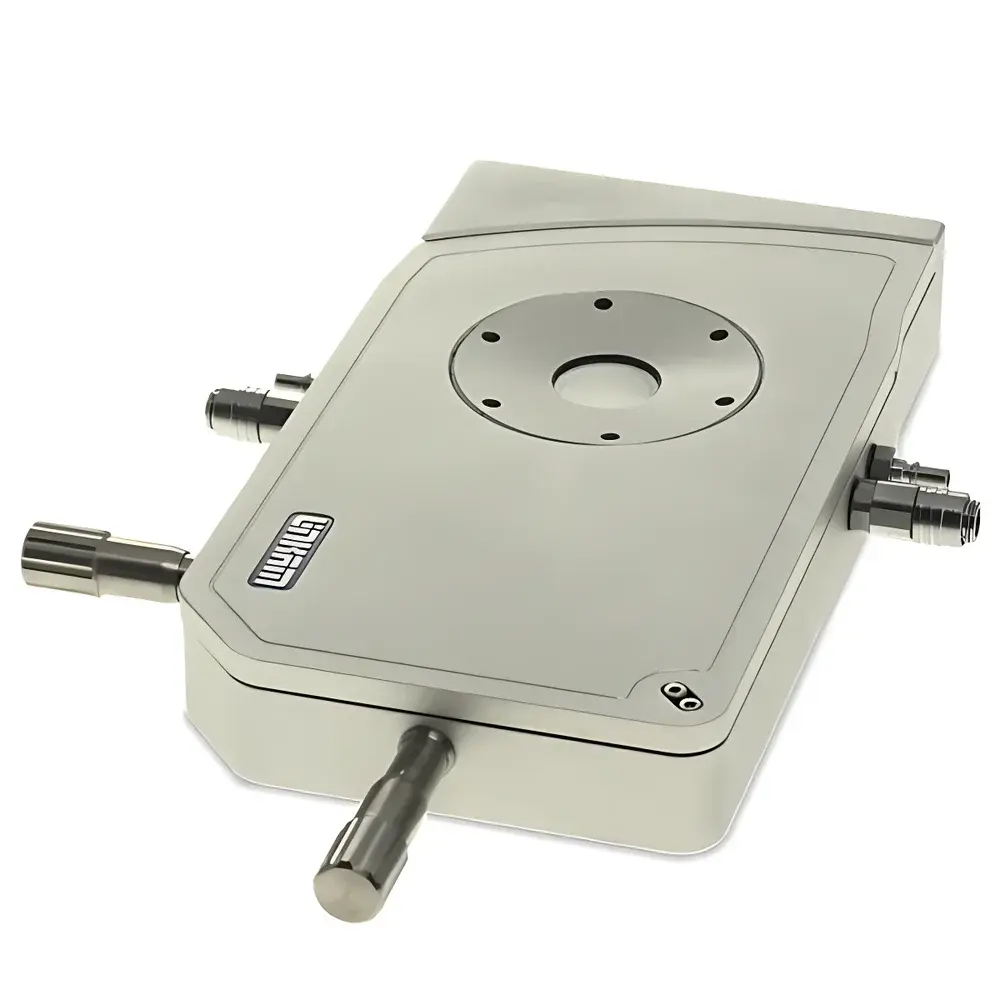
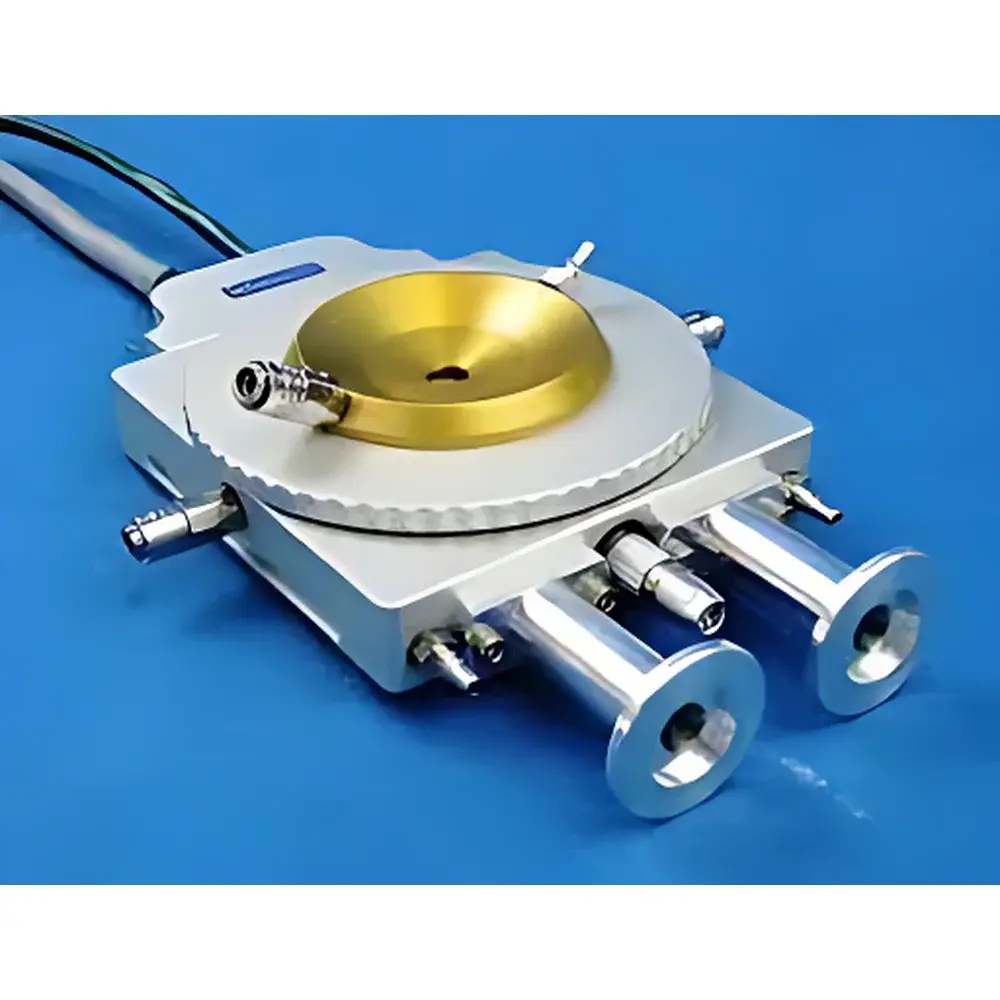
Linkam LTS420 Large-Area Heating and Cooling Stage for Optical Microscopy
| Brand | Linkam |
|---|---|
| Origin | United Kingdom |
| Model | LTS420 |
| Temperature Range | −196 °C to +420 °C (liquid nitrogen required for sub-ambient operation) |
| Stage Dimensions | 160 × 80 × 24 mm |
| Sample Area | 53.5 × 43 mm |
| X–Y Translation Range | 15 × 15 mm |
| Standard Slide Holder | 76 × 26 mm |
| Optical Aperture | 2.5 mm diameter |
| Temperature Stability | < ±0.1 °C at isothermal conditions |
| Heating/Cooling Rate | 0.1–50 °C/min (controller-dependent) |
| Sensor | 100 Ω Platinum RTD |
| Environmental Control | Sealed chamber with gas inlet/outlet valves (inert atmosphere or humidity control) |
| Optical Configuration | Compatible with transmitted and reflected light microscopy |
| Electrode Integration | Optional internal electrodes for electric field application or signal measurement (LCD cell-ready configuration) |
Overview
The Linkam LTS420 Large-Area Heating and Cooling Stage is a precision-engineered thermal stage designed specifically for integration with upright optical and metallurgical microscopes. It operates on the principle of resistive heating and cryogenic cooling—utilizing a polished, high-thermal-conductivity heating element in direct contact with standard microscope slides—to enable stable, uniform temperature control across a wide operational range (−196 °C to +420 °C). Its large sample area (53.5 × 43 mm) and fine mechanical translation (±15 mm in both X and Y axes) support extended observation fields and precise sample repositioning without stage removal. The stage features a minimal 2.5 mm optical aperture to reduce radial thermal gradients across the specimen while maintaining compatibility with both brightfield and darkfield illumination paths. Designed originally for liquid crystal phase transition studies, the LTS420 accommodates optional internal electrode configurations for in situ electric field application or dielectric response measurement—making it suitable for functional materials characterization under controlled thermal and environmental conditions.
Key Features
- Wide temperature range spanning cryogenic (liquid nitrogen-cooled) to high-temperature regimes, with independent controller enabling programmable ramp rates from 0.1 to 50 °C/min
- High thermal stability (< ±0.1 °C) at isothermal setpoints, achieved via 100 Ω platinum resistance thermometer feedback and optimized thermal mass distribution
- Airtight sample chamber with dual gas ports for purging with inert gases (e.g., N₂, Ar) or controlled humidity environments—critical for oxidation-sensitive or hygroscopic samples
- Top-sliding transparent cover facilitating rapid sample loading while preserving optical access for both transmission and reflection microscopy modes
- Compact footprint (160 × 80 × 24 mm) and low-profile design ensuring mechanical compatibility with most upright metallurgical and polarized light microscopes
- Standard slide holder accommodating 76 × 26 mm glass substrates; compatible with industry-standard 25 × 75 mm and 26 × 76 mm microscope slides
Sample Compatibility & Compliance
The LTS420 supports a broad spectrum of solid-state and thin-film specimens—including metallic alloys, semiconductor wafers, polymer films, liquid crystal cells, and mineral sections—without requiring custom mounting fixtures. Its sealed chamber enables ASTM E2070-compliant thermal analysis of moisture-sensitive materials and ISO 11357-series dynamic thermal testing protocols when coupled with calibrated imaging systems. The stage’s construction adheres to CE marking requirements for laboratory equipment (2014/30/EU EMC Directive and 2014/35/EU Low Voltage Directive), and its temperature sensor traceability aligns with ISO/IEC 17025 calibration standards when used with accredited reference thermometers. For regulated environments, the optional LTS-E420 variant (with integrated electrodes) supports GLP-compliant electrical biasing experiments under documented thermal profiles.
Software & Data Management
The LTS420 operates with Linkam’s TC125 temperature controller, which provides real-time temperature logging, multi-segment ramp/soak programming, and synchronized time–temperature curve export in CSV format. When interfaced via RS232 or USB, the system integrates with third-party acquisition software (e.g., NIS-Elements, ZEN, or MATLAB-based image analysis platforms) for correlated thermal–optical data capture. Audit trails—including operator ID, timestamped setpoint changes, and thermal deviation alerts—are recordable for 21 CFR Part 11–compliant workflows when paired with validated electronic lab notebook (ELN) systems. No proprietary image analysis suite is bundled; however, the stage’s mechanical repeatability and thermal fidelity ensure high inter-laboratory reproducibility for quantitative morphological assessments.
Applications
- Phase transition analysis of liquid crystals, polymers, and pharmaceutical hydrates using polarized light microscopy
- In situ metallurgical grain growth and recrystallization studies during controlled heating cycles
- Thermal expansion coefficient measurement of thin-film coatings via digital image correlation (DIC)
- Oxidation kinetics of high-temperature alloys under inert or reactive gas atmospheres
- Dielectric spectroscopy of electroactive materials under simultaneous thermal and electric field stress
- Crystallization behavior of amorphous metals and bulk metallic glasses observed via time-resolved brightfield imaging
FAQ
What cooling method is required to reach −196 °C?
Liquid nitrogen delivery via an external cryogenic transfer line is mandatory; the stage does not include an integrated cryocooler.
Is the LTS420 compatible with motorized microscope stages?
Yes—the manual X–Y translation mechanism is mechanically decoupled from the thermal core, allowing retrofit integration with motorized base stages when space and load capacity permit.
Can humidity be actively controlled inside the chamber?
The stage supports passive humidity equilibration using pre-conditioned gas streams; active humidity control requires external vapor generator integration via the standard gas inlet port.
Does the stage meet vacuum compatibility requirements?
No—the LTS420 is rated for atmospheric and positive-pressure inert gas operation only; it is not designed for vacuum service.
What is the maximum recommended load weight on the stage surface?
The specified mechanical load limit is 200 g distributed evenly across the central 40 × 30 mm region to preserve thermal uniformity and sensor accuracy.





