
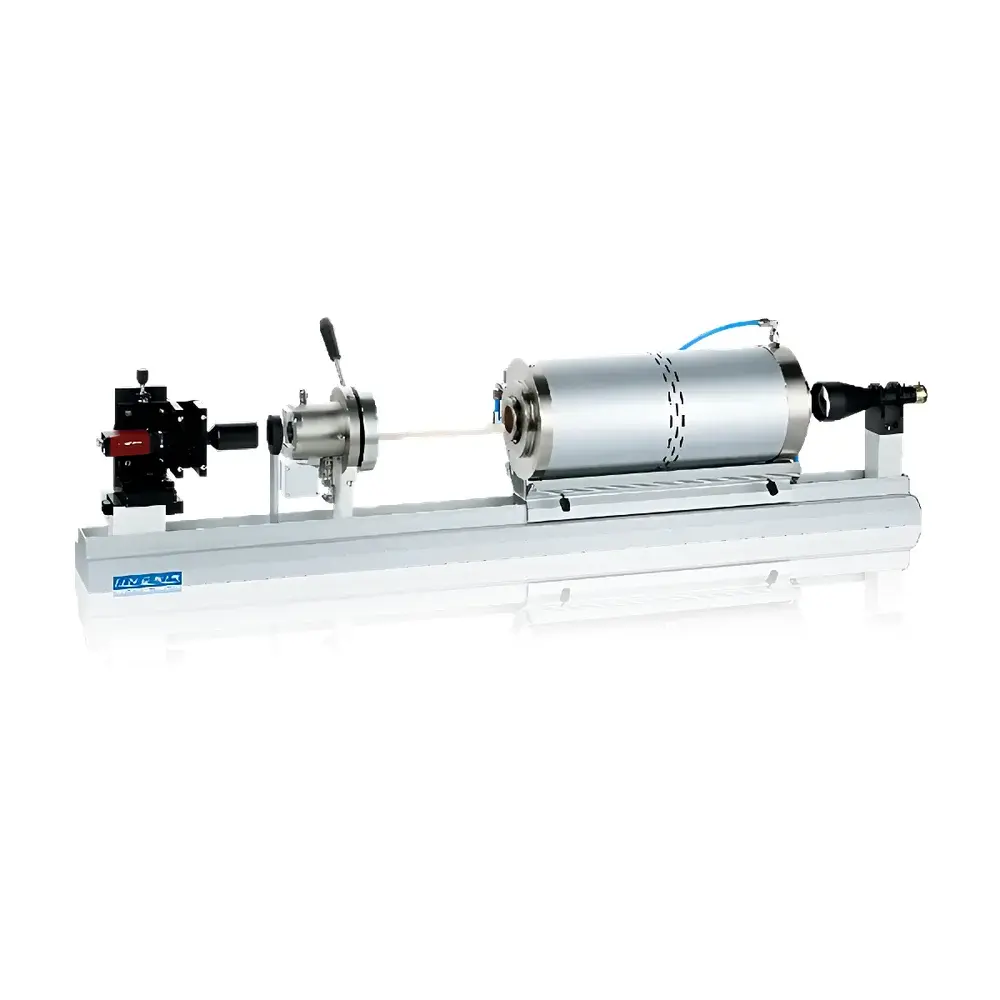
LINSEIS DIL L74 HM High-Temperature Heating Microscope
| Brand | LINSEIS |
|---|---|
| Origin | Germany |
| Model | DIL L74 HM |
| Temperature Range | –100 °C to 500 °C (RT–500 / 1000 / 1500 / 2000 °C) |
| Heating Rate | 0.01–100 °C/min (dependent on furnace configuration) |
| Field of View | 10 × 14 mm² |
| Measurement Resolution | up to 1 µm |
| Atmosphere Options | inert, reducing, oxidizing, vacuum (optional) |
| Vacuum Level | 10⁻⁵ mbar |
| Compliance Standards | DIN 51730, ISO 540, CEN/TS 15404, ASTM D1857, BS 1016-15, CEN/TS 15370-1, IS 12891, NF M03-048 |
Overview
The LINSEIS DIL L74 HM High-Temperature Heating Microscope is a precision laboratory instrument engineered for real-time thermal-optical characterization of solid and molten materials under controlled atmospheric and thermal conditions. It integrates optical dilatometry with high-resolution digital microscopy, enabling non-contact, in-situ observation and quantitative morphometric analysis across a broad temperature range—from cryogenic (–100 °C) to ultra-high temperatures (up to 2000 °C). Unlike conventional dilatometers relying solely on mechanical or capacitive displacement sensors, the DIL L74 HM employs a calibrated optical imaging system to track dimensional changes, surface topology evolution, and interfacial phenomena—including sintering kinetics, softening behavior, wetting dynamics, and contact angle formation—without physical contact or sample perturbation. The system’s hermetically sealed, vacuum-capable chamber (down to 10⁻⁵ mbar) supports precise atmosphere control (inert Ar/N₂, reducing H₂/N₂, oxidizing air/O₂), making it suitable for applications governed by thermodynamic stability, redox-sensitive phase transitions, or volatile-species evolution.
Key Features
- Optical non-contact measurement principle eliminating mechanical drift and probe interference
- High-resolution color CMOS camera system delivering spatial resolution down to 1 µm over a 10 × 14 mm² field of view
- Modular furnace configurations supporting multiple maximum operating temperatures: 500 °C, 1000 °C, 1500 °C, and 2000 °C
- Programmable heating/cooling rates from 0.01 to 100 °C/min, optimized per furnace type and thermal mass
- Polarized illumination module enhancing contrast for transparent, reflective, or low-contrast samples (e.g., glasses, oxides, slags)
- Integrated vacuum system with turbomolecular pumping capability (base pressure ≤10⁻⁵ mbar)
- Automated event-triggered furnace control synchronized with image capture and analysis routines
Sample Compatibility & Compliance
The DIL L74 HM accommodates diverse sample geometries—including powders, pressed pellets, rods, thin films, and irregular ash residues—without requiring mounting fixtures that may introduce thermal artifacts. Its compatibility extends to refractory ceramics, metallurgical slags, coal and biomass ashes, dental porcelains, solder pastes, fluxes, and oxide-based composites. All automated morphometric evaluations—including height, width, aspect ratio, circularity, projected area, and contact angle—are traceable to internationally recognized standard test methods. Software algorithms for characteristic temperature determination (softening, hemispherical, spherical, and flow temperatures) are validated against DIN 51730, ISO 540, and CEN/TS 15404. The system architecture supports audit-ready data logging aligned with GLP and GMP requirements; raw video streams, timestamped metadata, and parameter logs are stored in vendor-neutral formats (AVI, TIFF, CSV) with full version-controlled calibration records.
Software & Data Management
The proprietary ThermoSoft® platform provides unified control of thermal profiling, image acquisition, and quantitative analysis. Image sequences are processed using edge-detection and contour-fitting algorithms to extract geometric parameters frame-by-frame. Contact angles are determined via tangent-based droplet profile analysis, with optional baseline correction for curved substrates. Temperature-dependent contact angle curves are generated automatically across user-defined thermal segments. The software includes built-in reporting templates compliant with ASTM D1857 (coal ash fusibility) and CEN/TS 15370-1 (biomass ash behavior), exportable as PDF or Excel. All operations—including method creation, calibration application, and result annotation—are logged with operator ID, timestamp, and instrument state. Optional 21 CFR Part 11 compliance packages provide electronic signature support, audit trail integrity, and role-based access control.
Applications
The DIL L74 HM serves critical roles in materials development, quality assurance, and regulatory testing. In energy research, it characterizes coal and biomass ash fusibility for boiler slagging prediction. In metallurgy, it evaluates flux–slag–metal interfacial interactions during smelting and refining. Ceramic engineers use it to optimize sintering schedules for technical ceramics and dental prosthetics by correlating shrinkage onset with grain boundary mobility. Glass scientists assess devitrification thresholds and thermal expansion anomalies. In electronics manufacturing, it quantifies solder paste collapse behavior and wetting kinetics on printed circuit board substrates. Additional use cases include refractory material qualification under simulated service atmospheres, catalyst support thermal stability screening, and high-temperature sealant performance evaluation.
FAQ
What temperature ranges are supported, and how is furnace selection determined?
The DIL L74 HM offers four furnace options: RT–500 °C, RT–1000 °C, RT–1500 °C, and RT–2000 °C. Selection depends on sample composition, expected phase transitions, and required atmosphere compatibility (e.g., graphite furnaces for >1500 °C require inert/vacuum environments).
Can the system perform simultaneous dilatometric and optical measurements?
Yes—the optical measurement subsystem operates independently of mechanical transducers, enabling true parallel acquisition of dimensional change (via pixel-scale tracking) and visual microstructural evolution.
Is vacuum operation mandatory for inert gas experiments?
No; vacuum pre-purge is recommended before introducing reactive gases (e.g., H₂), but inert purging at atmospheric pressure is fully supported and commonly used for routine ash fusibility tests.
How is contact angle accuracy ensured across temperature gradients?
The system uses sub-pixel edge localization combined with real-time thermal drift compensation derived from fiducial markers embedded in the sample stage, achieving reproducible contact angle uncertainty <±1.5° over 0–1200 °C.
Does the software support custom analysis protocols beyond standard ash fusibility?
Yes—ThermoSoft® allows scripting of user-defined morphometric parameters, conditional triggers (e.g., “start cooling when contact angle drops below 30°”), and integration with external data sources via COM/ActiveX interfaces.



