
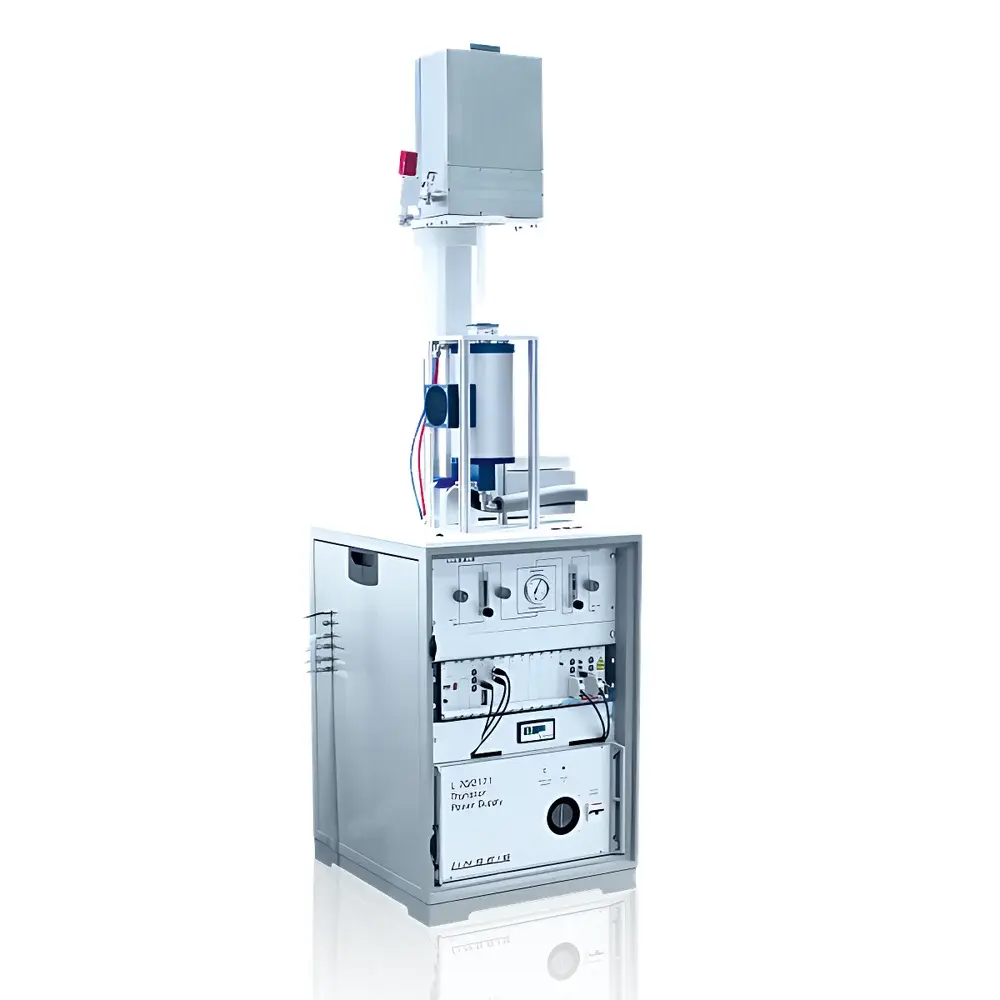
LINSEIS DIL L75 Laser Dilatometer
| Brand | LINSEIS |
|---|---|
| Origin | Germany |
| Model | DIL L75 Laser |
| Temperature Range | −180–500 °C |
| Heating/Cooling Rate | 0.01–50 K/min |
| Sample Length | up to 20 mm |
| Sample Diameter | up to φ7 mm |
| Measurement Resolution | 0.3 nm |
| Atmosphere Options | inert, oxidizing, reducing, vacuum |
Overview
The LINSEIS DIL L75 Laser Dilatometer is a high-precision, non-contact thermal expansion measurement system engineered for metrological-grade dimensional stability analysis across wide temperature domains. It operates on the principle of Michelson interferometry—where a stabilized He–Ne laser beam is split into reference and measurement paths, with the latter reflected from the sample surface. Displacement-induced phase shifts in the recombined beam are resolved with sub-nanometer sensitivity, delivering absolute linear expansion data without mechanical contact, thermal lag, or probe compliance artifacts. Unlike conventional push-rod dilatometers reliant on physical transducers and calibration-dependent offset corrections, the DIL L75 Laser provides traceable, drift-free length change quantification directly in nanometers. Its dual-range furnace configuration supports both cryogenic (−180 °C) and high-temperature (up to 1000 °C) operation, enabling seamless characterization of coefficient of linear expansion (CTE), sintering behavior, phase transition temperatures, and glass transition points across ceramics, metals, composites, semiconductors, and advanced functional materials.
Key Features
- Sub-nanometer resolution (0.3 nm) enabled by stabilized He–Ne laser interferometry — 33× higher than conventional push-rod systems
- Non-contact measurement eliminates mechanical loading, thermal conduction errors, and probe wear
- Dual-zone furnace architecture supporting two independent temperature regimes: low-temperature mode (−180 °C to 500 °C) and high-temperature mode (RT to 1000 °C)
- Programmable heating/cooling rates from 0.01 K/min to 50 K/min with <±0.1 K accuracy over full range
- Universal sample compatibility: no surface metallization or geometry constraints required; works with reflective and non-reflective surfaces alike
- Modular atmosphere control system accommodating inert (Ar, N₂), oxidizing (air, O₂), reducing (H₂/N₂ mixtures), and high-vacuum (<10⁻³ mbar) environments
- Fused silica sample holders ensure minimal thermal expansion contribution and chemical inertness
Sample Compatibility & Compliance
The DIL L75 Laser accommodates cylindrical samples up to 20 mm in length and 7 mm in diameter, with no requirement for end-face polishing or coating. Its optical design tolerates surface roughness, porosity, and moderate absorption — validated for graphite, borosilicate glass, SiC composites, Invar alloys, GaN wafers, and polymer-derived ceramics. All hardware and software modules comply with ISO/IEC 17025 requirements for testing laboratories, and the system supports GLP/GMP-aligned audit trails when configured with optional 21 CFR Part 11-compliant software licensing. Data acquisition adheres to ASTM E228, ISO 11359-2, and DIN 51045 standards for linear thermal expansion measurement.
Software & Data Management
The integrated ThermoSoft™ platform provides real-time interferometric signal visualization, automated baseline correction, CTE derivation via numerical differentiation, and multi-run statistical comparison (e.g., repeatability assessment per ASTM E831). Raw displacement vs. temperature datasets are exported in ASCII and HDF5 formats, compatible with MATLAB, Python (NumPy/Pandas), and third-party analytics tools. The software includes customizable report templates conforming to internal QA protocols or external regulatory submissions. Optional modules enable remote monitoring via Ethernet, scheduled unattended runs, and integration into centralized LIMS environments through OPC UA interfaces.
Applications
- Quantification of ultra-low CTE in Invar-type Fe–Ni alloys and Zerodur®-class glasses
- Sintering kinetics and densification onset detection in powder metallurgy and ceramic green bodies
- Thermal mismatch analysis at metal–ceramic and semiconductor–substrate interfaces
- Reversible/irreversible expansion hysteresis in shape-memory alloys (NiTi, CuAlBe)
- Moisture-induced swelling and desorption shrinkage in hygroscopic polymers and MOFs
- Phase transformation mapping (e.g., martensitic, perovskite, quartz ↔ cristobalite) via inflection point analysis
FAQ
Does the DIL L75 Laser require sample surface metallization or polishing?
No — the interferometric detection system functions reliably on as-received, matte, oxidized, or porous surfaces without surface preparation.
Can the instrument measure expansion under controlled partial pressures of reactive gases?
Yes — the gas handling module supports programmable flow control and pressure regulation down to 10⁻² mbar, enabling studies in diluted H₂, CO, or steam atmospheres.
Is calibration traceable to national metrology institutes?
Yes — factory calibration uses NIST-traceable interferometric standards; users may perform in-situ verification using certified fused silica reference rods.
How is thermal lag minimized during rapid heating cycles?
The compact furnace geometry, low-mass sample holder, and direct optical readout eliminate thermal inertia-related delays inherent in rod-coupled transducers.
What level of measurement repeatability is achievable for Invar alloys below 250 °C?
Typical run-to-run deviation is ≤0.01% strain over four consecutive measurements — validated against ASTM E228 interlaboratory precision criteria.



