
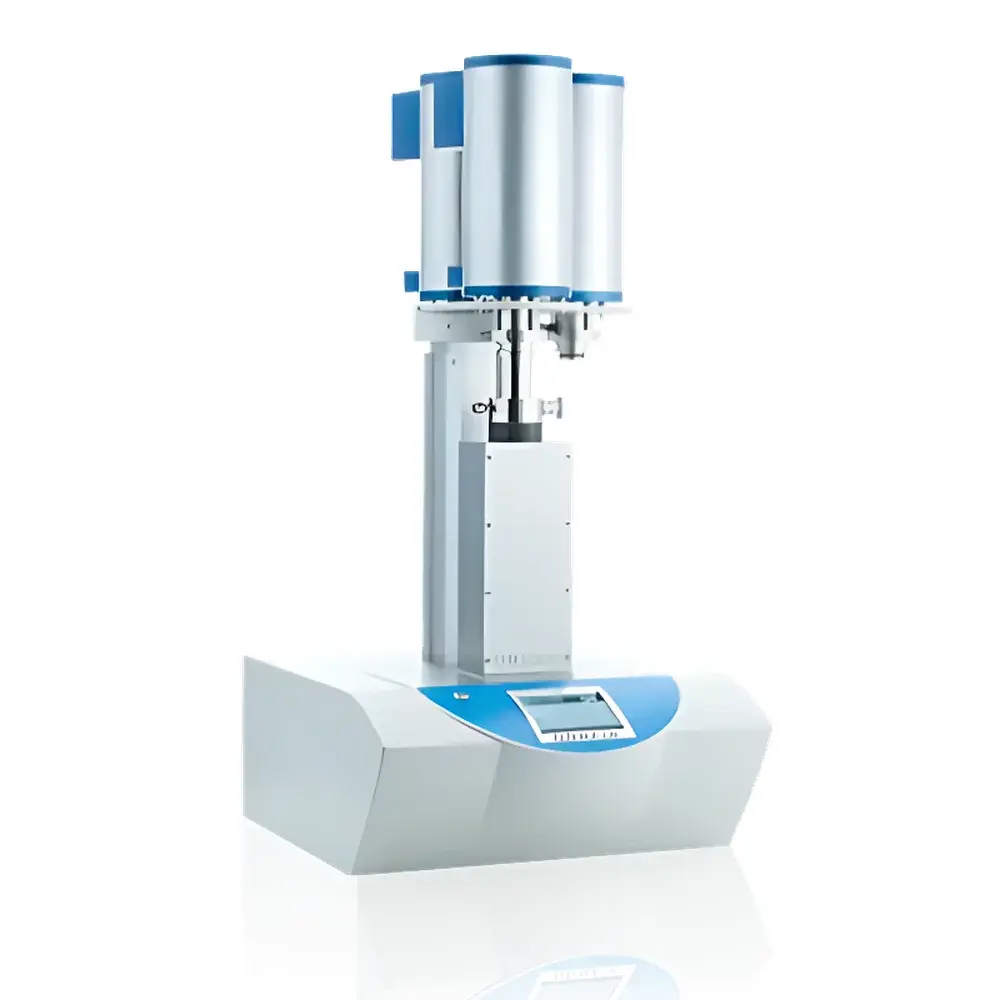
LINSEIS DIL L75 Quattro Quadruple-Sensor Thermal Dilatometer
| Brand | LINSEIS |
|---|---|
| Origin | Germany |
| Model | DIL L75 Quattro |
| Temperature Range | −180 to 500/700/1000 °C |
| Heating/Cooling Rate | 0.01–50 K/min (dependent on furnace configuration) |
| Sample Length | ≤50 mm |
| Sample Diameter | ≤7 mm |
| Measurement Range | 500 / 5000 µm |
| Resolution | 1.25 nm |
| Atmosphere | Inert, oxidizing, reducing, vacuum (static/dynamic) |
| Furnace Options | Multi-furnace modular system |
| Sensor Architecture | Four independent high-precision linear variable differential transformers (LVDTs) |
| Zero-Point Calibration | Fully automated per channel |
| Interface | Integrated electronics with USB connectivity |
Overview
The LINSEIS DIL L75 Quattro is a high-throughput, quadruple-sensor thermal dilatometer engineered for precise, reproducible measurement of linear dimensional changes in solid materials under controlled thermal programs and defined atmospheres. Based on the fundamental principle of contact-based dilatometry—where a calibrated LVDT transducer detects minute axial displacements of a sample rod resting on a fixed reference base—the instrument quantifies thermal expansion or contraction coefficients (CTE), sintering kinetics, phase transition temperatures, and densification behavior. Unlike conventional single- or dual-sensor dilatometers, the L75 Quattro integrates four fully independent measurement channels within a single platform, enabling concurrent analysis of up to four samples—or three samples referenced against one certified standard—without cross-channel interference. This architecture significantly enhances laboratory throughput while maintaining traceable metrological integrity across all channels. The system supports ultra-low temperature operation down to −180 °C (with cryogenic accessory) and extends to extreme high temperatures up to 2800 °C (with graphite or specialized refractory furnace), making it suitable for R&D and quality control in advanced ceramics, aerospace alloys, nuclear materials, and next-generation battery components.
Key Features
- Quadruple-sensor configuration: Four isolated LVDT transducers with individual signal conditioning, enabling simultaneous, non-interfering measurements on up to four samples.
- Multi-furnace modularity: Interchangeable furnace modules (quartz, alumina, graphite, molybdenum, tungsten) allow rapid transition between temperature regimes—e.g., loading new samples into a second furnace while the first cools—minimizing instrument downtime.
- Automated zero-point calibration: Proprietary signal amplifier performs real-time, per-channel auto-zeroing prior to each run, compensating for thermal drift and mechanical relaxation effects.
- Manual push-rod speed release: Tool-free, tactile activation enables instantaneous disengagement of all four push-rods for fast, repeatable sample exchange without recalibration.
- Motorized vertical furnace lift: Precision-guided elevation mechanism ensures consistent probe-sample contact force and eliminates manual alignment errors.
- Integrated environmental control: Dual-gas mass flow controllers support dynamic or static atmosphere management—including inert (Ar, N₂), oxidizing (air, O₂), reducing (H₂/N₂, CO), and high-vacuum (<10⁻⁴ mbar) conditions—with full pressure logging and safety interlocks.
Sample Compatibility & Compliance
The DIL L75 Quattro accommodates cylindrical specimens up to 50 mm in length and 7 mm in diameter, compatible with standard crucible geometries and reference standards traceable to NIST or PTB. Sample holders include fused silica (≤1000 °C), high-purity alumina (≤1750 °C), and high-density graphite (≤2800 °C). All furnace and sensor assemblies comply with IEC 61000-6-3 (EMC) and IEC 61010-1 (safety). Data acquisition and reporting support audit-ready compliance with GLP, GMP, and FDA 21 CFR Part 11 requirements when configured with optional electronic signature and audit trail modules. Method validation protocols align with ASTM E228, ISO 11359-1/-2, and DIN 51045 for coefficient of linear expansion determination.
Software & Data Management
Control and analysis are performed via LINSEIS ThermoSoft™ v5.x—a Windows-based platform supporting multi-user role management, method templating, and real-time visualization of displacement, temperature, and atmosphere parameters. The software includes advanced sintering analysis tools such as Rate-Controlled Sintering (RCS) mode, which implements Palmour III theory to dynamically adjust heating rates based on real-time densification feedback—enabling closed-loop optimization of ceramic green-body consolidation toward theoretical density. Raw data are stored in vendor-neutral HDF5 format with embedded metadata (time stamps, furnace ID, gas composition, operator ID), ensuring long-term archival integrity and third-party interoperability. Export options include CSV, Excel, and XML for integration into LIMS or statistical process control (SPC) systems.
Applications
The L75 Quattro delivers critical insights across materials science domains: characterization of CTE mismatch in metal-ceramic seals for SOFC stacks; monitoring glass transition and softening points in optical glasses; quantifying anisotropic expansion in textured polycrystals; evaluating thermal stability of polymer composites under fire-test conditions; and optimizing sintering cycles for zirconia, silicon carbide, and tungsten heavy alloys. Its high-resolution (1.25 nm) displacement detection and sub-millikelvin thermal stability make it particularly valuable for low-expansion material development (e.g., Zerodur®, ULE®) and qualification of additively manufactured nickel superalloys where residual stress evolution must be correlated with thermal history.
FAQ
What is the maximum allowable sample mass for the DIL L75 Quattro?
The instrument does not specify a strict mass limit; however, mechanical stability and thermal equilibration time are optimized for samples weighing ≤10 g. Excess mass may affect response time and contact-force uniformity.
Can the system perform isothermal holds with active atmosphere control?
Yes—fully programmable isothermal segments support continuous gas flow, pressure regulation, and real-time atmosphere composition monitoring via integrated MFCs and optional residual gas analyzers.
Is calibration traceable to national standards?
All displacement and temperature calibrations are performed using NIST-traceable reference materials (e.g., SRM 735a for CTE, ITS-90 fixed points), with certificates provided upon installation and annual service.
Does the software support automated report generation compliant with ISO 17025?
Yes—ThermoSoft™ includes customizable report templates with configurable headers, footers, uncertainty budgets, and digital signature fields aligned with ISO/IEC 17025 documentation requirements.
How is thermal lag minimized during fast heating rates?
The system employs differential thermocouple positioning (sample vs. furnace), adaptive PID tuning per furnace module, and optional sample-stage thermocouples to enable real-time thermal gradient compensation in data reduction algorithms.



