
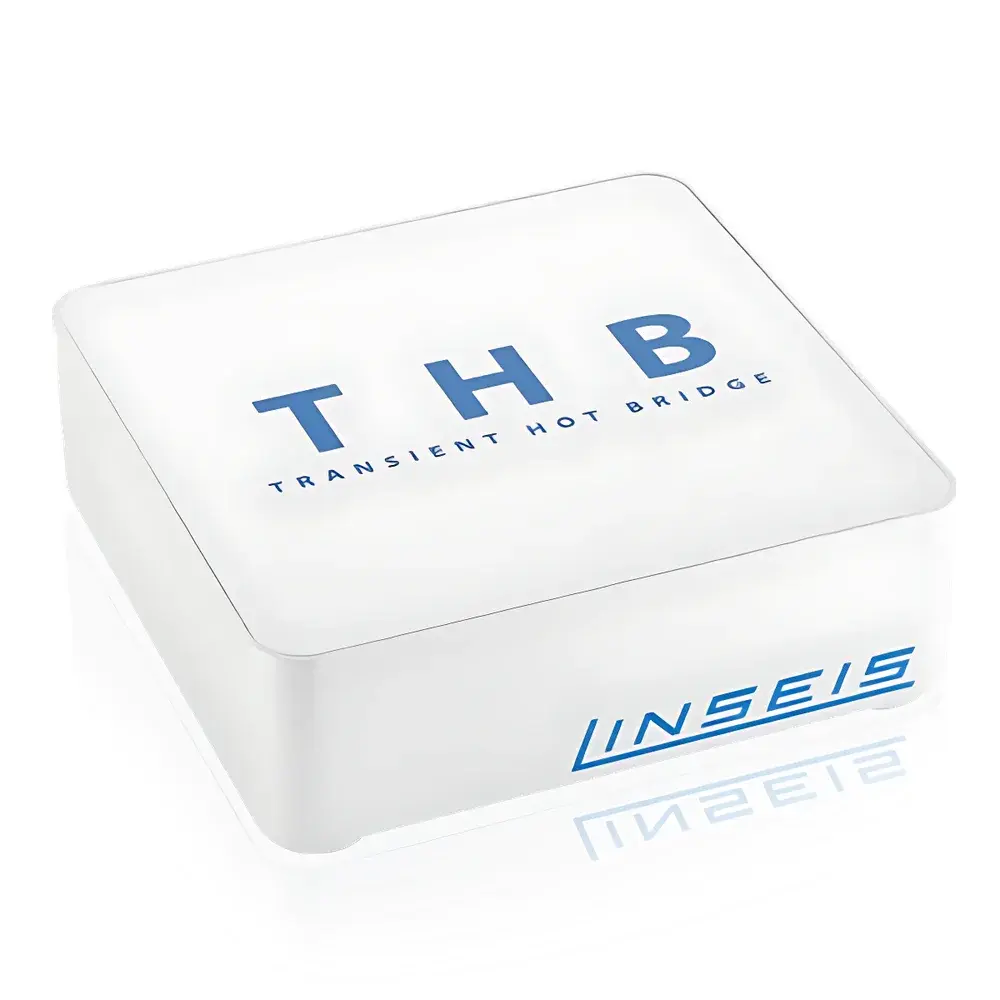
LINSEIS THB L56 Transient Hot Bridge Thermal Conductivity Analyzer
| Brand | LINSEIS |
|---|---|
| Origin | Germany |
| Model | THB L56 |
| Thermal Conductivity Range | 0.005–1800 W/(m·K) |
| Sample Types | Solids, Powders, Gels, Liquids |
| Standards Compliance | ASTM D5930-01, ISO 22007-2, ASTM D5334 |
| Measurement Principle | Transient Hot Bridge (THB) |
| Temperature Range (Sensor) | −150 to 700 °C |
| Typical Measurement Time | 1–10 min (solids), 1–120 s (liquids) |
| Specific Heat Capacity Range | 0.1–5 J/(g·K) |
| Thermal Diffusivity Range | 0.05–1200 mm²/s |
| Minimum Sample Size | 1.5 × 1.5 × 2 mm |
| Sensor Materials | Polyimide, Ceramic |
Overview
The LINSEIS THB L56 is a high-precision transient hot bridge (THB) thermal conductivity analyzer engineered for rapid, absolute measurement of three fundamental thermophysical properties—thermal conductivity (λ), thermal diffusivity (α), and specific heat capacity (cp)—in a single, non-destructive test cycle. Unlike steady-state or laser flash methods, the THB technique employs a dual-function sensor acting simultaneously as both heater and temperature detector. When energized with a short current pulse, the sensor induces a localized, transient temperature rise in direct contact with the sample. The resulting time-dependent voltage response is analyzed using analytical solutions of the heat conduction equation under defined boundary conditions, enabling model-free calculation of λ, α, and cp without calibration transfer or reference material dependency. This principle delivers traceable, absolute measurements compliant with international standards including ASTM D5930-01 (Standard Test Method for Thermal Conductivity of Plastics), ISO 22007-2 (Plastics — Determination of Thermal Conductivity and Thermal Diffusivity — Part 2: Transient Plane Source Method), and ASTM D5334 (Standard Test Method for Thermal Conductivity of Soil and Soft Rock). The THB L56 is designed for laboratory and industrial R&D environments where reproducibility, minimal sample preparation, and broad dynamic range are critical.
Key Features
- Triple-property output: Simultaneous determination of thermal conductivity, thermal diffusivity, and specific heat capacity from one measurement sequence
- Transient hot bridge principle: Enables absolute, calibration-independent results with high repeatability (±2% typical for solids, ±3% for liquids)
- Modular sensor architecture: Interchangeable polyimide and ceramic sensors optimized for low-λ insulators (e.g., aerogels, polymers) or high-λ conductors (e.g., metals, graphite composites)
- Wide operational temperature range: Sensor-rated from −150 °C to +700 °C, compatible with external furnaces or liquid baths for controlled thermal environments
- Minimal sample requirements: As small as 1.5 × 1.5 × 2 mm for solids; no geometric constraints for powders, gels, or liquids—samples are measured in native state without pelletization or pressing
- Short measurement duration: 1–10 minutes for solids; sub-2-minute acquisition for liquids, supporting high-throughput screening
- No pre-measurement calibration: Factory-characterized sensor response eliminates daily recalibration while maintaining NIST-traceable accuracy
Sample Compatibility & Compliance
The THB L56 accommodates heterogeneous sample forms without modification: rigid or flexible solids (including anisotropic composites), loose or compacted powders, viscoelastic gels, pastes, and Newtonian/non-Newtonian liquids. Its contact-based method ensures reliable data for materials with low thermal effusivity (e.g., foams, biological tissues) and high-effusivity substrates (e.g., copper alloys, silicon wafers). All configurations meet regulatory requirements for quality-controlled environments: full audit trail logging, user access levels, and electronic signature support align with FDA 21 CFR Part 11 and GLP/GMP documentation frameworks. Data export formats (CSV, XML, PDF) facilitate integration into LIMS and statistical process control systems. Compliance documentation—including Declaration of Conformity, ISO/IEC 17025-aligned uncertainty budgets, and standard operating procedure templates—is provided with each system.
Software & Data Management
The THB ControlSuite software provides intuitive, wizard-guided operation with real-time signal visualization, automatic baseline correction, and adaptive curve-fitting algorithms based on multi-parameter inverse modeling. Raw thermovoltage transients are stored with metadata (timestamp, operator ID, sensor serial, ambient conditions). Post-processing includes comparative analysis across temperature ramps, statistical reporting (mean, SD, CV%), and automated compliance flagging against user-defined specification limits. Data integrity safeguards include write-protected archives, version-controlled method files, and encrypted database storage. Export modules support ASTM E1447-compliant reporting and direct import into MATLAB, Python (via Pandas), and JMP for advanced multivariate correlation studies.
Applications
The THB L56 supports thermophysical characterization across advanced materials development: phase change materials (PCMs) for thermal energy storage—where λ vs. temperature profiles identify solid–liquid transition points and hysteresis behavior; battery electrode slurries and thermal interface materials (TIMs), where gel-to-solid curing kinetics are tracked via evolving λ and α; aerospace composites requiring through-thickness anisotropy mapping; and semiconductor packaging substrates demanding sub-5 W/(m·K) resolution at cryogenic temperatures. It is routinely deployed in national metrology institutes, automotive OEM validation labs, and academic centers investigating next-generation insulation, thermoelectrics, and additive-manufactured metals.
FAQ
Does the THB L56 require reference standards for routine operation?
No. The transient hot bridge method is inherently absolute; sensor self-calibration eliminates dependence on certified reference materials for daily use.
Can the THB L56 measure anisotropic materials?
Yes—by orienting the sensor normal to the expected heat flow direction and using directional mounting fixtures, in-plane vs. through-plane conductivity can be differentiated.
Is the system compatible with inert or reactive atmospheres?
When coupled with optional glovebox-integrated furnace modules or sealed liquid bath enclosures, measurements under N2, Ar, or vacuum (10−3 mbar) are fully supported.
How is traceability maintained across instrument lifetime?
Each sensor carries a unique calibration certificate referencing NIST-traceable primary standards; firmware updates preserve historical measurement equivalence via embedded correction matrices.
What sample preparation is needed for powder measurements?
None beyond gentle leveling—no compaction, binder addition, or sintering. Loose powders are measured directly in standard crucibles or custom holders.



