
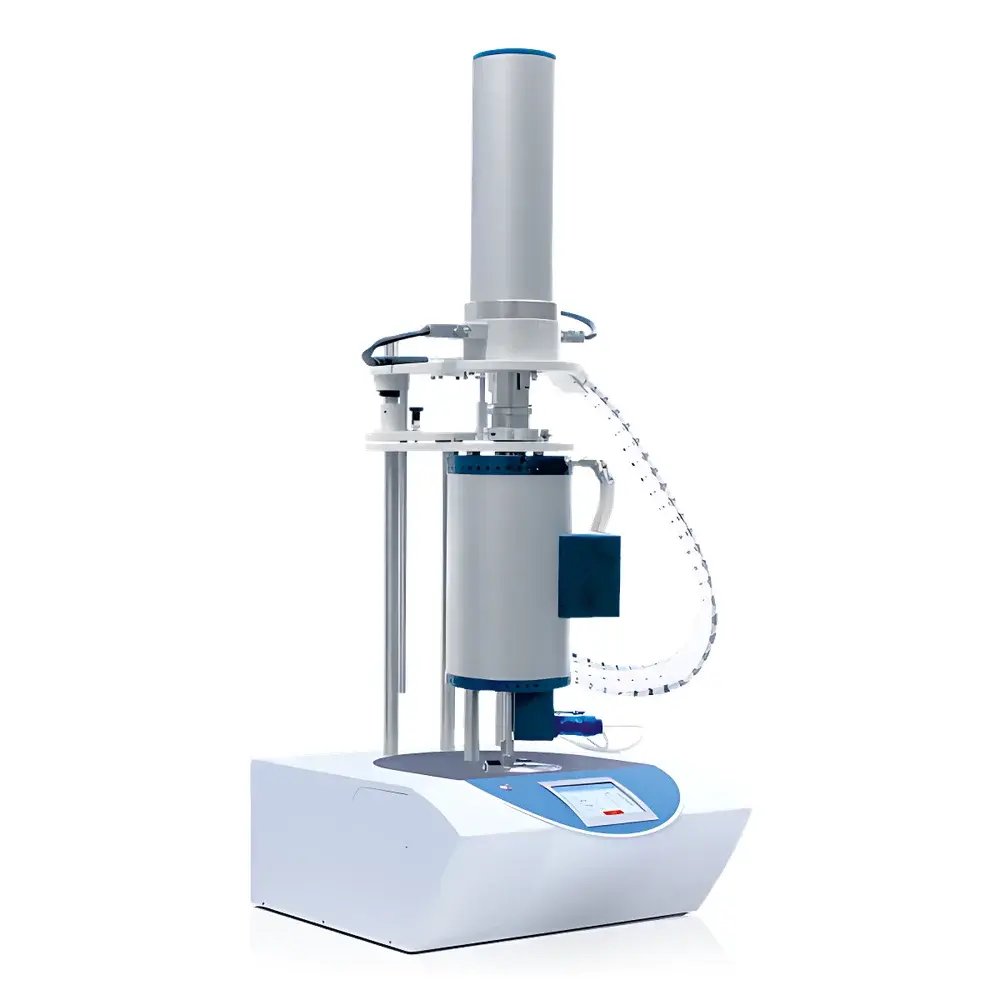
LINSEIS TMA L72 Thermomechanical Analyzer
| Brand | LINSEIS |
|---|---|
| Origin | Germany |
| Model | TMA L72 (TMA PT1600) |
| Temperature Range | RT to 1600 °C |
| Force Range | up to 1 N or 5.7 N |
| Frequency Range | 1 Hz or 5 Hz |
| Resolution | 0.125 nm |
| Atmosphere Options | Oxidizing, Reducing, Inert, Static/Dynamic |
| Sample Max Height | 30 mm |
| Interface | USB |
| Optional Modules | DTA Analysis Software, Rate-Controlled Sintering (RCS) Software |
Overview
The LINSEIS TMA L72 (also designated TMA PT1600) is a high-precision thermomechanical analyzer engineered for quantitative measurement of dimensional changes in solid and semi-solid materials under controlled thermal and mechanical stimuli. Operating on the principle of contact-based probe displacement detection, the instrument applies a defined static or dynamic force to a sample while subjecting it to programmable temperature ramps or isothermal holds. The resulting axial expansion, contraction, or creep deformation is resolved with sub-nanometer sensitivity—enabling rigorous characterization of thermal expansion coefficients (CTE), glass transition temperatures (Tg), softening points (Tf), sintering kinetics, stress relaxation behavior, and phase transformation onset temperatures. Designed and manufactured in Germany, the TMA L72 integrates a robust dual-furnace architecture capable of continuous operation from ambient (RT) up to 1600 °C, with optional cryogenic extension down to –150 °C via liquid nitrogen cooling. Its modular mechanical drive system supports both constant-load (static) and oscillatory (dynamic) modes, making it suitable for ISO 11359-2, ASTM E831, and ASTM D696-compliant testing protocols across academic, industrial R&D, and quality control laboratories.
Key Features
- High-resolution displacement detection: 0.125 nm resolution achieved via differential capacitive transducer and low-noise signal conditioning
- Dual-mode force application: Selectable static load (up to 1 N standard; 5.7 N optional) or dynamic oscillatory loading (1–5 Hz frequency range)
- Thermally stable furnace design: Precision-controlled heating/cooling rates from 0.01 to 100 K/min, with ±0.1 K temperature accuracy over full 1600 °C range
- Multi-atmosphere compatibility: Sealed quartz or alumina sample chamber configurable for oxidizing (air, O2), reducing (H2, forming gas), inert (N2, Ar), or vacuum environments—static or dynamic flow
- Modular sample stage: Interchangeable probe geometries accommodate rods, fibers, films, cylinders, and irregular solids up to 30 mm in height
- Fully integrated electronics: Onboard PID controller, digital force actuator, and USB 2.0 interface eliminate external DAQ dependency
Sample Compatibility & Compliance
The TMA L72 accommodates diverse material classes—including metals, technical ceramics, oxide and non-oxide refractories, polymer composites, amorphous glasses, and carbon-based systems—without requiring metallization or conductive coating. Its open-sample geometry permits direct insertion of as-received specimens (e.g., sintered green bodies, drawn fibers, injection-molded plaques). Compliance is maintained with international standards governing thermal expansion (ISO 11359-2), linear thermal expansion of plastics (ASTM D696), and thermomechanical property determination in metallic materials (ASTM E831). When configured with optional DTA module, simultaneous thermomechanical and thermal event detection satisfies USP and ICH Q5C guidelines for biopolymer stability assessment. Data acquisition meets FDA 21 CFR Part 11 requirements when paired with validated LINSEIS ThermoSoft™ software featuring electronic signatures, audit trails, and role-based access control.
Software & Data Management
Control and analysis are performed using LINSEIS ThermoSoft™ v5.x—a Windows-based platform supporting method scripting, real-time visualization, and automated report generation. The software implements GLP/GMP-aligned workflows: all calibration events, instrument parameters, user actions, and raw data timestamps are immutably logged. Dynamic TMA experiments (e.g., frequency sweeps at fixed temperatures or temperature sweeps under oscillatory load) are fully parameterizable. Integrated DTA functionality enables concurrent exothermic/endothermic peak identification alongside dimensional change. Export formats include ASCII, CSV, and XML for third-party statistical analysis (e.g., JMP, MATLAB, Python pandas). Optional Rate-Controlled Sintering (RCS) module provides closed-loop feedback for precise densification profiling during ceramic or powder metallurgy process development.
Applications
- Determination of coefficient of linear thermal expansion (CLTE) in aerospace-grade superalloys and CMCs
- Quantification of Tg, Tf, and cold crystallization onset in amorphous thermoplastics and biodegradable polyesters
- Monitoring of binder burnout, particle rearrangement, and neck growth during ceramic green body sintering
- Stress relaxation and creep compliance mapping in high-performance elastomers and shape-memory alloys
- Phase transition analysis in ferroelectric oxides (e.g., BaTiO3) and martensitic steels
- Interfacial adhesion evaluation in fiber-reinforced polymer composites via constrained expansion testing
FAQ
What is the maximum operating temperature of the TMA L72, and is cryogenic capability available?
The standard furnace achieves 1600 °C; with optional LN2-cooled cryostat, the lower limit extends to –150 °C.
Can the TMA L72 perform simultaneous DTA measurements?
Yes—when equipped with the optional DTA sensor module, it delivers synchronized thermomechanical and thermal event data.
Is the system compliant with FDA 21 CFR Part 11 for regulated environments?
Full compliance is achieved using ThermoSoft™ with enabled audit trail, electronic signature, and data integrity modules.
What sample geometries are supported without custom fixtures?
Standard configurations support cylindrical rods (diameter ≤12 mm), flat films (≤25 mm × 25 mm), fibers (diameter ≥50 µm), and irregular solids up to 30 mm height.
How is force calibrated, and what traceability does it provide?
Force calibration is performed using NIST-traceable dead-weight standards; certificate of calibration is supplied with each instrument installation.



