
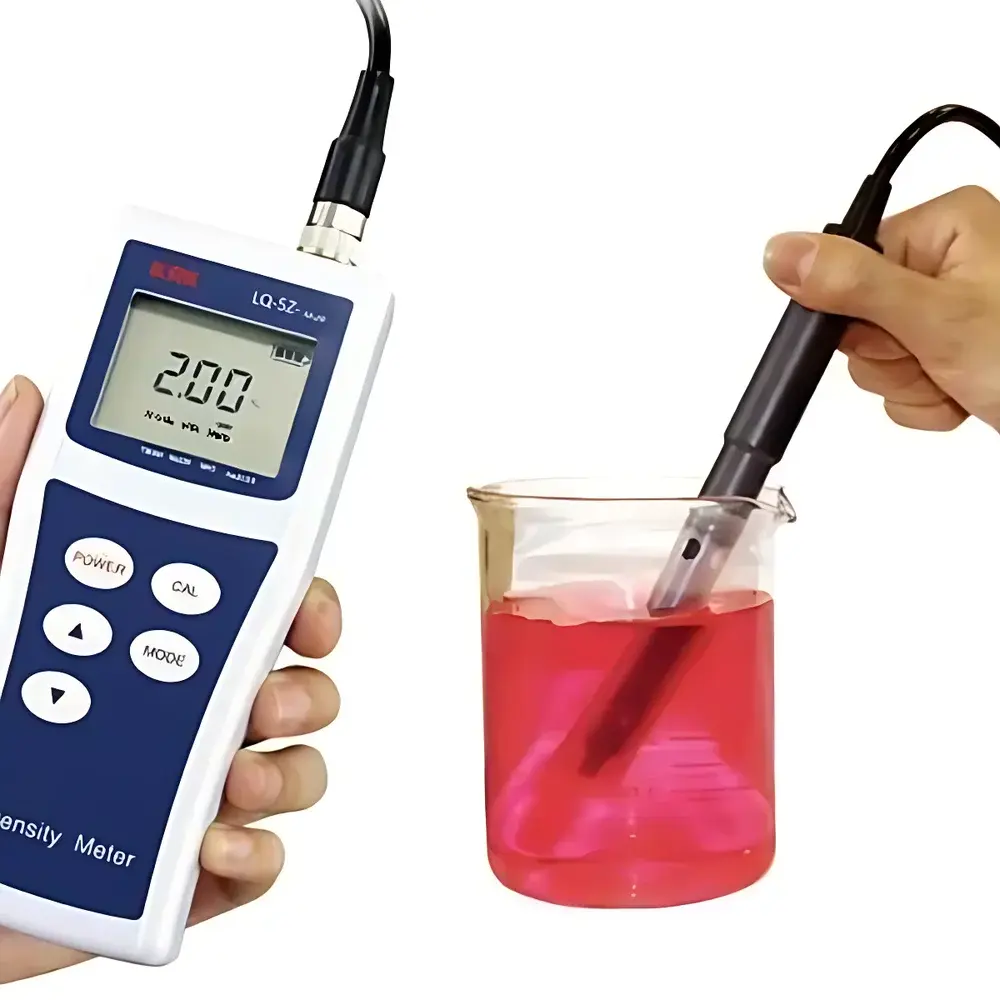
LQ-5Z Multi Alkalinity Speciation Analyzer (THAM / NaOH / Na₂CO₃ / NH₃·H₂O) by Rikari Kagaku
| Brand | Rikari Kagaku |
|---|---|
| Origin | Japan |
| Model | LQ-5Z Multi |
| Measurement Principle | Potentiometric Electrode Method |
| Analyte Range | THAM 0–5% w/w, NaOH 0–3% w/w, Na₂CO₃ 0–10% w/w, NH₃·H₂O 0–2% w/w |
| Sample Temperature Range | 0.0–40.0 °C |
| Calibration | Single-point zero calibration |
| Temperature Compensation | Automatic (NTC-based) |
| Enclosure Rating | IP66 |
| Power Supply | 3× LR03 (AAA) alkaline batteries |
| Auto-power-off | Yes |
| Electrode Type | 4C-series combination electrode |
| Electrode Cable Length | 1 m |
| Instrument Dimensions (H×W×D) | 38 × 75 × 180 mm |
| Electrode Dimensions (Ø × L) | 17 × 180 mm |
| Weight | Instrument ≈ 300 g, Electrode ≈ 50 g |
Overview
The LQ-5Z Multi Alkalinity Speciation Analyzer is a handheld, field-deployable potentiometric instrument engineered for rapid, selective quantification of individual alkaline species in aqueous solutions—specifically tetramethylammonium hydroxide (THAM), sodium hydroxide (NaOH), sodium carbonate (Na₂CO₃), and aqueous ammonia (NH₃·H₂O). Unlike conventional titrimetric methods requiring reagents, burettes, endpoint detection, and trained personnel, the LQ-5Z Multi employs a proprietary 4C-type combination electrode system that delivers stable, Nernstian response to each target analyte under defined pH and ionic strength conditions. The device operates on the principle of selective ion activity measurement, where the electrode’s membrane composition and internal reference architecture are optimized to differentiate between hydroxide, carbonate/bicarbonate, and ammonium-derived alkalinity contributions—provided the sample contains only one dominant alkaline component. This constraint ensures analytical specificity without chromatographic or spectrophotometric separation, making it suitable for routine QC checks in water treatment plants, pharmaceutical buffer preparation, semiconductor rinse monitoring, and electroplating bath management.
Key Features
- Single-analyte speciation capability for THAM, NaOH, Na₂CO₃, and NH₃·H₂O—no cross-interference when sample matrix is chemically homogeneous
- Integrated automatic temperature compensation using an embedded NTC sensor (0.0–40.0 °C), eliminating manual correction and reducing thermal drift
- Rugged IP66-rated housing certified for dust-tight operation and resistance to powerful water jets—designed for industrial floor, outdoor sampling, and humid laboratory environments
- Low-power architecture with three AAA alkaline cells (LR03), supporting >2,000 measurements per battery set and intelligent auto-shutdown after 10 minutes of inactivity
- Compact ergonomic design: instrument body weighs only ~300 g; electrode (Ø17 mm × 180 mm) features a robust PTFE-shielded junction and replaceable electrolyte reservoir
- Zero-point calibration only—no multi-point standardization required—reducing operational complexity and consumable dependency
Sample Compatibility & Compliance
The LQ-5Z Multi is validated for use with clear, non-viscous, low-turbidity aqueous samples containing ≤500 mg/L total suspended solids. It is not intended for mixed-alkalinity samples (e.g., NaOH + Na₂CO₃ coexistence) or solutions with strong chelators (e.g., EDTA), high phosphate, or heavy metal ions (>1 mg/L Cu²⁺/Fe³⁺), which may poison the electrode surface or distort activity coefficients. While not formally certified to ISO/IEC 17025, the analyzer conforms to the functional requirements outlined in ASTM D1067 (Standard Test Methods for Acidity or Alkalinity of Water) for field screening applications. Its zero-calibration protocol aligns with GLP documentation practices when paired with traceable temperature verification and electrode performance logs.
Software & Data Management
The LQ-5Z Multi operates as a standalone instrument with no onboard data logging or Bluetooth/Wi-Fi connectivity. All measurements are displayed in real time on a high-contrast LCD with % w/w readout and temperature overlay. For regulatory traceability, users are advised to record results manually or via external digital loggers compliant with FDA 21 CFR Part 11—particularly in pharmaceutical water system validation where alkalinity control supports USP Purified Water specifications. Electrode maintenance records (calibration date, storage solution, response time verification) should be retained per GMP Annex 11 guidance for critical process monitoring equipment.
Applications
- Routine verification of THAM concentration in photoresist developer formulations used in semiconductor wafer fabrication
- On-site monitoring of NaOH dosage in boiler feedwater pretreatment and caustic cleaning cycles
- Quality release testing of NH₃·H₂O solutions in pharmaceutical excipient manufacturing (e.g., ammonia-based pH adjustment)
- Process control of Na₂CO₃ levels in textile dyeing baths and wastewater neutralization units
- Educational laboratories demonstrating potentiometric selectivity principles in analytical chemistry curricula
FAQ
Can the LQ-5Z Multi measure mixed alkaline solutions?
No. The instrument assumes a single-dominant alkaline species. Coexisting bases (e.g., NaOH and Na₂CO₃) produce ambiguous potential responses and invalidate concentration calculation.
Is electrode recalibration required before each measurement?
No. Only periodic zero-point verification is needed—typically before first use of the day or after prolonged storage. Frequent recalibration is unnecessary due to electrode stability and low-drift reference design.
What maintenance does the 4C electrode require?
Rinse with deionized water after each use; store immersed in 3 mol/L KCl solution. Replace the internal electrolyte every 3 months or if response time exceeds 15 seconds.
Does the device meet any international safety standards?
Yes. The instrument complies with IEC 61010-1:2010 for electrical safety in laboratory equipment and carries CE marking under the EMC Directive 2014/30/EU.
Can temperature-compensated readings be exported digitally?
No. The LQ-5Z Multi has no data output interface. Manual transcription or external camera-based documentation is required for audit trails.
Related Products







