
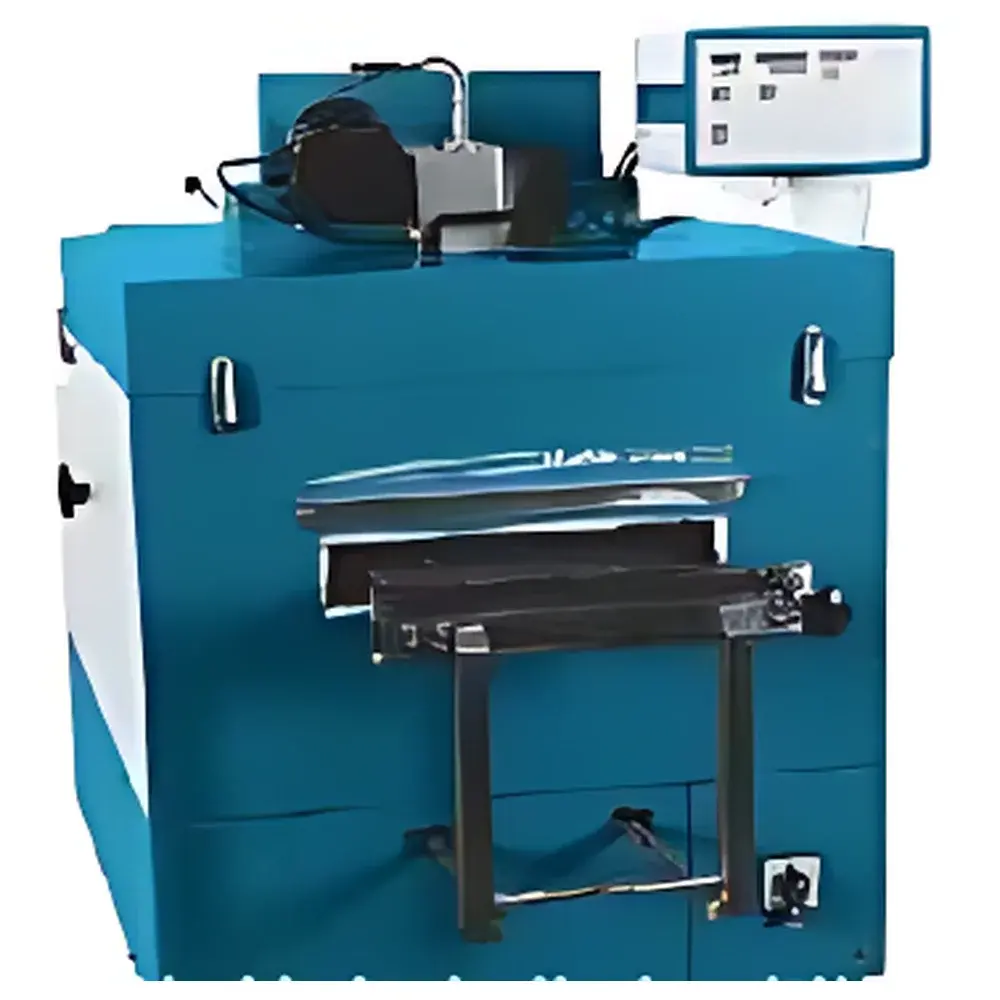
LTH450 Automated Sample-Loading High-Temperature Conveyor Oven
| Origin | Switzerland |
|---|---|
| Manufacturer Type | Authorized Distributor |
| Origin Category | Imported |
| Model | LTH450 |
| Pricing | Upon Request |
Overview
The LTH450 Automated Sample-Loading High-Temperature Conveyor Oven is an engineered thermal processing system designed for precise, repeatable, and fully automated heat treatment of coated metallic substrates—particularly steel and aluminum coils—under laboratory-scale conditions that replicate industrial continuous coil coating line parameters. It operates on forced-convection heating principles, utilizing a high-capacity axial fan-driven air circulation system to ensure uniform thermal distribution across the process chamber. The oven supports critical thermal processes including drying, curing, baking, annealing, and controlled quenching of primers, adhesives, paints, and functional surface coatings. Its architecture enables direct integration with S-RRCBW (Semi-Continuous Reverse Roll Coating Bench Workstation) systems, allowing freshly coated samples to be transferred directly onto the conveyor and subjected to programmable thermal profiles without manual intervention. This capability bridges the gap between R&D formulation development and full-scale production validation, minimizing material waste and accelerating time-to-decision in coating process optimization.
Key Features
- Fully automated sample handling: motorized conveyor with programmable dwell time (5 s – 999 min), synchronized entry/exit actuation, and optional foot-switch control for hands-free operation
- High-precision temperature control: Pt100 resistance thermometers integrated into both chamber air and optional non-contact infrared surface sensors (for real-time substrate surface temperature monitoring)
- Digitally regulated forced-air circulation: infinitely variable fan speed (up to ~1000 m³/h), with externally adjustable baffle system enabling top-only, bottom-only, or balanced dual-direction airflow
- Modular control unit: compact, integrated electronics housed beneath the oven body—eliminating need for external control cabinets and reducing footprint
- Advanced thermal safety architecture: redundant temperature monitoring (main Pt100 + auxiliary overtemperature limiter), automatic heater cut-off upon fan failure, and mechanical brake-equipped castor wheels for stable positioning
- Expandable thermal profiling: up to 20-step multi-stage programs (20 total sequences), each defining ramp rate, soak duration, and fan speed; compatible with RS232 interface for real-time data logging and remote parameter adjustment
- Integrated rapid cooling options: tilt-mounted water-quench fixture, motorized rear door lift mechanism, and exhaust fan (30 m³/h capacity) for fume management during volatile binder decomposition
Sample Compatibility & Compliance
The LTH450 accommodates flat-panel specimens up to 30 × 38 cm, making it suitable for standardized test panels used in ASTM D523, ISO 2808, and EN 13523-1 compliant coating evaluation. Its design supports GLP-aligned experimental traceability through time-stamped, parameter-locked thermal cycles. Optional RS232 connectivity enables audit-ready data export for FDA 21 CFR Part 11–compliant environments when paired with validated third-party software. The system meets IEC 61000-6-3 (EMC) and IEC 61000-6-2 (immunity) standards, and its electrical safety conforms to IEC 61010-1 for laboratory equipment. Temperature uniformity across the working zone complies with DIN 12880 Class 2 specifications (±3 °C at 400 °C), verified per internal calibration protocol using NIST-traceable reference probes.
Software & Data Management
The embedded microcontroller provides intuitive front-panel programming with digital display of setpoint temperature, elapsed dwell time, fan RPM, and real-time chamber temperature. All operational parameters—including program sequence, ramp rates, hold durations, and fan speed—are stored in non-volatile memory. When connected via RS232, the oven streams timestamped process data (temperature, time, fan status) to host PCs running custom or vendor-supplied logging applications. Optional weekly timer functionality supports unattended overnight or weekend cycling (4 ON/OFF cycles per day; 1 manually scheduled cycle up to 5 days in advance). Data integrity is preserved through hardware-level write protection and cyclic redundancy checksums during transmission.
Applications
- Accelerated cure kinetics studies for waterborne and solvent-based coil coatings
- Thermal stability assessment of UV-curable and thermoset polymer systems
- Optimization of crosslink density vs. dwell time/temperature profiles
- Simulation of industrial stoving ovens for automotive OEM primer-surfacer-bake sequences
- Pre-treatment parameter validation prior to pilot-line trials
- Controlled oxidative aging of protective barrier layers on galvanized steel
- Residual solvent analysis support via timed thermal desorption protocols
FAQ
What is the maximum operating temperature, and is 450 °C standard or optional?
The base configuration supports up to 400 °C; operation at 450 °C requires factory-installed high-temp insulation and upgraded heating elements as a configured option.
Can the oven accommodate non-planar or three-dimensional samples?
No—the LTH450 is engineered exclusively for flat, rigid substrates mounted on standardized mesh carriers; curvature or irregular geometry compromises airflow uniformity and thermal repeatability.
Is calibration documentation provided with the instrument?
Yes—each unit ships with a factory calibration certificate covering Pt100 sensor accuracy (±0.15 °C at 200 °C), temperature uniformity mapping, and fan flow verification, traceable to national metrology institutes.
How is thermal uniformity maintained across the full chamber volume?
Through optimized duct geometry, dynamically balanced axial fan assembly, and user-adjustable inlet baffles that enable directional airflow tuning to compensate for load asymmetry.
Does the system support integration with LIMS or MES platforms?
Native integration is not built-in, but RS232 output allows middleware-based ingestion into LIMS/MES via serial-to-IP gateways when combined with appropriate parsing logic and validation protocols.
Related Products



