
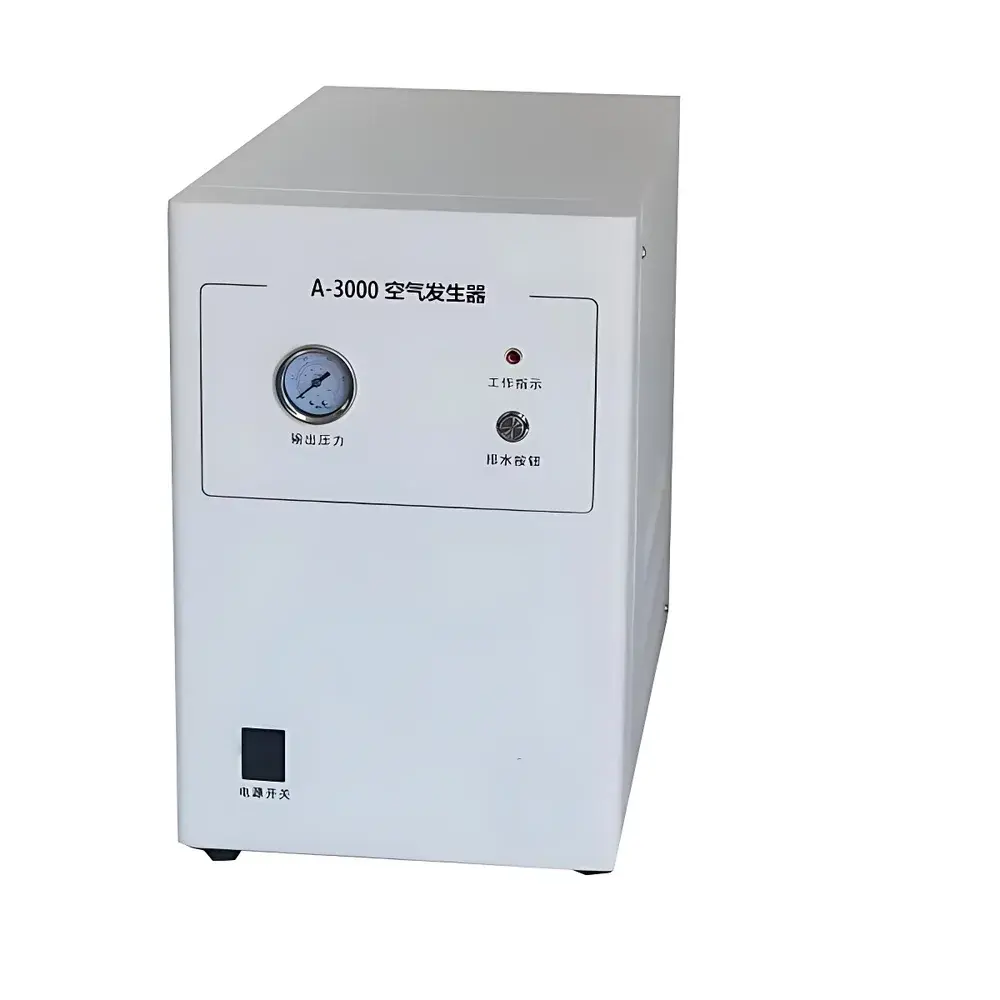
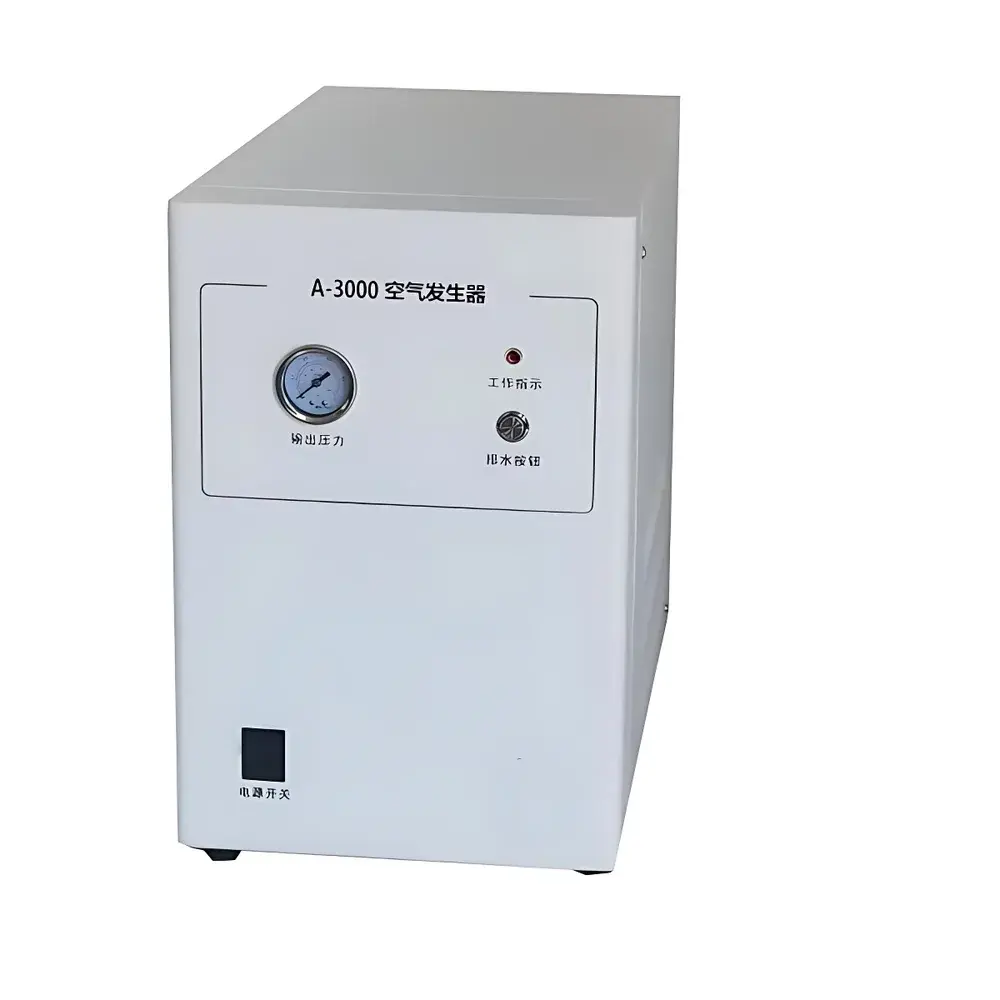
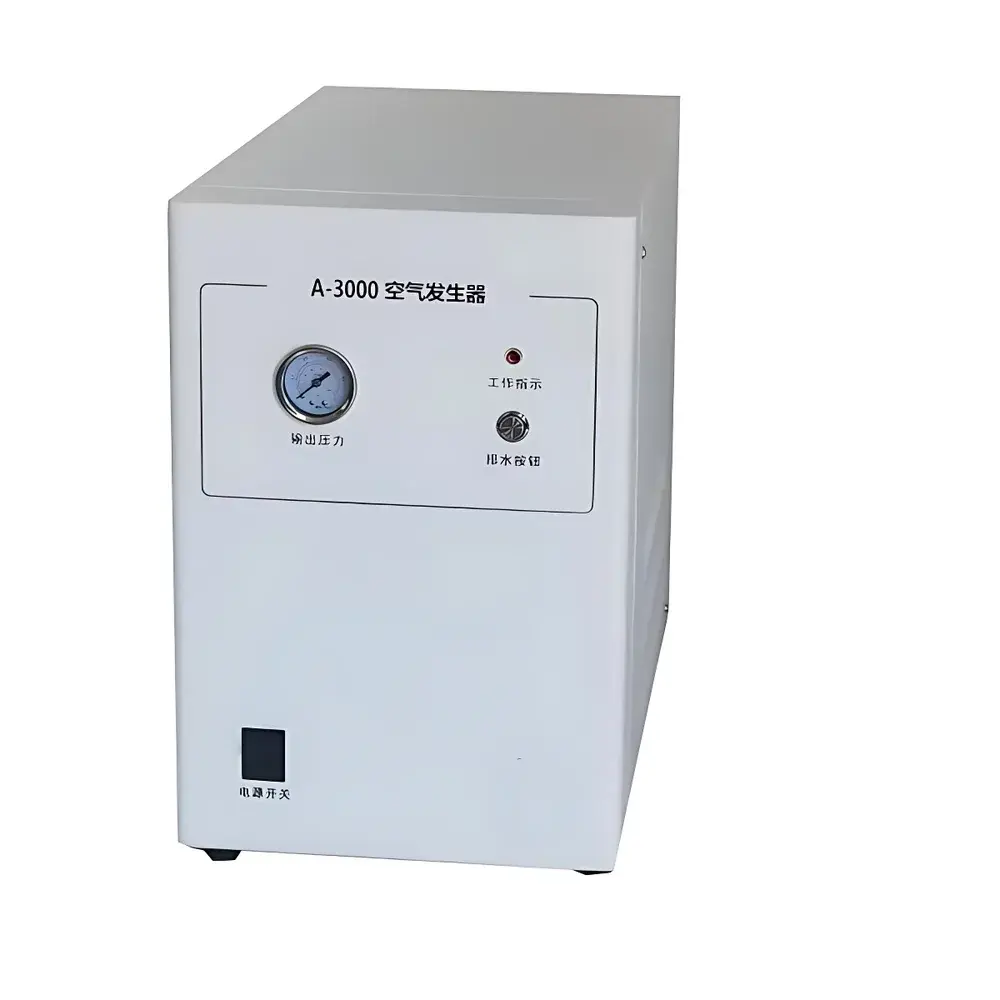
Luchuang A-3000 Air Generator for GC Laboratory Applications
| Brand | Luchuang |
|---|---|
| Origin | Shandong, China |
| Manufacturer Type | Direct Manufacturer |
| Model | A-3000 |
| Output Flow Rate | 3000 mL/min |
| Maximum Output Pressure | 0.6 MPa |
| Hydrocarbon Content | <0.1 ppm (as total hydrocarbons) |
| Oxygen Content | 20–22% (v/v) |
| Moisture Content | <3 ppm (v/v) |
| Total Hydrocarbons (THC) | <1 ppm (v/v) |
| Pressure Stability | ≤0.003 MPa |
| Rated Power | 185 W |
| Noise Level | ≤42 dB(A) |
| Dimensions (L×W×H) | 450 × 250 × 365 mm |
Overview
The Luchuang A-3000 Air Generator is an engineered solution designed to supply clean, dry, and stable compressed air for gas chromatography (GC) systems—specifically as the combustion air source for flame ionization detectors (FID), nitrogen–phosphorus detectors (NPD), and flame photometric detectors (FPD). Unlike high-pressure cylinder-based air supplies, this generator delivers continuous, on-demand air without logistical constraints or safety risks associated with compressed gas storage. It operates on a dual-stage compression architecture coupled with integrated thermal and pressure safety controls. The system employs a brushless induction compressor with ambient-pressure start-up functionality, significantly reducing mechanical stress during cold starts and extending service life. Air purification follows a sequential adsorption process: first through color-indicating silica gel for moisture removal, then over 13X molecular sieve beds for deep desiccation and hydrocarbon scavenging. Dual-stage pressure regulation ensures consistent delivery across variable load conditions, while an automatic condensate drain valve prevents liquid accumulation in the internal buffer tank—enhancing long-term reliability and minimizing manual maintenance.
Key Features
- Dual-stage pressure regulation: Independent A-port (0–0.4 MPa, adjustable, for GC detector use) and B-port (0.5 MPa fixed, for integration with nitrogen generators)
- Comprehensive safety architecture: Dual overpressure protection + thermal cut-off at 80 °C compressor housing temperature
- Low-noise operation: Acoustic enclosure design achieves ≤42 dB(A) at 1 m distance, suitable for shared laboratory environments
- Real-time purity monitoring: Visual silica gel indicator (blue → pink transition) enables proactive desiccant replacement
- Energy-efficient operation: 185 W rated power draw supports 24/7 unattended runtime under typical GC duty cycles
- Compact footprint: 450 × 250 × 365 mm dimensions allow flexible benchtop placement without compromising accessibility
Sample Compatibility & Compliance
The A-3000 meets baseline air purity requirements specified in ASTM D4052 (for hydrocarbon-free carrier and support gases), ISO 8573-1 Class 2:2:2 (compressed air quality for instrumentation), and USP (for pharmaceutical analytical applications requiring low-hydrocarbon air). Its output satisfies GC detector manufacturer specifications for FID air supply (e.g., Agilent, Shimadzu, Thermo Fisher), including maximum allowable THC (<1 ppm) and dew point (<−70 °C equivalent to <3 ppm moisture). While not certified to FDA 21 CFR Part 11 out-of-the-box, the unit’s stable, traceable output parameters and absence of consumable calibration gases make it compatible with GLP/GMP-aligned validation protocols when paired with external verification (e.g., periodic GC–MS hydrocarbon screening or cavity ring-down spectroscopy moisture analysis).
Software & Data Management
The A-3000 operates as a standalone hardware platform without embedded firmware or digital connectivity. All operational parameters—including pressure setpoints, thermal status, and flow stability—are monitored via analog gauges and passive indicators. This design prioritizes electromagnetic compatibility (EMC) and avoids software-related failure modes common in networked lab instruments. For laboratories implementing centralized asset management, the unit’s consistent electrical signature (185 W @ 220 V AC, 50 Hz), mechanical durability, and documented maintenance intervals (e.g., silica gel replacement every 6–12 months depending on ambient humidity) support predictive scheduling within CMMS platforms such as IBM Maximo or Siemens Desigo.
Applications
- Primary combustion air source for FID, NPD, and FPD in routine and regulatory GC analysis
- Support gas for GC–MS systems requiring ultra-low hydrocarbon background
- Zero-air generation when paired with catalytic converters (external configuration)
- Lab-wide compressed air supply for pneumatic actuators, sample dilution manifolds, or purge-and-trap interfaces
- Replacement for high-pressure air cylinders in ISO/IEC 17025-accredited testing laboratories seeking improved audit readiness and reduced cylinder handling risk
FAQ
What is the expected service life of the silica gel and 13X molecular sieve cartridges?
Under standard laboratory conditions (23 °C, 50% RH), silica gel typically requires replacement every 6–9 months; 13X molecular sieve beds last 12–18 months. Replacement intervals shorten in high-humidity environments or continuous high-flow operation.
Can the A-3000 be used with GC systems requiring zero air (hydrocarbon-free air)?
The A-3000 meets standard GC detector specifications (<1 ppm THC), but does not achieve true “zero air” (<0.01 ppm THC). For zero-air applications, integration with an external catalytic hydrocarbon scrubber is recommended.
Is the unit compatible with 110 V / 60 Hz power supplies?
No—the A-3000 is configured for 220 V AC, 50 Hz input only. Voltage conversion requires an externally rated isolation transformer meeting IEC 61558-2-4 standards.
Does the automatic drain valve require periodic cleaning or maintenance?
Yes—the float-type condensate valve should be inspected quarterly for sediment buildup; ultrasonic cleaning in isopropyl alcohol is advised if flow resistance increases.
How is pressure stability verified during qualification?
Pressure stability (≤0.003 MPa variation) is validated using a calibrated digital pressure transducer (e.g., Druck DPI 610) sampling at 10 Hz over ≥30 minutes under full-load conditions (3000 mL/min at 0.4 MPa).



