
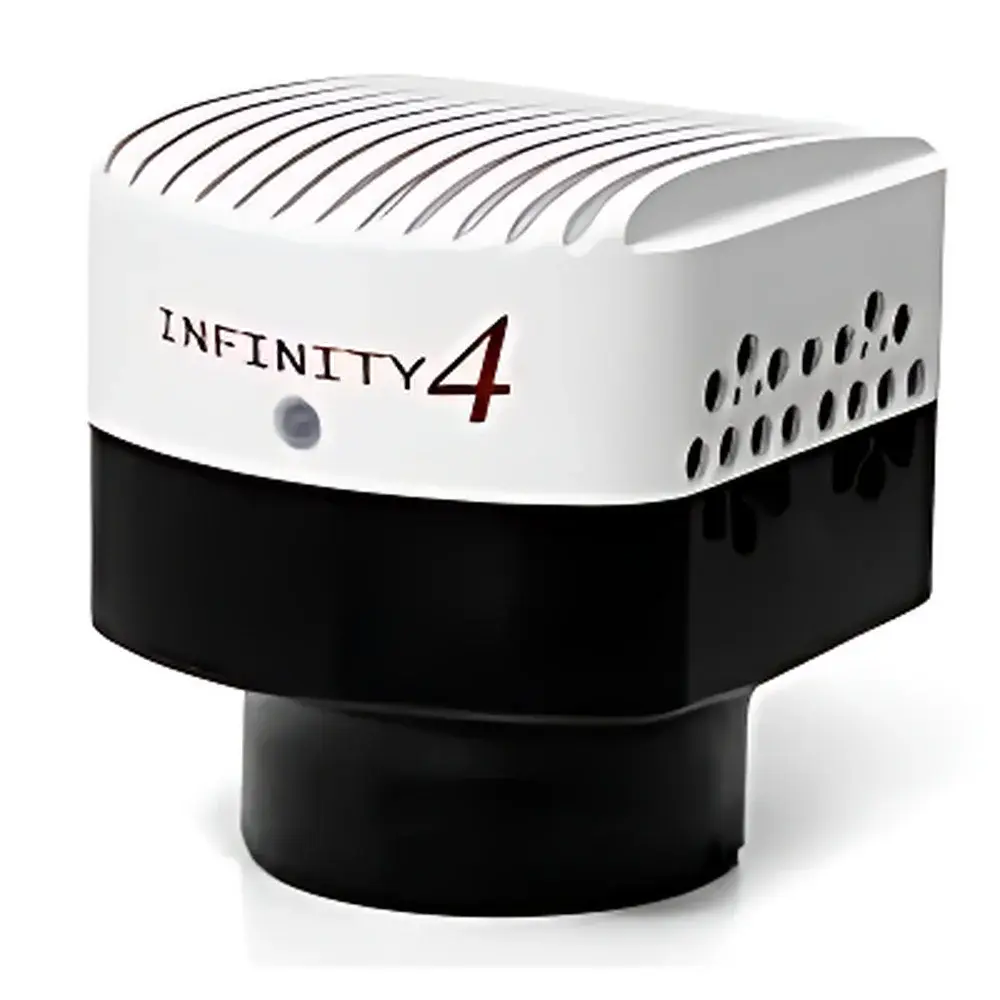
Lumenera INFINITY 4-11 High-Resolution Scientific CCD Camera
| Brand | Lumenera |
|---|---|
| Origin | Canada |
| Model | INFINITY 4-11 |
| Sensor Type | Kodak KAI-11002 CCD |
| Resolution | 4008 × 2672 pixels (11 MP) |
| Pixel Size | 9 µm |
| Full-Frame Readout Speed | 3.5 fps |
| ROI & Binned Readout Speed | >60 fps |
| Dynamic Range | >65 dB |
| Bit Depth | 8/12-bit |
| Color Option | Monochrome or Color |
| Interface | USB 2.0 |
| Sensor Format | 35 mm (full-frame) |
Overview
The Lumenera INFINITY 4-11 is a high-performance, full-frame scientific CCD camera engineered for demanding quantitative imaging applications in life sciences, industrial inspection, and materials analysis. Built around the proven Kodak KAI-11002 interline-transfer CCD sensor, it delivers 11 megapixels of spatial resolution across a native 35 mm optical format—enabling wide-field acquisition without image stitching while preserving critical signal fidelity. Its architecture adheres to fundamental principles of low-noise photon detection: deep depletion silicon, thermoelectric stabilization (optional), and correlated double sampling (CDS) readout minimize read noise and dark current, ensuring high signal-to-noise ratio (SNR) even under low-light conditions typical in fluorescence microscopy, time-lapse cytology, or precision metrology. Unlike consumer-grade sensors, the KAI-11002 features true global shutter operation, eliminating motion artifacts during fast transient imaging—a requirement for synchronization with pulsed light sources or mechanical stages.
Key Features
- 11-megapixel resolution (4008 × 2672) on a full-frame 35 mm CCD sensor for maximal field-of-view coverage and pixel-level geometric accuracy
- 9 µm square pixels optimized for diffraction-limited optical systems and high MTF preservation
- Configurable bit depth: hardware-selectable 8-bit or 12-bit digitization to balance speed and dynamic range per application
- Flexible readout modes: full-frame at 3.5 fps; region-of-interest (ROI) and hardware binning enable >60 fps for rapid sequence capture
- Dynamic range exceeding 65 dB—achieved through low-noise analog front-end design and CDS architecture—supporting simultaneous visualization of weak and saturated signals
- USB 2.0 interface with deterministic latency and driver-level memory mapping for deterministic frame timing and minimal host CPU overhead
- Comprehensive trigger support: TTL-compatible input/output lines for external synchronization with shutters, lasers, or motion controllers
Sample Compatibility & Compliance
The INFINITY 4-11 integrates seamlessly into standardized optical platforms including inverted and upright microscopes (C-mount and F-mount adapters available), macro imaging stations, and automated inspection rigs. Its mechanical design conforms to ANSI/EIA-742-A dimensional standards for interchangeability with OEM optical modules. From a regulatory standpoint, the camera supports audit-ready data acquisition workflows compliant with GLP and GMP environments when deployed with validated software stacks. While the device itself is not FDA-cleared, its output metadata—including timestamped exposure parameters, gain settings, and sensor temperature logs—meets minimum traceability requirements outlined in ISO 13485 Annex A and ASTM E2912 for digital image documentation in regulated quality control processes.
Software & Data Management
Lumenera’s proprietary INFINITY ANALYZE software provides native support for real-time histogram analysis, multi-channel overlay, non-uniformity correction (NUC), and flat-field calibration. The SDK (Software Development Kit) includes C/C++, Python, and MATLAB bindings with full access to all camera registers and asynchronous acquisition buffers. All captured images embed EXIF-compliant metadata tags (e.g., exposure time, binning factor, sensor temperature) enabling automated parsing in LIMS or ELN systems. When paired with third-party platforms such as MicroManager or NIS-Elements, the camera satisfies FDA 21 CFR Part 11 requirements for electronic records via optional digital signature integration and secure audit trail logging.
Applications
- Widefield fluorescence microscopy requiring high-resolution z-stack reconstruction and colocalization analysis
- High-content screening (HCS) where consistent pixel geometry and calibrated intensity linearity are prerequisites for phenotype classification
- Industrial PCB inspection and semiconductor wafer metrology leveraging sub-pixel centroiding and edge-detection repeatability
- Time-resolved particle tracking in microfluidics using ROI-triggered burst acquisition
- Documentation of archival specimens in museum and forensic labs where color fidelity and geometric stability must be preserved across decades
- Teaching laboratories requiring robust, maintenance-free imaging tools compatible with standard optics curricula
FAQ
Is the INFINITY 4-11 suitable for live-cell imaging?
Yes—its low read noise (<15 e⁻ RMS), global shutter, and optional thermoelectric cooling enable stable, quantitative acquisition over extended durations without phototoxicity-induced drift.
Does the camera support hardware binning?
Yes—2×2, 3×3, and 4×4 hardware binning modes are implemented at the sensor level, improving SNR and frame rate simultaneously without interpolation artifacts.
Can I use this camera with third-party microscope software?
Yes—the SDK provides TWAIN, DirectShow, and GenICam-compliant interfaces, ensuring compatibility with major commercial and open-source microscopy platforms.
What is the maximum cable length supported for USB 2.0 operation?
Up to 5 meters with active extension cables certified for isochronous bandwidth preservation; longer distances require USB 3.0 hubs or fiber-optic extenders (not included).
Is firmware upgradable in the field?
Yes—firmware updates are delivered via Lumenera’s secure download portal and applied using the INFINITY CAPTURE utility without hardware modification.



