
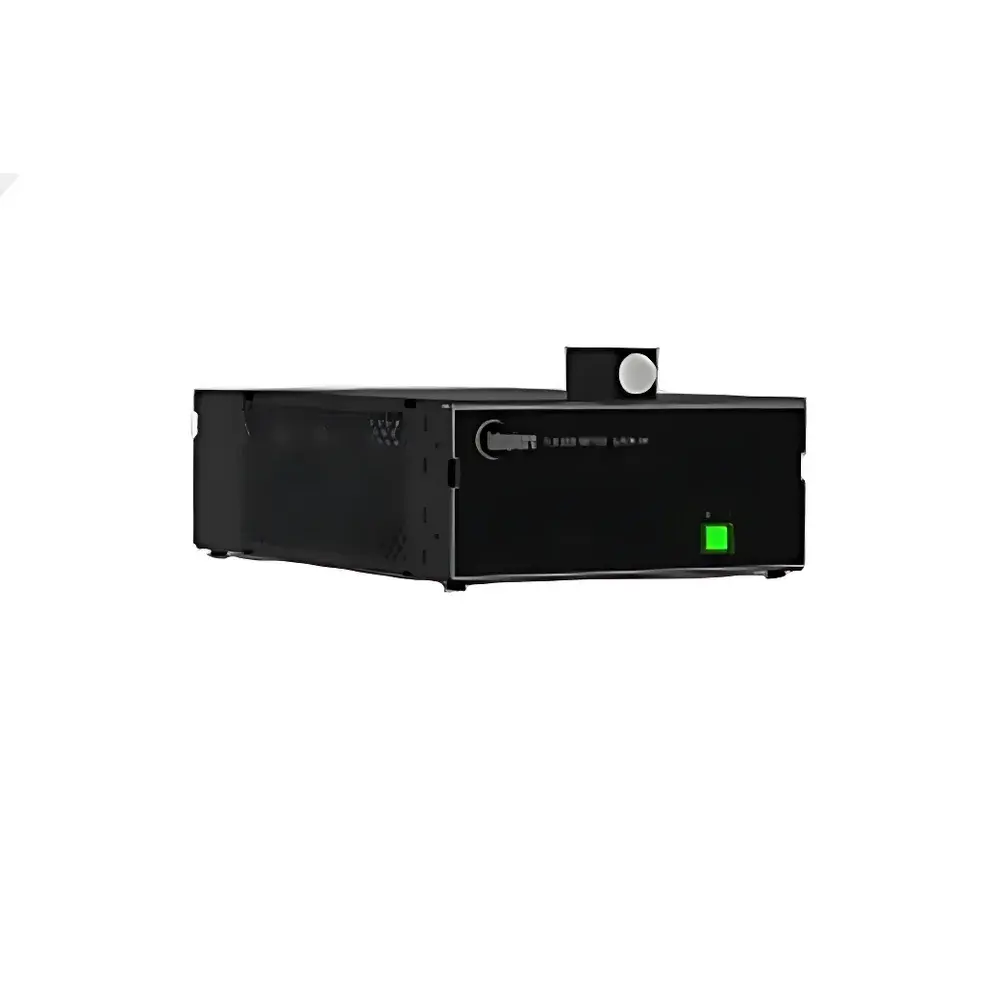
Lumenera LFFM-20 High-Speed Flicker Analyzer
| Brand | Lumenera |
|---|---|
| Origin | USA |
| Manufacturer Type | Authorized Distributor |
| Product Origin | Imported |
| Model | LFFM-20 |
| Price Range | USD 14,000 – 28,000 |
| Sampling Rate | 0–20 kHz |
| Dynamic Range | 2 × 10⁵ |
| Spectral Response | CIE 1931 V(λ), f₁′ ≤ 4.5% |
| Detector Dimensions (mm) | 25 × 25 × 45 |
| Power Meter Dimensions (mm) | 300(L) × 210(W) × 90(H) |
| Interface | USB |
| Compliance Standards | IEC TR 61547-1, CIE TN 006:2016, IEEE 1789-2015, ENERGY STAR SSL V2.1, IES TM-30-20, CEC Title 20, ASSIST Mp, CIE SVM, Pst-LM |
Overview
The Lumenera LFFM-20 High-Speed Flicker Analyzer is a precision optical metrology instrument engineered for quantitative assessment of temporal light modulation (TLM) in solid-state lighting (SSL) sources—including LED lamps, drivers, and luminaires—under real-world operating conditions. It operates on the principle of high-bandwidth photometric sampling synchronized with calibrated spectral responsivity approximating the CIE 1931 photopic luminosity function V(λ). Unlike conventional photometers limited to DC or low-frequency AC response, the LFFM-20 employs a high-speed silicon photodiode detector coupled with a low-noise analog front-end and 16-bit ADC, enabling continuous waveform capture at up to 20 kHz. This architecture ensures traceable, repeatable measurement of flicker metrics defined by international standards including IEC TR 61547-1, IEEE 1789-2015, and CIE TN 006:2016. The system is designed for use in R&D laboratories, quality assurance departments, and third-party testing facilities requiring compliance validation for ENERGY STAR, DLC, CEC Title 20, and IESNA TM-30-20 reporting.
Key Features
- Full compliance with globally recognized flicker evaluation protocols: Flicker Index (FI), Percent Flicker (PF), Modulation Depth (MD), Short-Term Flicker Indicator (Pst-LM), Stroboscopic Visibility Measure (SVM), ASSIST Mp, and modulation percentage.
- Real-time dual-domain visualization: simultaneous time-domain waveform display and frequency-domain FFT spectrum analysis with auto-peak detection and harmonic identification.
- CIE 1931 V(λ)-matched spectral response with f₁′ error ≤ 4.5%, certified per CIE S 023/E:2018 requirements for photometric accuracy.
- High dynamic range of 2 × 10⁵, supporting measurements from sub-millilux to >100 klx without manual range switching.
- USB 2.0 interface with deterministic latency and packet integrity—optimized for integration into automated test benches and production line environments.
- Robust mechanical design: compact detector head (25 × 25 × 45 mm) with integrated thermal stabilization; main power meter unit (300 × 210 × 90 mm) constructed from anodized aluminum for EMI shielding and long-term dimensional stability.
Sample Compatibility & Compliance
The LFFM-20 is compatible with all common SSL configurations, including single-channel and multi-channel PWM-dimmable LEDs, constant-current-driven COBs, and hybrid AC/DC driver topologies. Its detector head may be mounted directly on integrating spheres (e.g., Lumenera LFC series), goniophotometers, or handheld fixtures via standard ¼”-20 threaded adapters. All firmware and calibration data are NIST-traceable and include full uncertainty budgets per ISO/IEC 17025:2017 Annex A.5. The system supports audit-ready data logging compliant with FDA 21 CFR Part 11 when deployed with validated software configurations, and meets GLP/GMP documentation requirements for regulated lighting product certification.
Software & Data Management
The native LFFM Control Suite provides intuitive, wizard-driven operation with one-click metric extraction. Raw waveform data (time-stamped, 16-bit resolution) and processed results are stored in HDF5 format for interoperability with MATLAB, Python (h5py), and LabVIEW. Export options include CSV, PDF reports (with embedded metadata), and XML for LIMS integration. The software includes built-in pass/fail thresholds per ENERGY STAR V2.1 and CEC Title 20 specifications. An optional SDK (C/C++, .NET, Python bindings) enables OEM integration, custom dashboard development, and synchronization with external DAQ systems or PLC-controlled test sequences.
Applications
- LED driver design validation: characterization of PWM frequency stability, duty-cycle drift, and inter-harmonic content under load variation.
- Photobiological safety assessment: correlation of SVM and Pst-LM values with stroboscopic effect risk in industrial, educational, and healthcare environments.
- Quality control in manufacturing: statistical process control (SPC) of flicker parameters across batch lots using automated report generation and outlier detection.
- Regulatory submission support: generation of test reports compliant with IEC 62612, EN 61000-3-2, and DOE Lighting Facts labeling requirements.
- Research on visual performance: experimental studies linking modulation depth and fundamental frequency to task performance, fatigue, and migraine trigger thresholds.
FAQ
Does the LFFM-20 require external calibration against a reference lamp?
No. Each unit ships with factory-applied NIST-traceable calibration coefficients embedded in firmware. Annual recalibration is recommended per ISO/IEC 17025 guidelines.
Can the system measure flicker from non-LED sources such as fluorescent or HID lamps?
Yes—the detector’s 20 kHz bandwidth and wide dynamic range support accurate capture of 100/120 Hz fundamental harmonics and higher-order modulations typical of magnetic/electronic ballasts.
Is the software compatible with Windows 11 and 64-bit architectures?
Yes. LFFM Control Suite v4.2+ supports Windows 10/11 (64-bit), with signed drivers and TLS 1.2+ secure communication for remote diagnostics.
What is the minimum measurable modulation depth?
Under optimal signal-to-noise conditions (≥100 lx incident illuminance), the system resolves modulation depths down to 0.2% with <±0.1% repeatability (k=2).
Can multiple LFFM-20 units be synchronized for multi-point spatial flicker mapping?
Yes—via external TTL trigger input and programmable delay offsets in the SDK, enabling phase-coherent acquisition across up to 8 synchronized channels.




