
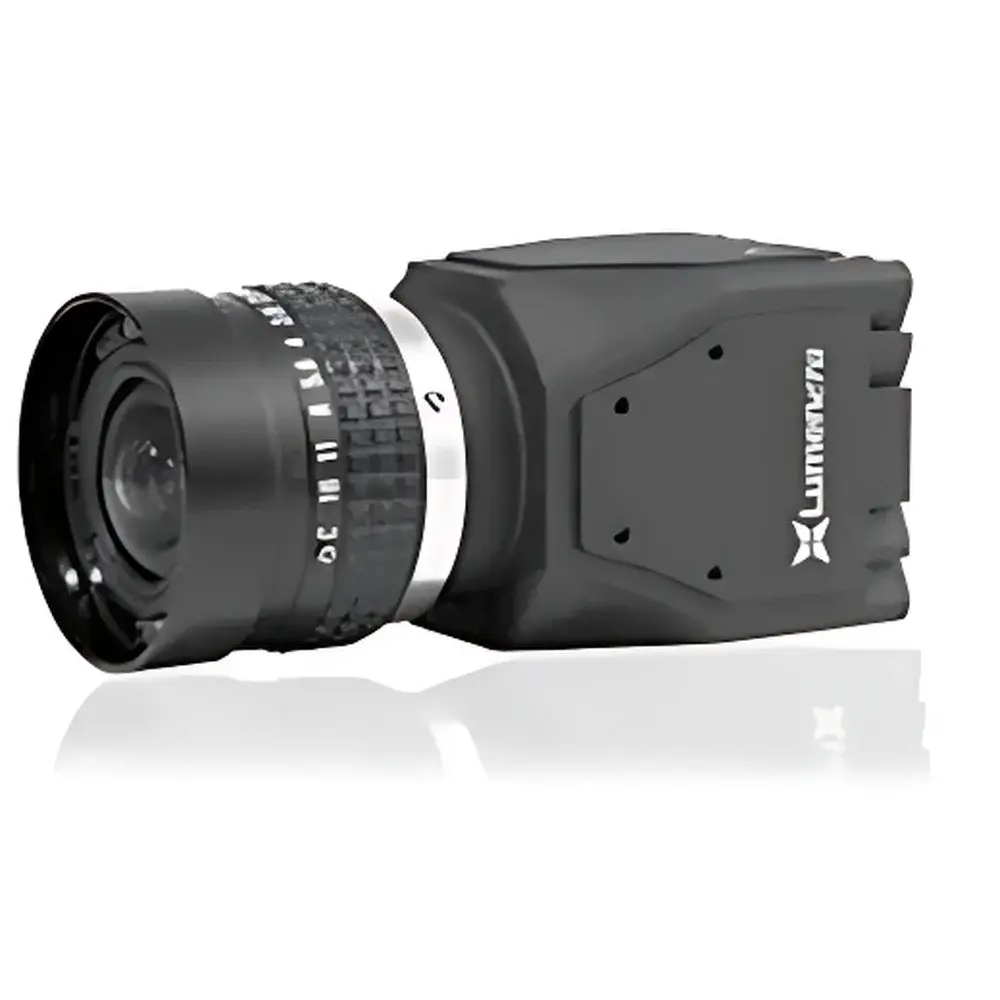
Lumenera Lt225 USB 3.0 High-Resolution Global Shutter CMOS Camera
| Brand | Lumenera |
|---|---|
| Origin | Canada |
| Manufacturer Type | Authorized Distributor |
| Origin Category | Imported |
| Model | Lt225 |
| Imaging Sensor | CMOSIS CMV2000 (Color/Monochrome/NIR) |
| Sensor Size | 2/3" |
| Pixel Size | 5.5 × 5.5 µm |
| Resolution | 2048 × 1048 pixels |
| ROI Control | Any multiple of 8 × 8 |
| Frame Rate | 170 fps at full resolution |
| Bit Depth | 8-bit or 12-bit selectable |
| Gain Range | 1.0–1.6× |
| Dynamic Range | 60 dB |
| Full Well Capacity | 13,500 e⁻ |
| Peak Quantum Efficiency | 45% (color), 64% (monochrome) |
| Read Noise | 13 e⁻ |
| Dark Current | 125 e⁻/s (@25 °C die temperature) |
| Interface | USB 3.0 with micro locking connector |
| Lens Mount | C-Mount |
| Dimensions | 40 × 40 × 53 mm |
| Mass | 138 g |
Overview
The Lumenera Lt225 is a high-performance, USB 3.0–enabled industrial imaging camera engineered for precision machine vision and scientific applications requiring high frame rates, global shutter synchronization, and consistent pixel-level fidelity. Built around the CMOSIS CMV2000 sensor—a globally shuttered, rolling-readout–optimized CMOS device—the Lt225 eliminates motion-induced distortion in fast-moving scenes without mechanical shutter dependency. Its 2/3″ optical format, combined with 5.5 µm square pixels and native 2048 × 1048 resolution, delivers an optimal balance between spatial sampling density and light collection efficiency. The camera operates across visible, near-infrared (NIR), and monochrome spectral configurations, supporting application-specific sensor variants to meet varying quantum efficiency and spectral response requirements. Designed for continuous-duty operation in industrial environments, the Lt225 features thermally stable housing, robust mechanical construction, and lockable USB 3.0 connectivity—ensuring data integrity during sustained acquisition cycles typical in automated inspection, traffic analytics, and real-time motion control systems.
Key Features
- Global electronic shutter architecture enabling artifact-free imaging of high-speed targets (e.g., conveyor belts, rotating machinery, vehicle passage)
- USB 3.0 interface with micro locking connector for vibration-resistant, high-bandwidth (up to 400 MB/s) image streaming and deterministic latency
- Hardware-accelerated region-of-interest (ROI) selection in increments of 8 × 8 pixels, allowing dynamic resolution–frame rate trade-offs without host CPU overhead
- Selectable 8-bit or 12-bit pixel depth per acquisition, configurable via software API to match dynamic range requirements and storage constraints
- Low-noise analog signal chain: 13 e⁻ read noise and 125 e⁻/s dark current (measured at 25 °C die temperature) support quantitative intensity analysis in low-light conditions
- C-mount lens interface with standardized flange distance (17.526 mm), compatible with industry-standard telecentric, macro, and wide-angle optics
- Compact form factor (40 × 40 × 53 mm) and lightweight design (138 g) facilitate integration into space-constrained OEM subsystems and embedded vision platforms
Sample Compatibility & Compliance
The Lt225 supports diverse sample modalities through its spectral flexibility: color variants enable RGB-based classification and surface defect mapping; monochrome versions maximize photon capture for fluorescence or low-signal transmission microscopy; NIR-optimized sensors extend usability into 700–1000 nm bands for semiconductor wafer inspection or agricultural phenotyping. All configurations comply with CE, FCC Class A, and RoHS directives. For regulated environments—including ISO 13485–certified medical device manufacturing or GLP-compliant analytical labs—the camera’s deterministic trigger timing, non-volatile configuration storage, and metadata-embedded TIFF/RAW output formats support audit-ready documentation workflows. While not FDA 21 CFR Part 11–certified out-of-the-box, the SDK enables integration with validated software platforms that implement electronic signatures and audit trail logging.
Software & Data Management
Lumenera provides the fully documented Lt225 Software Development Kit (SDK), supporting Windows, Linux (x86_64), and macOS platforms. The SDK includes C/C++, Python, MATLAB, and .NET bindings, along with sample code for synchronous multi-camera triggering, hardware ROI streaming, and real-time histogram analysis. Image data is delivered in lossless formats—including packed 12-bit RAW, TIFF, and AVI—with embedded timestamping (µs resolution), sensor temperature telemetry, and exposure/gain metadata. Integration with third-party frameworks such as HALCON, OpenCV, and National Instruments Vision Builder AI is validated. For long-duration acquisitions, the SDK supports ring-buffer memory management and direct-to-disk streaming with checksum verification to prevent data corruption during multi-hour sessions.
Applications
- Traffic monitoring and automatic license plate recognition (ALPR), where global shutter eliminates smearing across high-velocity vehicles
- High-speed industrial inspection: PCB solder-joint verification, pharmaceutical blister-pack seal integrity, and automotive component dimensional metrology
- Scientific imaging: time-resolved particle tracking, flow visualization in microfluidic channels, and pump-probe experiments requiring precise inter-frame synchronization
- OEM system integration: embedded into portable spectrometers, handheld NIR analyzers, and robotic vision guidance modules
- Academic research: quantitative biology (cell motility assays), materials science (grain boundary dynamics), and physics education labs requiring reproducible, low-latency image capture
FAQ
Is the Lt225 suitable for use in vacuum or extreme temperature environments?
No—the camera is rated for ambient operation between 0 °C and 50 °C and is not hermetically sealed or vacuum-compatible. External thermal management is required for extended operation above 40 °C.
Does the SDK support GenICam-compliant configuration?
No—the Lt225 uses Lumenera’s proprietary protocol stack. However, GenTL transport layer compatibility is available via optional middleware for integration into GenICam–based vision ecosystems.
Can I synchronize multiple Lt225 units with sub-microsecond jitter?
Yes—hardware trigger input/output lines support master-slave cascading with ≤500 ns inter-unit skew when using external precision clock distribution.
What is the maximum sustained frame rate when streaming 12-bit data over USB 3.0?
At full resolution (2048 × 1048), the sustained throughput is 170 fps with 12-bit packing enabled; ROI reduction increases frame rate linearly with pixel count reduction.
Is firmware update capability provided through the host interface?
Yes—field-upgradable firmware is supported via the SDK, with rollback protection and CRC-verified installation to ensure system stability post-update.




