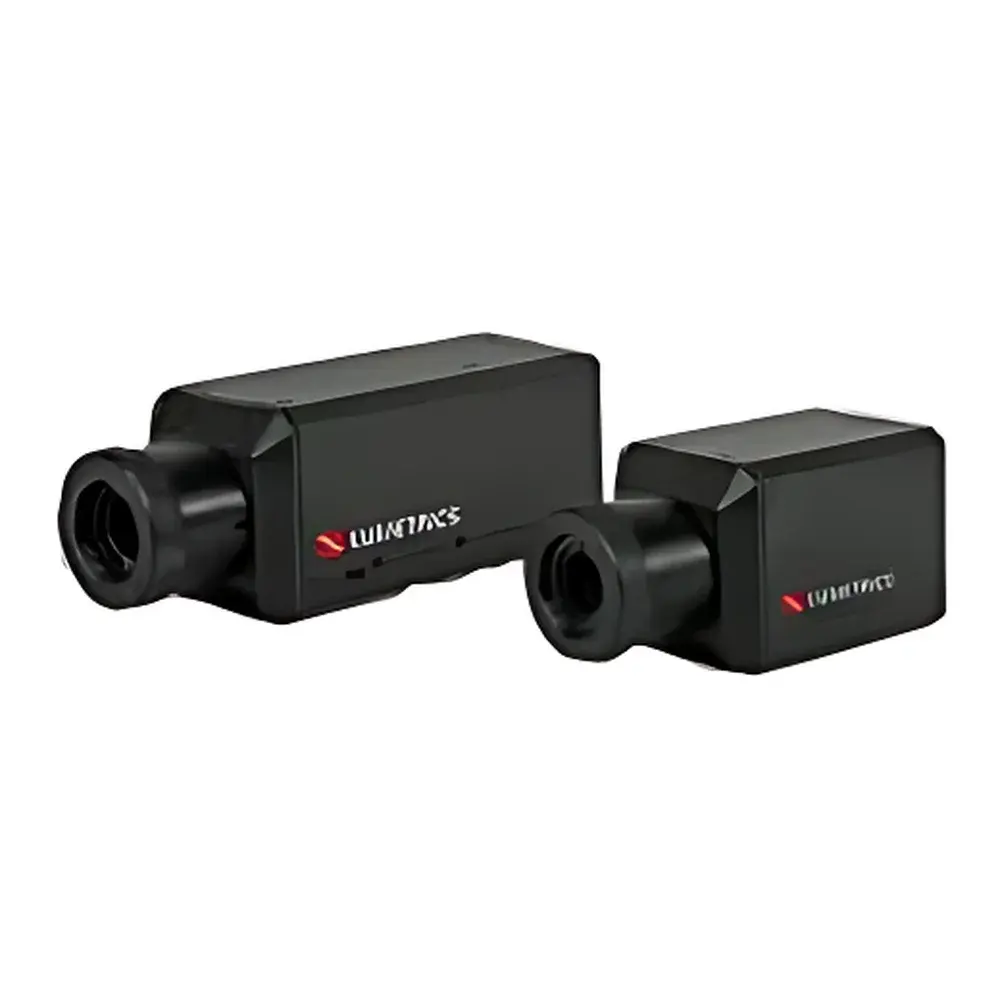
Lumetrics CLAS-2D Wavefront Analyzer
| Origin | USA |
|---|---|
| Manufacturer Type | Authorized Distributor |
| Origin Category | Imported |
| Model | CLAS-2D |
| Price | USD 48,500 (FOB) |
Overview
The Lumetrics CLAS-2D Wavefront Analyzer is a compact, high-performance, four-wave lateral shearing interferometric sensor engineered for rapid, non-contact, and quantitative measurement of optical wavefront phase aberrations in laser beams and collimated light. Operating on the principle of multi-channel lateral shearing interferometry—distinct from conventional Shack–Hartmann or curvature sensing—the CLAS-2D captures full-field wavefront gradients simultaneously across its micro-lens array, enabling direct reconstruction of absolute phase with sub-wavelength accuracy. Designed for integration into adaptive optics (AO) loops, precision optical alignment workflows, and R&D-grade beam characterization, the instrument delivers real-time wavefront data without requiring reference beams or complex calibration procedures. Its architecture supports three native spectral bands: UV–VIS–NIR (300–1100 nm), SWIR (1100–1700 nm), and MWIR (8.0–9.2 µm), making it uniquely suited for cross-band optical system validation—from ultrafast Ti:sapphire lasers to quantum cascade laser diagnostics and thermal imaging optics.
Key Features
- Four-wave lateral shearing interferometry (4WLSI) core engine—eliminates reliance on external references or moving parts
- Simultaneous acquisition of wavefront slope gradients in both x- and y-directions across full aperture
- Sub-λ/100 RMS sensitivity (model-dependent; CLAS-2D base configuration achieves λ/50 at 633 nm)
- Dynamic range up to 120λ (peak-to-valley) without range switching or hardware reconfiguration
- Achromatic design optimized for broadband operation across specified spectral bands
- Integrated high-speed CMOS imaging sensor with 12-bit digitization and >100 Hz frame rate (full resolution)
- Compact form factor (≤120 × 120 × 85 mm) with standard C-mount and kinematic mounting interfaces
- Field-replaceable lenslet arrays supporting customizable spatial sampling densities (e.g., 102 × 102, 68 × 68, down to 29 × 29)
Sample Compatibility & Compliance
The CLAS-2D accepts collimated or near-collimated beams with diameters ranging from 1 mm to 25 mm (dependent on selected lenslet array and focal length module). It is compatible with continuous-wave (CW) and pulsed lasers (≥10 ns pulse width), including excimer, diode, fiber, solid-state, and quantum cascade sources. All CLAS-2D configurations comply with ISO 10110-5 (surface irregularity specification), ISO 14132-3 (optical test instruments—terminology and definitions), and ASTM E284 (standard terminology relating to optics). Data integrity meets GLP/GMP traceability requirements when used with optional audit-trail-enabled software modules compliant with FDA 21 CFR Part 11. No hazardous materials or Class 3B/4 laser components are integrated into the sensor head—user safety aligns with IEC 60825-1:2014.
Software & Data Management
The CLAS-2D is shipped with Lumetrics’ proprietary WaveView™ software suite (v5.2+), a Windows-based application providing real-time phase visualization, Zernike polynomial decomposition (up to 36 terms), PV/RMS error reporting, M² estimation (when paired with beam profiler), and export of calibrated phase maps in HDF5, TIFF, and CSV formats. The SDK includes C/C++, Python, and MATLAB APIs for OEM integration and custom AO loop development. All software modules support time-stamped metadata logging—including environmental temperature, exposure settings, and user-defined experiment IDs—and enable automated pass/fail thresholding per ISO 10110-5 tolerancing. Optional WaveControl™ add-on enables closed-loop AO operation with third-party deformable mirrors and SLMs via TCP/IP or USB 3.0.
Applications
- Adaptive optics system commissioning and closed-loop performance validation (astronomy, ophthalmology, free-space optical communications)
- High-precision alignment and wavefront error mapping of large-aperture telescopes, collimators, and parallel optical paths
- Characterization of aspheric and freeform optics—including molded IR lenses, off-axis paraboloids, and diffractive elements
- Beam quality assessment of ultrafast amplifiers and OPCPA systems (pulse-front tilt, spatio-temporal coupling analysis)
- In-process metrology of optical coatings and thin-film stacks via wavefront shift monitoring
- Wavefront-guided iris registration and aberration compensation in clinical aberrometry platforms
- Thermal drift quantification in satellite-borne optical benches under vacuum and thermal cycling conditions
- Validation of computational imaging systems, including coded aperture and phase retrieval architectures
FAQ
Does the CLAS-2D require external calibration with a reference flat?
No. The 4WLSI architecture is intrinsically self-referencing and does not rely on external calibration standards for absolute phase retrieval.
Can the CLAS-2D measure diverging or converging beams directly?
It is designed for collimated or quasi-collimated input. Divergent/convergent beams must be relayed through a collimation telescope prior to measurement.
Is the MWIR (8–9.2 µm) configuration compatible with cryogenic environments?
Yes—the CLAS-NearIR-640 variant features a thermally stabilized housing and InSb-compatible optics rated for operation between –40 °C and +60 °C.
What is the minimum measurable wavefront gradient?
Typical slope resolution is 0.5 µrad RMS for the CLAS-2D base configuration (102 × 102 array, f = 4.75 mm), limited by photon shot noise and detector readout stability.
Does WaveView™ support automated report generation compliant with ISO/IEC 17025?
Yes—customizable templates include instrument ID, operator signature, uncertainty budget propagation, and revision-controlled PDF export with embedded digital signatures.