
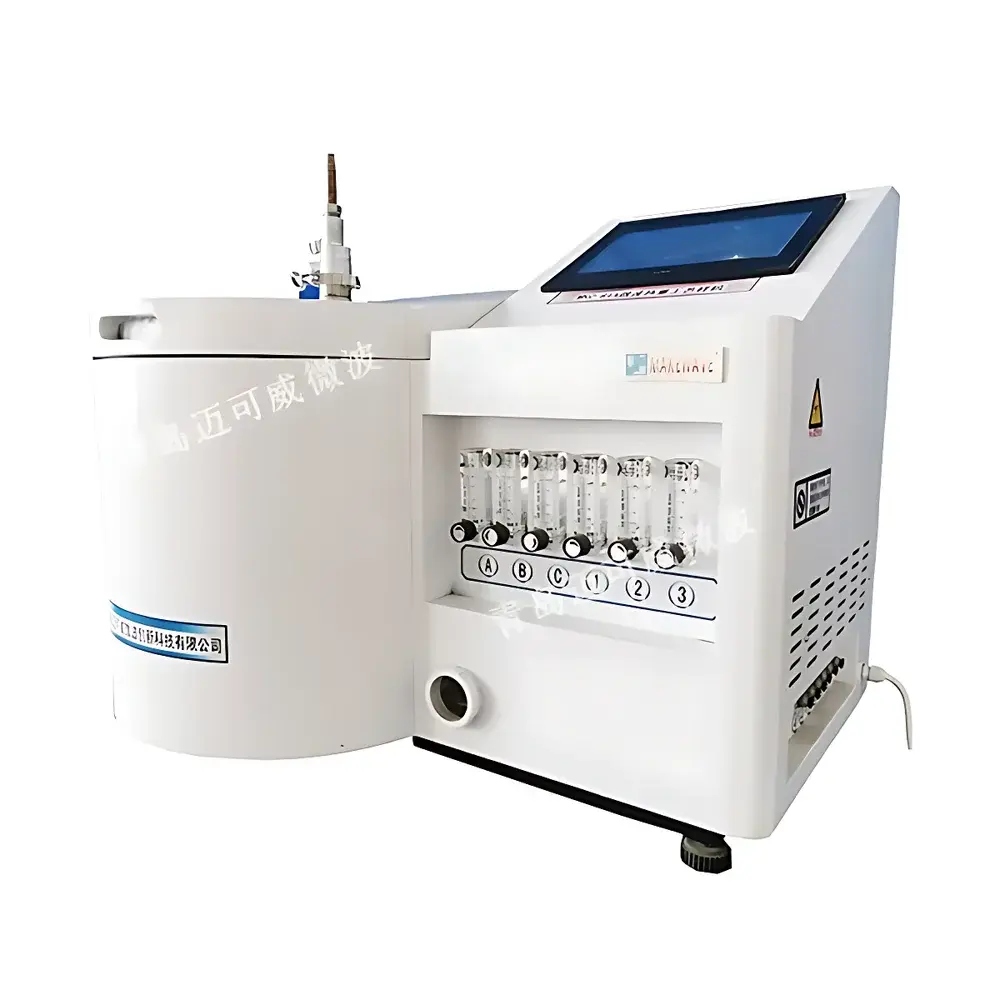
MakeWave MKC-R1A Microwave-Enhanced Thermogravimetric Analyzer (Residue Analysis)
| Brand | MakeWave |
|---|---|
| Origin | Shandong, China |
| Manufacturer Type | Direct Manufacturer |
| Country of Origin | China |
| Model | MKC-R1A |
| Price Range | USD 14,000–28,000 |
| Temperature Range | 0–900 °C |
| Temperature Accuracy | ±3 K |
| Balance Sensitivity | 1 µg |
| Heating/Cooling Rate | Up to 100 K/min |
Overview
The MakeWave MKC-R1A is a purpose-engineered microwave-enhanced thermogravimetric analyzer designed for high-fidelity residue quantification—specifically ash content, char yield, and inorganic residue profiling—under controlled atmospheric and dynamic thermal conditions. Unlike conventional TGA systems relying on resistive or infrared heating, the MKC-R1A integrates 2450 MHz continuous-wave microwave energy as the primary thermal excitation source. This enables volumetric, dielectric heating directly within the sample matrix, resulting in rapid, uniform internal energy deposition—particularly advantageous for heterogeneous, low-thermal-conductivity, or high-dielectric-loss materials. The system operates on the principle of real-time mass tracking under precisely regulated microwave power, temperature, and gas environment, delivering TG, dTG, and derivative Ft curves with sub-milligram resolution. Its architecture bridges classical thermogravimetry with emerging microwave-material interaction science, supporting research into dielectric loss tangent (tan δ), complex permittivity (ε*), and non-equilibrium thermal decomposition pathways.
Key Features
- Microwave-specific TGA platform optimized for residue analysis (ash, char, fixed carbon) in solid-state thermal processing
- Integrated high-stability microbalance with 50 g capacity and 1 µg sensitivity, calibrated for operation up to 900 °C
- Vertical well-type cavity design (500 mL internal volume) with top-loading ceramic crucibles (20–50 mL), enabling rapid sample insertion and minimal thermal disturbance
- Hermetic atmosphere chamber with three independent mass-flow-controlled gas inlets; supports positive-pressure operation and inert, oxidative, or reactive gas mixtures
- Real-time closed-loop control of both microwave power (0–800 W, non-pulsed, continuously variable) and sample temperature (0–900 °C), monitored via direct-contact-free infrared pyrometry
- PLC-based control system with 7-inch HMI touchscreen interface; stores multiple user-defined thermal programs with time-temperature-power profiles
- Compliance-grade safety architecture: λ/4 choke-sealed top lid with interlocked power cutoff, thermal insulation, and verified microwave leakage <5 mW/cm² (IEC 61000-4-3 compliant)
Sample Compatibility & Compliance
The MKC-R1A accommodates a broad range of solid and powdered samples—including polymers, biomass, coal, pharmaceutical excipients, catalysts, and ceramic precursors—within standard high-purity alumina or silicon carbide crucibles. Its microwave-driven heating mechanism eliminates thermal lag and surface-dominated heating artifacts common in resistance-heated TGAs, thereby improving reproducibility for materials exhibiting strong dielectric contrast. The system meets ISO 9001:2015 quality management requirements and incorporates engineering safeguards aligned with IEC 61010-1 (electrical safety) and IEC 62493 (electromagnetic compatibility for household and similar equipment). While not certified for GMP production environments, its data logging, program traceability, and audit-ready parameter recording support GLP-compliant laboratory workflows. Optional add-ons—including condensable vapor trapping and online gas sampling ports—facilitate evolved gas analysis (EGA) integration per ASTM E1131 and ISO 11358 methodologies.
Software & Data Management
Data acquisition and visualization are handled through an embedded industrial PLC runtime with synchronized timestamping across all channels: mass (mg), temperature (°C), microwave power (W), time (s), and gas flow rates (mL/min). Real-time plots of TG, dTG, and Ft (fractional mass loss) are rendered on-screen and exportable in CSV and ASCII formats for post-processing in MATLAB, Origin, or Thermo-Calc-compatible platforms. Each experimental run generates a metadata-rich log file containing instrument ID, operator tag, calibration status, ambient conditions, and full thermal protocol history—enabling full traceability. No proprietary binary formats or vendor-locked software dependencies are employed; raw data streams are accessible via USB or optional Ethernet interface for LIMS integration.
Applications
- Quantitative ash and volatile matter determination in coal, coke, and biochar per ASTM D3174 and ISO 1171
- Thermal stability assessment of flame-retardant polymers and nanocomposites under nitrogen/air switching protocols
- In-process monitoring of catalytic precursor decomposition and metal oxide formation kinetics
- Residue profiling of pharmaceutical tablets and excipients during forced degradation studies (ICH Q1A)
- Dielectric property mapping via controlled microwave power ramping at fixed temperature—correlating tan δ with mass loss onset
- High-throughput screening of biomass pyrolysis yields under variable heating rates (1–100 K/min)
FAQ
What distinguishes microwave heating from conventional resistive heating in TGA?
Microwave heating delivers energy volumetrically via dipole rotation and ionic conduction, reducing thermal gradients and enabling faster, more uniform heating—especially beneficial for insulating or layered samples where conductive heat transfer is inefficient.
Can the MKC-R1A perform simultaneous DTA or DSC measurements?
No. The MKC-R1A is a dedicated thermogravimetric platform. It does not integrate differential thermal analysis or calorimetric sensors. However, evolved gas analysis (EGA) can be coupled externally via its standardized gas outlet port.
Is the system compatible with regulatory-compliant electronic records (e.g., FDA 21 CFR Part 11)?
The base configuration provides audit-trail-capable data logging but lacks electronic signature, role-based access control, and automated backup required for full 21 CFR Part 11 compliance. These capabilities may be added via validated third-party LIMS middleware.
What crucible materials are recommended for 900 °C operation?
Alumina (Al₂O₃) crucibles rated to 1600 °C are standard; silicon carbide (SiC) crucibles are available for enhanced microwave coupling in high-loss applications.
Does the system require external cooling water or compressed air?
No. The MKC-R1A operates with passive air cooling and requires only a standard 220 VAC / 50 Hz supply. Exhaust is routed through a top-mounted natural draft vent compatible with standard fume hoods.



