
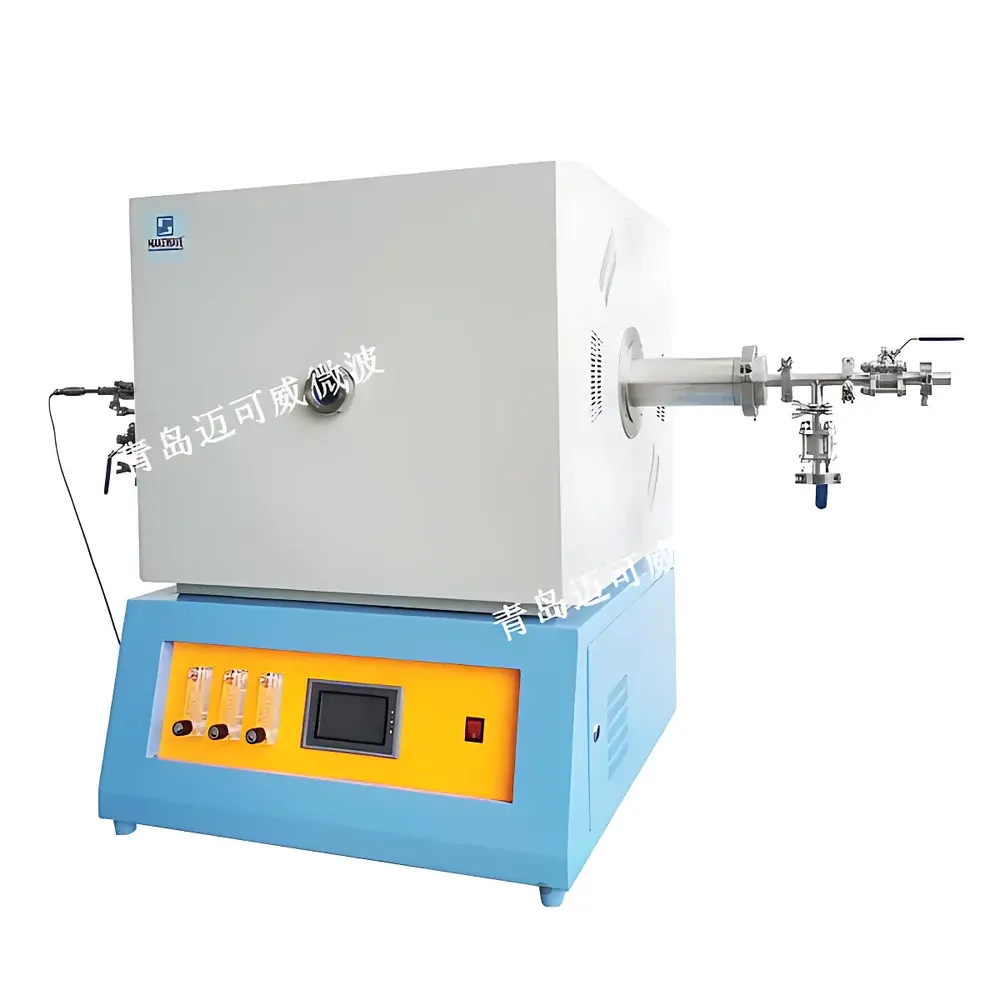
MakeWave MKG-GM2H50 Dual-Mode Microwave & Electrically Heated Vacuum High-Temperature Tube Furnace
| Brand | MakeWave |
|---|---|
| Origin | Shandong, China |
| Manufacturer Type | Direct Manufacturer |
| Product Category | Tube Furnace |
| Max Temperature | 1200°C |
| Temperature Control Accuracy | ±3°C |
| Total Rated Power | 7000 W (Microwave: 1600 W @ 2450 MHz |
| Electrical Heating | 1500 W) |
| External Dimensions | 1705 × 920 × 700 mm (W × H × D) |
| Tube Diameter Compatibility | Φ50 mm standard (customizable up to Φ230 mm) |
| Vacuum Range | 0 to –0.099 MPa |
| Cooling Method | Air-cooled |
| Weight | 90 kg |
| Compliance | ISO 9001 certified |
Overview
The MakeWave MKG-GM2H50 is an engineered dual-mode high-temperature tube furnace integrating microwave volumetric heating and resistive electric heating within a fully sealed, vacuum-capable quartz or ceramic tube environment. Unlike conventional resistance-heated tube furnaces—where heat transfers radially inward from the outer wall—the MKG-GM2H50 enables rapid, uniform, and selective energy coupling directly into the sample volume via 2450 MHz microwave irradiation. This hybrid architecture supports both kinetic-limited high-temperature synthesis (e.g., rapid carbothermal reduction, nitridation, or crystallization) and thermodynamically controlled annealing under precisely regulated atmospheres. The system operates across ambient to 1200°C, with real-time temperature feedback via embedded K-type thermocouples positioned adjacent to the sample zone—ensuring accurate process replication in research-scale material development, catalyst activation, and functional ceramic sintering.
Key Features
- Dual independent heating modalities: 1600 W continuous-wave microwave source (water-cooled magnetron, non-pulsed output) and 1500 W programmable resistive heating—operable separately, sequentially (‘relay mode’), or simultaneously for synergistic thermal profiles.
- Vacuum-tight stainless-steel (304) resonant cavity with full-flange metal sealing, rated for operation down to –0.099 MPa (absolute pressure), compatible with standard mechanical vacuum pumps and optional gas-dosing manifolds.
- Patented multi-layer insulation design (ZL200920352601.3): graded low-εr ceramic fiber modules reduce radial thermal conduction to ≤0.226 W/m·K, enabling stable high-temperature operation with minimized external surface temperature rise.
- Integrated PLC-based control system with 7-inch touchscreen HMI: stores up to 20 multi-segment heating programs; displays synchronized time–temperature–power curves; supports USB data export in CSV format for post-process analysis.
- Comprehensive safety architecture: conductive gasketed flanges limit microwave leakage to <5 mW/cm² (per GB 10436 and IEC 62233); dual-stage thermal shielding reduces external casing temperature to <50°C during 1200°C operation; interlocked door and vacuum/pressure sensors prevent unsafe startup conditions.
Sample Compatibility & Compliance
The MKG-GM2H50 accommodates cylindrical samples up to Φ50 mm diameter within standard fused quartz tubes (optional SiC, Al2O3, or BN tubes available per application requirements). Boat-type crucibles (50–100 mL capacity) are supplied in alumina, graphite, or silicon carbide variants to match microwave coupling behavior and chemical inertness. The system meets ISO 9001:2015 quality management standards and is designed for alignment with GLP-compliant lab practices—data logging includes timestamped temperature/power records with audit-trail capability. Vacuum integrity conforms to ASTM E595 outgassing specifications when operated with baked quartz components. Optional tri-gas mass-flow controller integration supports ASTM D3800 and ISO 11357-3-compliant thermal stability testing under reactive or inert atmospheres.
Software & Data Management
Control firmware implements closed-loop PID regulation of both temperature and microwave power, with adaptive tuning to compensate for load-dependent impedance shifts. All operational parameters—including ramp rates, dwell times, vacuum setpoints, and gas flow ratios—are configurable via intuitive touchscreen menus. Historical run data (time-stamped temperature, power, vacuum level, and thermocouple voltage) are stored internally and exportable to USB drives without proprietary software dependencies. Raw data files comply with ASTM E1447-21 formatting conventions for thermal process documentation, facilitating integration into LIMS environments or FDA 21 CFR Part 11–aligned electronic lab notebooks (when paired with validated third-party validation packages).
Applications
- Rapid synthesis of nanoscale metal oxides (e.g., LiFePO4, TiO2) with suppressed grain growth via microwave-selective heating.
- Vacuum-debinding and sintering of MIM (metal injection molding) feedstocks under oxygen-free conditions.
- Controlled atmosphere annealing of 2D materials (graphene, MXenes) requiring sub-ppm O2/H2O environments.
- Thermal decomposition kinetics studies of energetic materials or pharmaceutical intermediates under programmable vacuum ramps.
- High-temperature calibration of thermocouples and reference materials per ISO/IEC 17025-accredited protocols.
FAQ
Can the MKG-GM2H50 operate under hydrogen or ammonia atmospheres?
Yes—when equipped with optional corrosion-resistant gas manifolds and leak-tested quartz tubing, it supports Class II hazardous gas service per CGA G-1.1 guidelines.
Is microwave-specific safety training required for operators?
While the integrated shielding meets international leakage limits, users must complete site-specific RF safety orientation per IEEE C95.1 prior to first operation.
What vacuum pump compatibility is supported?
The system interfaces with standard two-stage rotary vane pumps (e.g., Edwards RV8, Leybold TRIVAC D); turbomolecular pumping is supported via optional CF-63 flange adapters.
How is temperature uniformity validated across the hot zone?
Uniformity mapping per ASTM E220 is performed at factory acceptance using five-point thermocouple profiling; typical axial deviation is ±8°C over 100 mm length at 1100°C.
Does the system support remote monitoring via Ethernet or Modbus?
Yes—RS485 Modbus RTU interface is standard; optional Ethernet/IP gateway enables SCADA-level integration with laboratory building management systems.



