
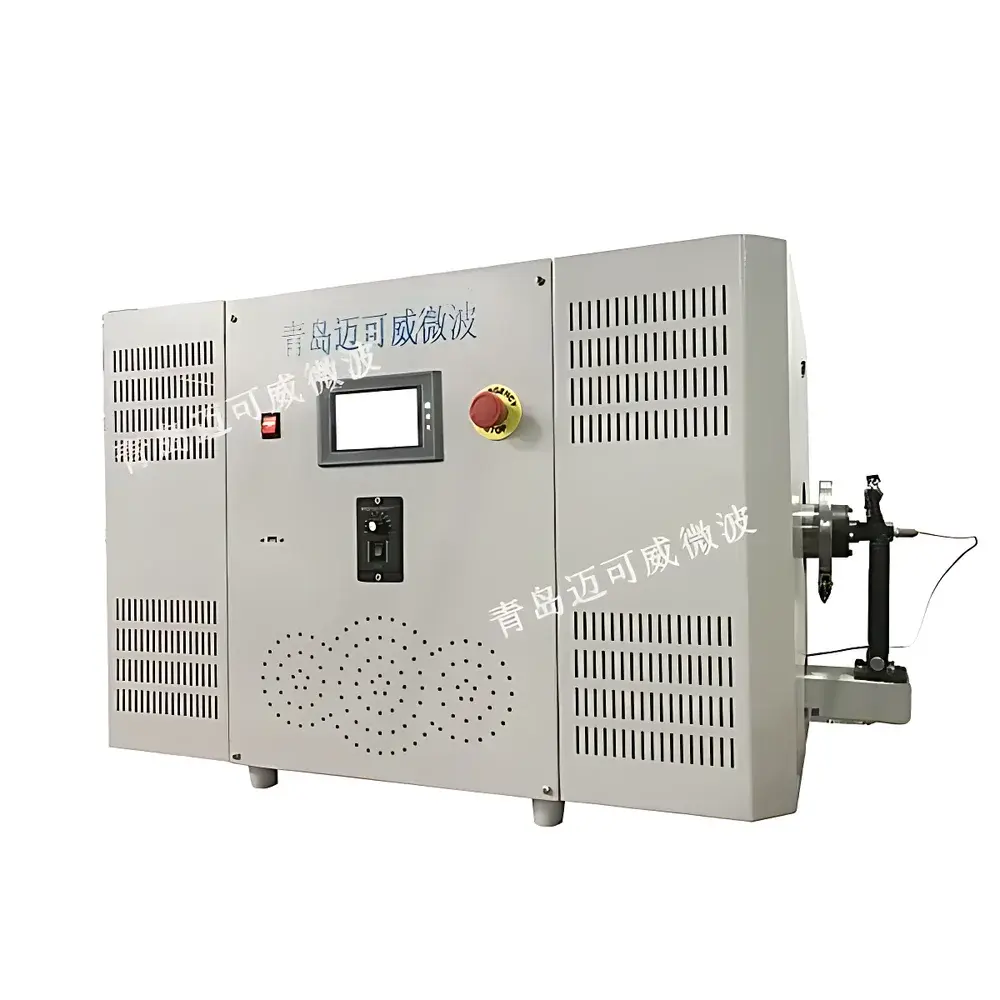
Makewave MKG-M4RA Rotating Microwave High-Temperature Tube Furnace
| Brand | Makewave |
|---|---|
| Origin | Shandong, China |
| Manufacturer Type | Direct Manufacturer |
| Product Category | Domestic |
| Model | MKG-M4RA |
| Instrument Type | Rotary Microwave Tube Furnace |
| Max Temperature | 900 °C |
| Temperature Control Accuracy | ±3 °C |
| Rated Microwave Power | 3200 W @ 2450 MHz |
| Heating Time to Max Temp | ≤20 min |
| Heating Method | Continuous Non-pulsed Microwave Energy |
| Internal Tube Diameter | Φ100 mm (for sample placement) |
| Chamber Construction | 304 Stainless Steel, Fully Sealed Resonant Cavity |
| Microwave Leakage | <5 mW/cm² |
| Power Supply | 220 V AC / 50 Hz |
| Total System Power Consumption | 5500 W |
| Dimensions (W×H×D) | 1800 × 600 × 700 mm |
| Weight | 75 kg |
| Compliance | ISO 9001 Certified |
Overview
The Makewave MKG-M4RA is a precision-engineered rotating microwave high-temperature tube furnace designed for advanced materials synthesis, thermal treatment, and controlled-atmosphere processing in research and pilot-scale laboratories. Unlike conventional resistance-heated tube furnaces, the MKG-M4RA employs continuous non-pulsed 2450 MHz microwave energy to achieve rapid, volumetric, and selective heating of dielectric and susceptive materials. Its integrated rotary motion system enables uniform thermal exposure across heterogeneous or granular samples—critical for consistent phase transformation, sintering, carbothermic reduction, and catalyst activation. The furnace operates within a fully sealed, gas-tight stainless-steel resonant cavity and supports both ambient, inert, reducing, and reactive atmospheres via configurable multi-gas inlet manifolds. With a maximum operating temperature of 900 °C and real-time infrared pyrometry directly monitoring sample surface temperature—not just furnace wall—the MKG-M4RA delivers superior thermal fidelity and reproducibility under dynamic process conditions.
Key Features
- Rotary microwave platform with continuously adjustable rotation speed (0–30 rpm), ensuring homogeneous heat distribution and mitigating thermal gradients in powder, pellet, or fiber-based samples.
- Optimized microwave cavity: 304 stainless-steel monolithic welded construction with full electromagnetic shielding; incorporates graded low-dielectric-loss ceramic fiber insulation (thermal conductivity ≈ 0.226 W/m·K) for minimized parasitic heat loss and enhanced energy efficiency.
- Φ100 mm quartz tube (standard), compatible with optional alumina or silicon carbide tubes for elevated chemical stability or extended service life at high temperatures.
- Real-time closed-loop control of both microwave power (0–3200 W, stepless) and temperature (0–900 °C), enabled by industrial-grade PLC and 7-inch HMI touchscreen interface.
- Multi-program memory function supporting up to 20 customizable thermal profiles, each with ramp-soak-hold segments, power modulation, and rotation scheduling.
- Comprehensive safety architecture: conductor-clamped flange joints, dual-layer thermal insulation (tube core → inner ceramic → metal cavity → outer air gap), and verified microwave leakage <5 mW/cm² (IEC 61000-4-3 compliant).
Sample Compatibility & Compliance
The MKG-M4RA accommodates diverse sample forms—including powders, pellets, fibers, and thin films—within its rotating Φ100 mm tube configuration. Its modular gas handling system supports single- or multi-gas delivery (e.g., N₂, Ar, H₂, NH₃, CO/CO₂ mixtures) with mass flow controllers and pressure-regulated exhaust routing. Optional tail-gas sampling ports enable in-line FTIR or GC-MS coupling for reaction monitoring. The system meets ISO 9001 quality management requirements and adheres to electromagnetic compatibility (EMC) standards per IEC 61000 series. While not certified for GMP production environments, its data logging, user-access controls, and audit-trail-capable firmware support GLP-aligned documentation practices in academic and industrial R&D settings.
Software & Data Management
The embedded control system records time-stamped temperature, power, rotation speed, and gas flow parameters at user-defined intervals (1–60 s). All datasets export natively to CSV format for post-processing in MATLAB, Python (Pandas), or OriginLab. No proprietary software installation is required—data retrieval occurs via USB flash drive or Ethernet-connected file transfer. Firmware supports firmware-upgradable logic for future protocol expansion (e.g., Modbus TCP integration with central lab automation systems). All operational logs—including fault codes, door interlock events, and overtemperature cutoffs—are timestamped and retained for ≥30 days.
Applications
- Controlled-atmosphere annealing of battery cathode precursors (e.g., LiCoO₂, NMC, LFP) with reduced dwell times and improved crystallinity.
- Rapid carbothermal reduction of metal oxides (e.g., MoO₃ → Mo, WO₃ → W) under Ar/H₂ mixtures.
- In situ thermal decomposition studies of MOFs and covalent organic frameworks (COFs) with simultaneous off-gas analysis.
- Graphitization and heteroatom doping of carbon nanomaterials using CH₄/NH₃ carrier gases.
- Thermal aging tests of electronic packaging materials under simulated reflow or burn-in conditions.
- Preparation of high-purity ceramic coatings via microwave-assisted CVD within rotating substrate geometry.
FAQ
What types of tubes are compatible with the MKG-M4RA?
Standard configuration includes a fused quartz tube (Φ100 mm × 600 mm); optional replacements include high-purity alumina (Al₂O₃, up to 1650 °C) and silicon carbide (SiC, up to 1800 °C), subject to custom quotation.
Can the system operate under vacuum?
No—this model is engineered for positive-pressure atmosphere control only. Vacuum-rated variants (MKG-M4RA-V) are available upon request with reinforced flanges and KF40 vacuum feedthroughs.
Is infrared temperature measurement validated against thermocouple reference?
Yes—calibration traceability is provided against NIST-traceable blackbody sources at 300 °C, 600 °C, and 900 °C. Emissivity correction (0.1–0.99) is user-adjustable per material class.
Does the system support remote monitoring or integration with LabView?
Native Ethernet port enables Modbus TCP communication for third-party SCADA or LabVIEW integration; API documentation and register maps are supplied with purchase.
What maintenance is required for sustained microwave performance?
Annual inspection of waveguide gaskets, magnetron cooling airflow, and cavity interior cleanliness is recommended. No routine magnetron replacement is anticipated within first 5,000 operational hours under normal load conditions.



