
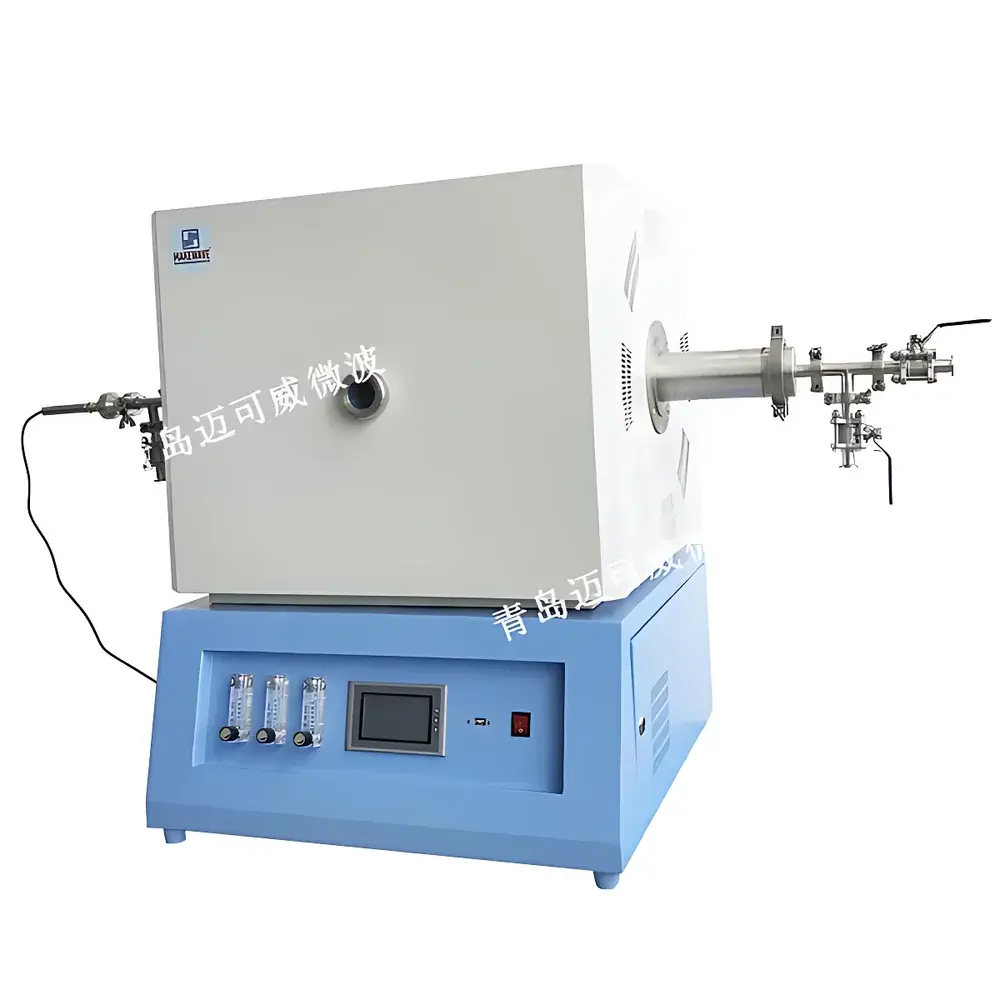
MakeWave MKG-T4H50 Microwave Vacuum High-Temperature Tube Furnace
| Brand | MakeWave |
|---|---|
| Origin | Shandong, China |
| Manufacturer Type | Direct Manufacturer |
| Country of Origin | China |
| Model | MKG-T4H50 |
| Instrument Type | Tube Furnace |
| Maximum Temperature | 1600 °C |
| Temperature Control Accuracy | ±3 °C |
| Rated Microwave Power | 3200 W at 2450 MHz |
| Heating Method | Continuous Non-pulsed Microwave Heating |
| External Dimensions | 1705 mm (W) × 920 mm (H) × 700 mm (D) |
| Tube Diameter Compatibility | Φ50 mm (standard), optional up to Φ100 mm |
| Vacuum Range | 0 to –0.099 MPa (absolute) |
| Cooling | Air-cooled (water-cooling optional) |
| Power Supply | 380 V AC / 50 Hz |
| Net Weight | 90 kg |
| Certification | ISO 9001 Certified |
Overview
The MakeWave MKG-T4H50 Microwave Vacuum High-Temperature Tube Furnace is an engineered platform for advanced materials processing under precisely controlled thermal, atmospheric, and electromagnetic conditions. Unlike conventional resistive tube furnaces, this system integrates continuous 2450 MHz microwave energy delivery with a fully sealed, vacuum-capable quartz or alumina tube configuration—enabling rapid, volumetric heating of dielectric and semiconducting samples while maintaining high-purity inert or reducing atmospheres. The furnace operates on the principle of selective microwave coupling: electromagnetic energy penetrates the sample directly, inducing internal dipole rotation and ionic conduction, thereby achieving faster thermal ramp rates and improved temperature uniformity across the heated zone compared to conductive/convective heating alone. Designed for R&D laboratories in ceramics, battery electrode synthesis, catalyst activation, and functional nanomaterials development, the MKG-T4H50 supports reproducible high-temperature treatments from 700 °C to 1600 °C within a Φ50 mm cylindrical reaction zone—fully compatible with standard high-purity alumina tubes and custom crucible systems.
Key Features
- Continuous non-pulsed microwave source (3200 W nominal, water-cooled magnetron) operating at 2450 MHz with closed-loop power regulation
- Hermetically sealed 304 stainless steel resonant cavity with multi-layer embedded insulation: low-emissivity ceramic fiber modules (thermal conductivity ≈ 0.226 W/m·K) minimize radial heat loss and enhance energy efficiency at elevated temperatures
- Integrated vacuum-compatible tube assembly: Φ50 mm high-purity alumina tube (optional SiC or quartz), flanged with conductive compression gaskets to suppress microwave leakage (<5 mW/cm², compliant with GB 10436 and ICNIRP guidelines)
- Infrared pyrometry system for direct surface temperature measurement—calibrated for emissivity compensation across common ceramic and metallic substrates
- PLC-based control architecture with 7-inch HMI touchscreen interface; real-time logging of time–temperature–power profiles with USB export capability (CSV format)
- Dual-mode operational flexibility: selectable vacuum (mechanical pump interface), inert gas purging (3-channel mass-flow-controlled inlet), or static ambient operation
- Modular safety architecture including interlocked door switches, overtemperature cutoff, pressure-relief venting, and active cooling monitoring
Sample Compatibility & Compliance
The MKG-T4H50 accommodates solid-state samples in boat-type crucibles (50–200 mL volume), including alumina, graphite, silicon carbide, and molybdenum variants—selected based on microwave coupling behavior and chemical compatibility with process gases. It supports ASTM C1171 (ceramic sintering), ISO 21361 (high-temperature material testing), and USP (residual solvent removal under controlled atmosphere). Vacuum performance meets industrial-grade requirements for oxide reduction and low-oxygen annealing (≤10⁻² mbar base pressure achievable with optional two-stage rotary vane pump). All electrical and microwave subsystems comply with IEC 61000-6-4 (EMC emission limits) and IEC 61000-6-2 (immunity standards). The unit is certified to ISO 9001:2015 for design, manufacturing, and service processes.
Software & Data Management
The embedded control firmware implements deterministic real-time scheduling for synchronized temperature ramping and microwave power modulation. Up to 20 independent process programs can be stored locally, each supporting segmented ramps, dwell steps, and conditional triggers (e.g., hold until vacuum reaches –0.095 MPa). Logged data includes timestamped values for chamber temperature, IR-measured sample temperature, forward/reflected microwave power, vacuum pressure, and gas flow rates—exportable via USB for post-processing in MATLAB, Python (Pandas), or LIMS-integrated platforms. Audit trails record operator ID, program selection, parameter modifications, and alarm events—supporting GLP/GMP documentation requirements under FDA 21 CFR Part 11 when paired with user-defined electronic signatures.
Applications
- Rapid sintering of oxide ceramics (e.g., ZnO, BaTiO₃) with reduced grain growth and enhanced density
- Controlled carbonization and graphitization of polymer-derived precursors under N₂ or Ar
- Thermal reduction of metal oxides (e.g., NiO → Ni, Co₃O₄ → Co) in vacuum or forming gas (H₂/N₂)
- High-temperature annealing of battery cathode materials (LiCoO₂, NMC) to optimize crystallinity and oxygen stoichiometry
- Preparation of phosphor powders and quantum dot precursors requiring short dwell times at >1400 °C
- In-situ studies of phase transformations using synchronized thermogravimetric or optical emission feedback (external port available)
FAQ
What tube diameters are supported beyond the standard Φ50 mm?
Custom configurations accommodate Φ60 mm, Φ80 mm, and Φ100 mm tubes with corresponding cavity re-tuning and power calibration—subject to engineering review and extended lead time.
Can the furnace operate continuously at 1600 °C under vacuum?
Yes—rated for sustained operation at 1600 °C in vacuum or inert gas; however, long-term stability at maximum temperature requires optional water-cooling retrofit and periodic inspection of tube integrity and gasket performance.
Is infrared temperature measurement traceable to NIST standards?
The integrated pyrometer is factory-calibrated against blackbody references; users may perform field verification using calibrated secondary standards per ASTM E2847.
Does the system support automated gas switching during a single run?
Yes—the three-channel MFC manifold allows pre-programmed sequential or ratio-based gas introduction (e.g., switch from Ar to 5% H₂/Ar at 1200 °C), with pressure-compensated flow control.
What maintenance intervals are recommended for the microwave source?
Magnetron life expectancy exceeds 5000 hours under normal duty cycle; routine checks include coolant flow verification, waveguide arcing inspection, and vacuum seal integrity assessment every 200 operating hours.
Related Products



