
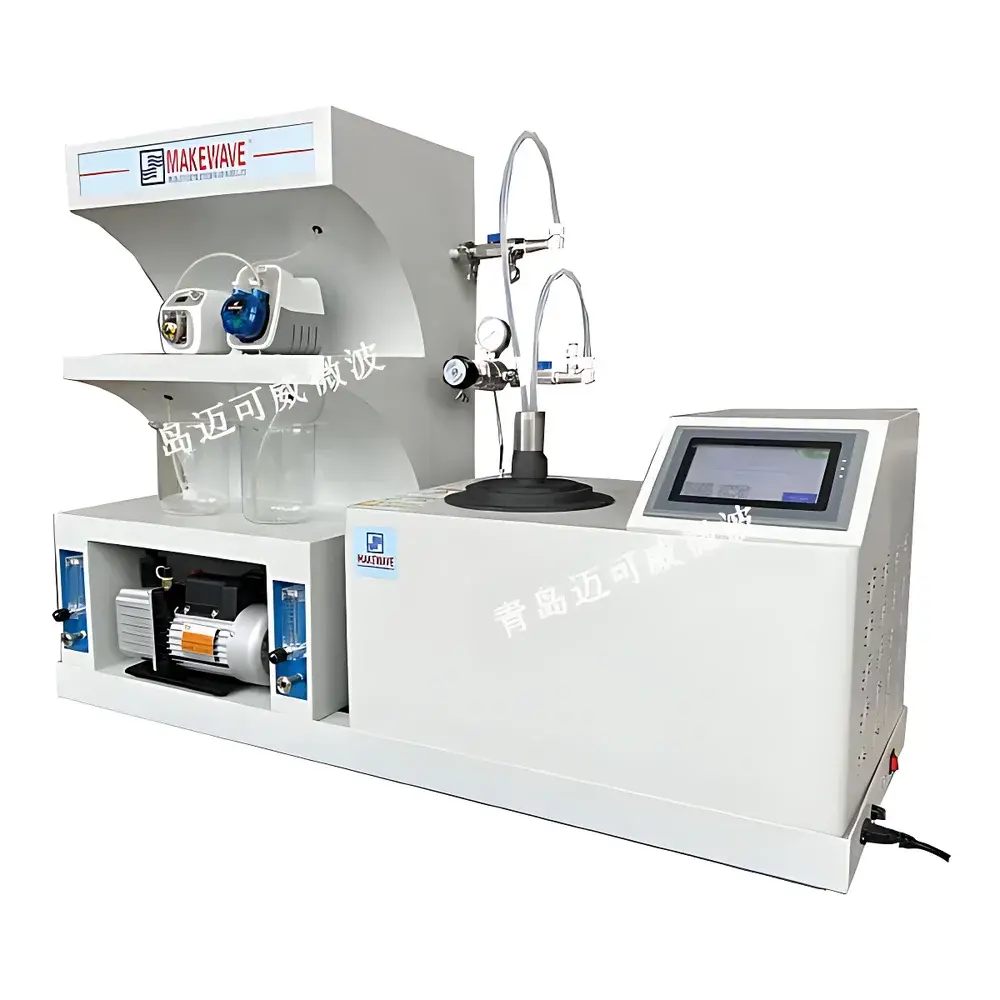
MakeWave MKM-CH1E Single-Mode Microwave Continuous-Flow Reactor
| Brand | MakeWave |
|---|---|
| Origin | Shandong, China |
| Manufacturer Type | Direct Manufacturer |
| Country of Origin | China |
| Model | MKM-CH1E |
| Vessel Volume | 1 L |
| Construction Material | 304 Stainless Steel (Internally PFA-Coated) |
| Operating Pressure Range | 0–0.5 MPa |
| Microwave Frequency | 2450 MHz |
| Microwave Power Output | 700 W (Continuously Adjustable, Non-Pulsed) |
| Temperature Control Range | 0–200 °C (Extended to 300 °C) |
| Flow Rate Range | 0–1000 mL/min |
| Reaction Tube Options | PFA tubing (Φ1 mm, Φ3 mm, Φ6 mm), Optional Glass Coiled Tubing |
| Safety Compliance | Microwave Leakage < 5 mW/cm² (IEC 61000-4-3 Equivalent), Interlocked Access Door, λ/4 Choke Seal, Real-Time Thermal & Overpressure Monitoring |
| Power Supply | 220 VAC / 50 Hz |
| Total Power Consumption | ≤1300 W |
| Dimensions (W×H×D) | 1270 × 923 × 472 mm |
| Net Weight | 75 kg |
Overview
The MakeWave MKM-CH1E Single-Mode Microwave Continuous-Flow Reactor is an engineered platform for precision-controlled, scalable microwave-assisted synthesis under dynamic flow conditions. Unlike conventional multimode cavity reactors—where field distribution is inherently heterogeneous—the MKM-CH1E employs a rigorously designed cylindrical single-mode resonant cavity operating at 2450 MHz. This architecture enables spatially confined, high-energy-density microwave coupling directly into the reaction stream, ensuring uniform volumetric heating with minimal thermal gradients across the reactor volume. The system operates on the principle of resonant mode excitation (TE011 dominant), where electromagnetic field distribution is analytically predictable and reproducible—critical for kinetic studies, process optimization, and regulatory-compliant method development. Designed for laboratory-scale continuous processing, it bridges the gap between batch microwave synthesis and industrial flow chemistry, supporting reaction residence times from seconds to minutes while maintaining strict control over temperature, pressure, and stoichiometric delivery.
Key Features
- Single-mode cylindrical resonant cavity (304 stainless steel, internally coated with multi-layer PFA) optimized for TE011 mode operation at 2450 MHz
- 700 W non-pulsed, continuously variable microwave power output with real-time feedback regulation
- 1 L effective cavity volume accommodating modular coiled reaction tubing systems (standard Φ6 mm PFA, optional Φ1 mm or Φ3 mm PFA, or borosilicate glass)
- Vertical-flow configuration enabling gravity-assisted phase management and eliminating dead-volume accumulation
- Closed-loop control of temperature (0–200 °C, extendable to 300 °C), pressure (0–0.5 MPa), and flow rate (0–1000 mL/min) via integrated PLC architecture
- Dual-sensor temperature monitoring: non-contact infrared pyrometry + embedded fiber-optic probe for cross-validated measurement
- Contact-type pressure transducer with digital compensation and alarm-triggered shutdown protocol
- Comprehensive safety architecture including interlocked access door, λ/4 choke seal, real-time microwave leakage monitoring (<5 mW/cm²), and redundant thermal cutoffs
Sample Compatibility & Compliance
The MKM-CH1E supports a broad spectrum of chemistries compatible with fluoropolymer and glass wetted materials—including acidic, basic, oxidizing, and halogenated reaction media. Its PFA-lined cavity and inert tubing options ensure compatibility with aggressive reagents commonly used in pharmaceutical intermediate synthesis (e.g., HNO3, HF, ClSO3H), transition-metal-catalyzed cross-couplings, and hydrothermal material synthesis. The system adheres to ISO 9001:2015 quality management requirements and incorporates design elements aligned with GLP and early-stage GMP expectations: full audit trail capability for parameter logging (time-stamped temperature/pressure/power/flow), user-access-level controls, and exportable CSV-formatted experimental records. While not certified to IEC 61010-1 or UL 61010-1 out-of-the-box, its electrical and mechanical safety subsystems meet equivalent performance benchmarks per EN 61000-6-3 (EMC) and EN 61000-6-4 (emission) standards.
Software & Data Management
The reactor integrates a dedicated HMI terminal running a deterministic real-time PLC control kernel. All operational parameters—including setpoints, actual values, and derivative signals (e.g., dT/dt)—are displayed simultaneously on a 10.1″ capacitive touchscreen with configurable trend plots. Up to 256 programmable protocols can be stored, each supporting multi-segment ramp/hold profiles with independent temperature-pressure-power constraints. Data acquisition occurs at 1 Hz resolution; raw time-series logs are stored internally and exportable via USB 2.0 to standard CSV files for post-processing in MATLAB, Python (Pandas), or industry-standard CQAs analysis tools. Optional Ethernet/IP or Modbus TCP interfaces enable integration into centralized lab automation networks (e.g., LabVantage, STARLIMS) for traceable workflow execution and electronic batch record generation.
Applications
- Pharmaceutical process R&D: rapid screening of API synthesis routes under controlled thermal profiles (e.g., Suzuki-Miyaura, Buchwald-Hartwig, SNAr)
- Continuous-flow heterocycle formation (triazoles, tetrazoles, benzimidazoles) with precise residence time control
- Hydrothermal nanomaterial synthesis (metal oxides, MOFs, perovskites) requiring simultaneous pressure and temperature modulation
- Microfluidic-scale catalytic hydrogenation and oxidation using gas–liquid segmented flow
- Accelerated solvent extraction (ASE) and enzymatic hydrolysis under pressurized microwave conditions
- Method transfer from batch microwave to continuous production-representative conditions for QbD implementation
FAQ
What distinguishes single-mode from multimode microwave reactors in continuous-flow applications?
Single-mode cavities generate a deterministic, high-field-intensity standing wave pattern ideal for uniform energy deposition into small-diameter flow paths. Multimode systems suffer from modal competition and hot/cold spots, limiting reproducibility and scalability in flow configurations.
Can the MKM-CH1E be integrated with existing lab infrastructure such as syringe pumps or gas mass flow controllers?
Yes—the system provides analog (0–10 V, 4–20 mA) and digital (Modbus RTU) I/O ports for synchronized control of external peristaltic pumps, MFCs, and back-pressure regulators.
Is the reactor suitable for reactions requiring inert or reducing atmospheres?
Optional dual-gas inlet manifold supports independent introduction of N₂, Ar, H₂, or CO, with pressure-balanced venting and inline oxygen monitoring compatibility.
How is calibration traceability maintained for temperature and pressure sensors?
Factory calibration certificates are provided for all primary sensors. Users may perform field verification using NIST-traceable reference probes inserted via dedicated service ports without disassembly.
What maintenance intervals are recommended for long-term reliability?
PFA tubing should be inspected after every 200 h of operation; cavity coating integrity verified annually; microwave waveguide gaskets replaced every 2 years or after 5000 cycles.



