
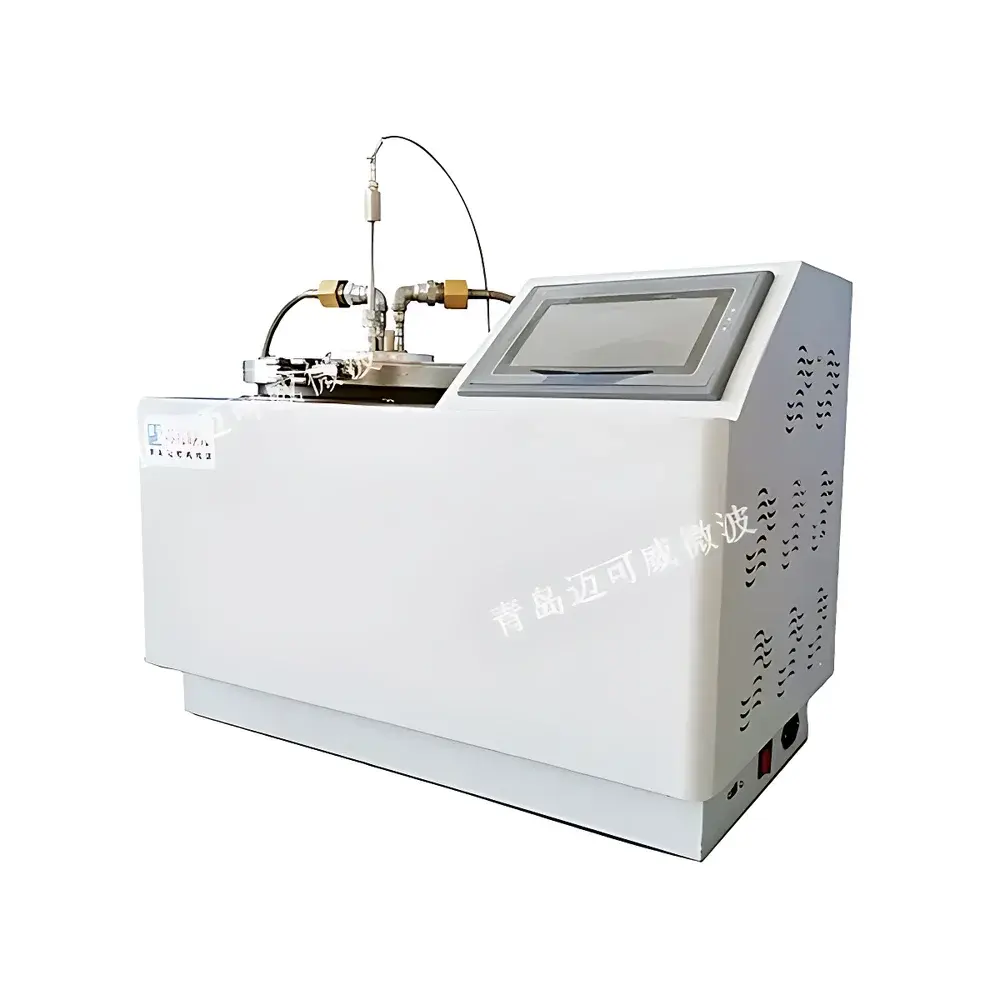
MakeWave MKM-H1G Single-Mode Microwave High-Pressure Synthesis Reactor
| Brand | MakeWave |
|---|---|
| Origin | Shandong, China |
| Manufacturer Type | Direct Manufacturer |
| Country of Origin | China |
| Model | MKM-H1G |
| Price Range | USD 14,000–28,000 (FOB) |
| Temperature Range | 0–300 °C |
| Pressure Range | 0–3 MPa (up to 10 MPa with external pressurization) |
| Microwave Power | 600 W (continuous, non-pulsed) |
| Magnetron Frequency | 2450 MHz |
| Stirring Method | Magnetic stirring |
| Reaction Volume | 1 L (cavity) |
Overview
The MakeWave MKM-H1G is a single-mode microwave high-pressure synthesis reactor engineered for precision-controlled, reproducible chemical transformations under elevated temperature and pressure conditions. Unlike conventional multimode microwave systems—where energy distribution is inherently heterogeneous—the MKM-H1G utilizes a rigorously tuned TM01 cylindrical resonant cavity to deliver spatially confined, high-energy-density microwave fields. This mode-selective architecture ensures uniform volumetric heating of reaction mixtures, minimizing thermal gradients and enabling strict adherence to Arrhenius-driven kinetics. Designed for closed-vessel operation, the system supports sealed reactions up to 300 °C and 10 MPa (with externally applied pressure), making it suitable for demanding applications in catalytic synthesis, hydrothermal material preparation, and rapid kinetic screening where conventional conductive heating fails to achieve required reaction rates or selectivity.
Key Features
- Single-mode TM01 resonant cavity fabricated from seamless 304 stainless steel with multi-layer PTFE coating for corrosion resistance in acidic, alkaline, and high-temperature environments
- Continuous, non-pulsed 600 W microwave output at 2450 MHz with real-time power modulation via closed-loop feedback control
- Integrated water-jacketed cooling structure for precise thermal management during exothermic or extended-duration reactions
- High-integrity 500 mL high-pressure reaction vessel with fiber-optic temperature sensing and magnetic stirring (PTFE-coated stir bar, variable speed)
- PLC-based control system with 7-inch industrial touchscreen interface; supports programmable ramp-hold profiles, data logging, and export of time-stamped temperature/pressure/power curves in CSV format
- Comprehensive safety architecture including λ/4 choke-sealed lid, interlocked door circuitry (instant power cutoff upon opening), and certified microwave leakage <5 mW/cm² (IEC 61000-4-3 compliant)
Sample Compatibility & Compliance
The MKM-H1G accommodates homogeneous liquid-phase reactions, heterogeneous catalytic suspensions, and solid-liquid extraction matrices within its 1 L single-mode cavity. Vessels are rated for ISO-standard pressure classes and compatible with common laboratory solvents (e.g., DMF, NMP, ethylene glycol, dilute mineral acids). The system meets ISO 9001:2015 quality management requirements and conforms to electromagnetic compatibility standards per IEC 61000-6-3 and IEC 61000-6-4. While not FDA-registered, its data integrity features—including audit-trail-capable event logging, user-access levels, and uneditable raw data storage—support GLP-compliant documentation workflows in academic, pharmaceutical, and contract research settings.
Software & Data Management
Control firmware implements deterministic real-time scheduling for synchronized acquisition of temperature (via calibrated fiber-optic probe), pressure (piezoresistive transducer), and microwave power (directional coupler feedback). All parameters are timestamped with millisecond resolution and stored internally on non-volatile memory. Users may define up to 20 independent method protocols, each supporting multi-step ramps, dwell times, and conditional triggers (e.g., “hold at 220 °C until pressure stabilizes ±0.2 MPa”). Exported datasets include metadata headers (operator ID, vessel ID, ambient lab conditions) and comply with ASTM E2500-17 guidelines for instrument qualification documentation. Optional Ethernet connectivity enables remote monitoring via secure HTTP(S) interface compatible with LIMS integration.
Applications
- Accelerated organic synthesis (e.g., Suzuki, Heck, and Buchwald–Hartwig couplings under inert atmosphere)
- Hydrothermal and solvothermal synthesis of MOFs, perovskites, and transition metal oxides
- Rapid digestion of biological tissues and environmental samples for elemental analysis (ICP-MS/OES sample prep)
- Enzymatic and peptide hydrolysis under controlled pH and thermal stress
- Green chemistry process development: solvent-free condensations, transesterifications, and depolymerizations
- Reaction calorimetry studies using comparative power-input vs. temperature-rise profiling
FAQ
What is the difference between single-mode and multimode microwave reactors?
Single-mode systems operate in a defined electromagnetic mode (e.g., TM01) within a precisely dimensioned cavity, yielding a fixed, repeatable field pattern ideal for quantitative reaction optimization. Multimode cavities rely on mode stirring and statistical field averaging, resulting in greater spatial variability and lower energy density.
Can the MKM-H1G be used for open-vessel reflux or atmospheric-pressure synthesis?
Yes—by installing optional atmospheric adapters and configuring the control logic for open-vessel mode, the platform supports reflux, distillation, and low-pressure catalysis without compromising temperature accuracy or stirring performance.
Is fiber-optic temperature measurement validated against reference standards?
Each fiber-optic probe is factory-calibrated against NIST-traceable thermocouples across 0–300 °C and supplied with individual calibration certificates meeting ISO/IEC 17025 requirements.
What maintenance is required for long-term reliability?
Annual verification of microwave leakage, cavity coating integrity, and pressure transducer linearity is recommended. No magnetron replacement is scheduled within the first 5,000 operating hours under normal load conditions.
Does the system support third-party automation integration?
Yes—Modbus TCP and RS-485 interfaces enable bidirectional communication with robotic liquid handlers, automated sampling stations, and centralized process control systems (e.g., DeltaV, Emerson DeltaV, or LabVIEW-based SCADA).



