
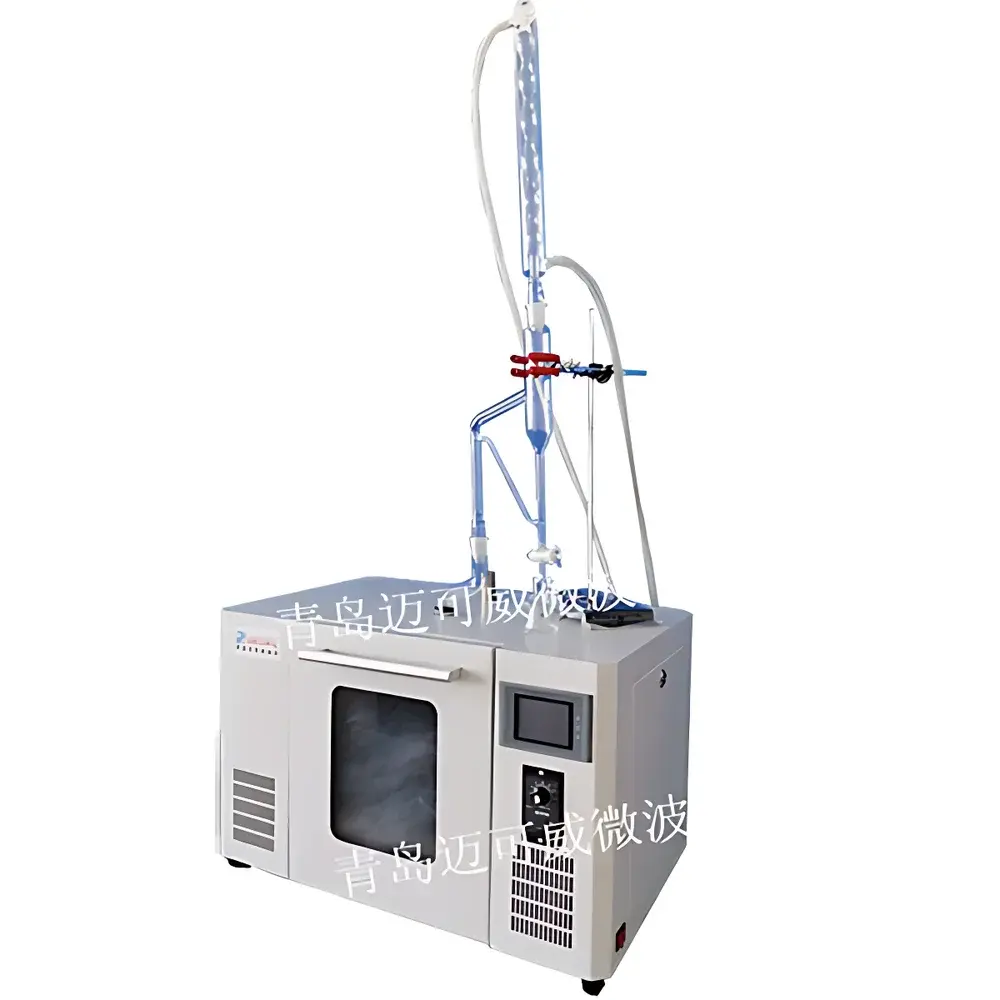
MakeWave MKX-E1A Microwave-Assisted Biological Extraction System
| Brand | MakeWave |
|---|---|
| Origin | Shandong, China |
| Manufacturer Type | Direct Manufacturer |
| Country of Origin | China |
| Model | MKX-E1A |
| Microwave Power | 800 W (continuous, non-pulsed) |
| Microwave Frequency | 2450 MHz |
| Temperature Control Range | 0–300 °C |
| Temperature Accuracy | ±1% of setpoint |
| Cavity Material | AISI 304 stainless steel with multi-layer PTFE (Teflon®) coating |
| Cavity Volume | ~20 L |
| Maximum Vessel Capacity | 2000 mL (open-atmosphere) |
| Cooling | External chilled water supply for condenser |
| Power Supply | 220 V AC / 50 Hz |
| Total Power Consumption | 3000 W |
| Dimensions (W×H×D) | 782 × 492 × 450 mm (main unit) |
| Weight | 65 kg |
| Safety Compliance | Microwave leakage <5 mW/cm² (IEC 61000-4-3 compliant) |
Overview
The MakeWave MKX-E1A Microwave-Assisted Biological Extraction System is an open-atmosphere, benchtop platform engineered for reproducible, thermally controlled microwave-assisted extraction (MAE) of bioactive compounds from diverse natural matrices. It operates on the principle of selective dielectric heating—where polar molecules (e.g., water, ethanol, methanol) absorb 2450 MHz microwave energy to generate rapid, volumetric internal heating—thereby accelerating mass transfer and improving extraction efficiency without pressurized containment. Unlike sealed-vessel MAE systems, the MKX-E1A supports atmospheric-pressure operation with integrated reflux condensation, enabling safe, scalable processing of heat-sensitive analytes such as essential oils, alkaloids, flavonoids, polyphenols, and pesticide residues. Its design prioritizes method flexibility, operator safety, and regulatory traceability—making it suitable for QC laboratories, academic research groups, environmental testing facilities, and botanical product development labs operating under GLP or ISO/IEC 17025 frameworks.
Key Features
- Continuous-wave 800 W microwave source at 2450 MHz, delivering stable, non-pulsed energy output for uniform thermal profiles across heterogeneous samples.
- 20 L reaction cavity constructed from welded AISI 304 stainless steel with multi-layer PTFE coating—resistant to organic solvents, mineral acids, and caustic reagents up to 300 °C.
- Open-system 2000 mL extraction vessel with real-time infrared temperature monitoring via side-wall emissivity compensation—ensuring accurate surface-and-bulk thermal feedback during reflux or static immersion protocols.
- Dual-mode solvent handling: compatible with low-dielectric solvents (e.g., hexane, chloroform) when combined with polar co-solvents or microwave-absorbing susceptors—enabling extraction of nonpolar phytochemicals.
- Integrated reflux condensation module with external chiller interface (5–25 °C inlet), supporting continuous solvent recovery and minimizing volatile loss during prolonged extractions.
- PLC-based control architecture with 7-inch color touchscreen HMI: stores ≥10 user-defined methods; logs time-stamped temperature, power, and duration data; exports CSV-formatted curves for audit-ready documentation.
- Comprehensive safety subsystem: dual mechanical/electrical door interlocks, λ/4 choke seal, dynamic pressure-relief hinge, and forced-air exhaust fan—all validated to maintain microwave leakage below 5 mW/cm² (per IEC 61000-4-3 and GB 4706.21).
Sample Compatibility & Compliance
The MKX-E1A accommodates solid, semi-solid, and slurry-phase biological samples—including dried herbs, fresh plant tissues, animal tissues, soil cores, airborne particulate filters (e.g., PM₂.₅ quartz filters), and polymer-bound residues. Its atmospheric design eliminates risk of vessel rupture and supports direct addition/removal of matrix during extraction—ideal for sequential fractionation or multi-step clean-up workflows. The system complies with ISO 9001:2015 quality management requirements and meets electromagnetic compatibility (EMC) and occupational exposure limits per IEC 62233 and ICNIRP guidelines. For regulated environments, its programmable logic controller enables full audit trails (time/date stamps, parameter changes, operator ID), supporting alignment with FDA 21 CFR Part 11 principles when paired with secure network logging.
Software & Data Management
The embedded control firmware provides real-time visualization of temperature vs. time and power vs. time profiles during operation. All process variables—including ramp rate, hold duration, maximum temperature, and actual cavity power—are recorded at 1-second intervals and stored in non-volatile memory. Data export is supported via USB flash drive in standard CSV format, facilitating import into LIMS platforms (e.g., LabWare, Thermo Fisher SampleManager) or statistical analysis tools (e.g., JMP, Python pandas). No proprietary software installation is required; raw files are human-readable and compatible with spreadsheet applications for immediate QA review. Optional Ethernet or RS-485 interfaces can be added for centralized lab automation integration.
Applications
- Essential oil isolation from citrus peels, lavender, and eucalyptus using steam-free, solvent-reflux MAE—reducing oxidation and preserving monoterpene integrity.
- Quantitative extraction of pharmacopoeial markers (e.g., ginsenosides, hypericin, curcumin) from herbal powders under standardized USP and Chinese Pharmacopoeia Chapter 2341 conditions.
- Accelerated recovery of organochlorine and organophosphate pesticides from agricultural soils and food commodities—validated against EPA Method 3546 and EN 15662.
- Simultaneous extraction and derivatization of fatty acids from microbial biomass prior to GC-FID analysis.
- Method development for green chemistry workflows—replacing Soxhlet with <70% reduced solvent volume and <80% shorter cycle times while maintaining analyte recovery ≥95% (vs. reference methods).
FAQ
Does the MKX-E1A support closed-vessel high-pressure extraction?
No. It is designed exclusively for open-atmosphere, reflux-coupled microwave extraction. High-pressure vessels require separate hardware and are not compatible with this platform.
Can the system be used with flammable solvents like diethyl ether or acetone?
Only under strict engineering controls: solvent vapor concentration must remain below 25% of LEL, and the exhaust system must be ducted to an external fume hood. Acetone is permitted; diethyl ether is not recommended due to peroxide formation and ignition risk.
Is the infrared temperature sensor calibrated traceable to NIST standards?
Yes—the factory calibration certificate includes uncertainty statements referenced to NIST-traceable blackbody sources (±0.5 °C at 100 °C), and field recalibration is supported using certified IR thermometers.
What maintenance is required for long-term reliability?
Quarterly inspection of PTFE cavity coating integrity, annual verification of door seal compression force and interlock timing, and biannual cleaning of condenser coils and exhaust filter—documented per ISO 9001 preventive maintenance log.
Does the system meet CE marking requirements for export to the EU?
Yes. It carries CE marking under the EMC Directive 2014/30/EU and Low Voltage Directive 2014/35/EU, with technical documentation available upon request for customs clearance.



