
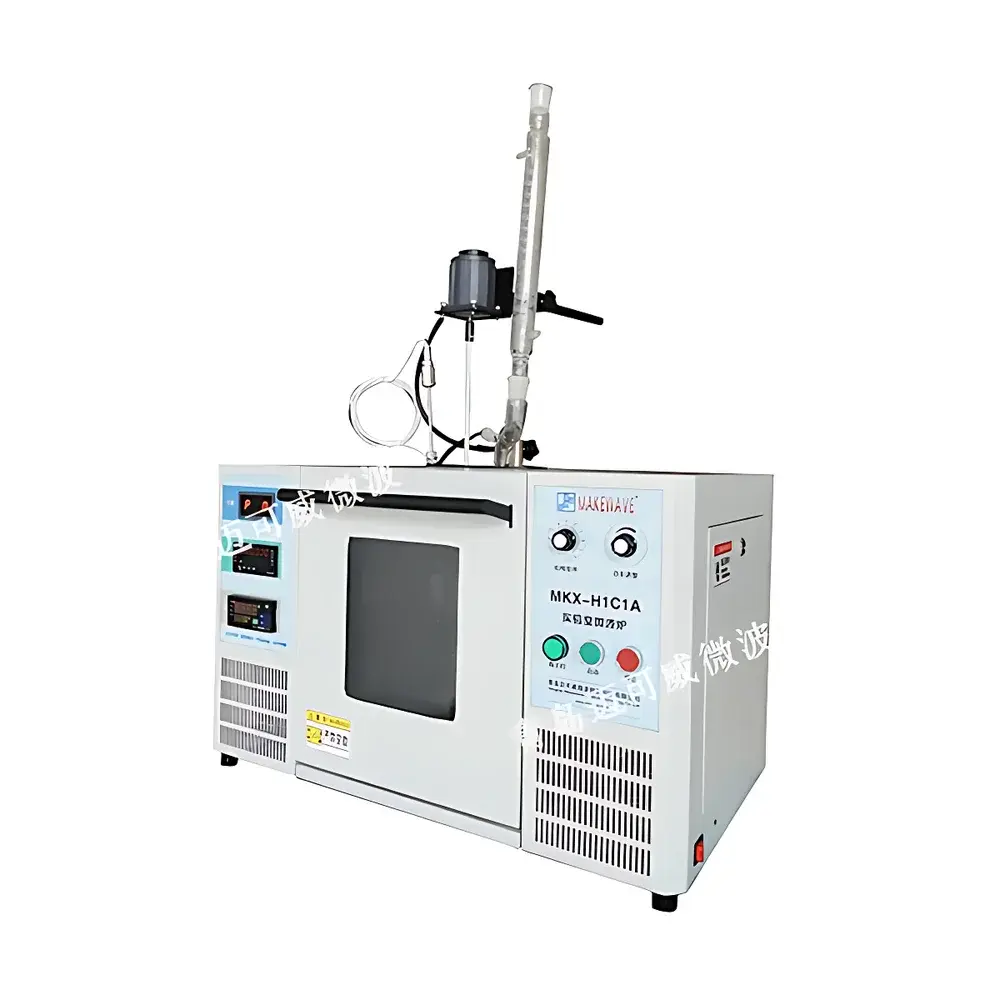
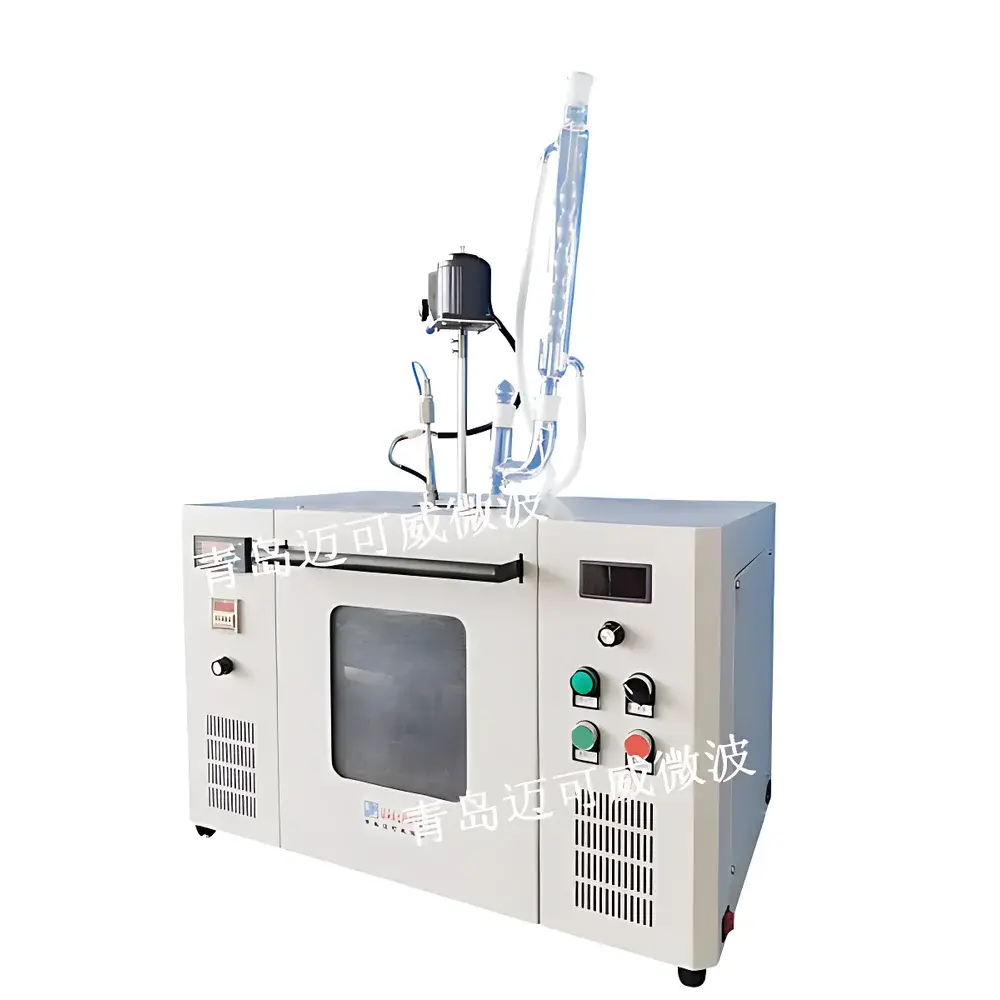
MakeWave MKX-H1C1A Open-Atmosphere Microwave Synthesis Reactor
| Brand | MakeWave |
|---|---|
| Origin | Shandong, China |
| Manufacturer Type | Direct Manufacturer |
| Country of Origin | China |
| Model | MKX-H1C1A |
| Temperature Range | 0–300 °C |
| Pressure Mode | Atmospheric (Open-Vessel) |
| Microwave Power Output | 900 W (continuous, non-pulsed) |
| Magnetron Frequency | 2450 MHz |
| Stirring Method | Mechanical stirring (PTFE anchor impeller) / Optional magnetic stirring |
| Reaction Volume | 500 mL |
| Cavity Volume | ~20 L |
| Power Supply | 220 V AC, 50 Hz |
| Total Power Consumption | 1300 W |
| Net Weight | 50 kg |
| External Dimensions (W×H×D) | 782 × 492 × 450 mm |
| Microwave Leakage | <5 mW/cm² (compliant with GB 10436 and IEC 61000-3-2) |
Overview
The MakeWave MKX-H1C1A is an open-atmosphere microwave synthesis reactor engineered for reproducible, controllable, and scalable chemical reactions under ambient pressure conditions. Unlike sealed-vessel high-pressure microwave systems, the MKX-H1C1A employs continuous 2450 MHz microwave irradiation to selectively energize polar molecules and ionic species in solution—enabling rapid, uniform volumetric heating without thermal lag. This principle supports kinetic acceleration, reduced thermal degradation, and improved selectivity in organic synthesis, inorganic coordination chemistry, materials precursor preparation, and extraction protocols. Designed as a benchtop platform for academic laboratories, QC/QA departments, and R&D centers, it integrates microwave energy delivery with conventional glassware-based reaction engineering—including reflux condensation, real-time temperature monitoring, and mechanical agitation—ensuring compatibility with standard synthetic workflows while eliminating autoclave-related safety constraints.
Key Features
- Open-vessel atmospheric reaction architecture: Supports standard 500 mL three-neck round-bottom flasks with simultaneous temperature sensing, mechanical stirring, and reflux condensation.
- Continuous-wave microwave generation: 900 W nominal output at 2450 MHz, delivered via non-pulsed magnetron for stable power density and precise thermal control.
- Corrosion-resistant cavity: 304 stainless steel housing with multi-layer PTFE coating; interior dimensions (275 mm height × ~20 L volume) accommodate vertical reaction assemblies and standard lab condensers.
- Integrated process monitoring: LED-lit cavity with reinforced borosilicate observation window; real-time visual verification of boiling behavior, phase separation, or precipitate formation.
- Robust safety system: Dual interlock door mechanism (power cutoff upon opening), λ/4 choke structure suppressing microwave leakage (<5 mW/cm²), and active exhaust fan for solvent vapor removal.
- Programmable automation: Independent control of temperature (0–300 °C, K-type thermocouple, immersion probe), microwave power (0–100% stepless), and reaction time (0–999 min).
Sample Compatibility & Compliance
The MKX-H1C1A accommodates a broad range of sample matrices—including aqueous, alcoholic, acidic, basic, and low-boiling organic solvents—without requiring specialized vessels or pressure-rated components. Its open-system design enables direct integration with standard Schlenk lines, gas inlets, and distillation setups. The reactor complies with ISO 9001:2015 quality management standards and meets electromagnetic compatibility (EMC) requirements per IEC 61000-3-2. While not certified for GLP or GMP environments by default, its temperature logging capability, repeatable power delivery, and audit-ready operation logs support method validation under ASTM E2877 (Standard Guide for Microwave-Assisted Chemical Synthesis) and internal SOP frameworks. All electrical components conform to IEC 61010-1 for laboratory equipment safety.
Software & Data Management
The MKX-H1C1A operates via embedded microcontroller-based logic—no external PC or proprietary software required. All operational parameters (setpoint temperature, actual temperature, applied power, elapsed time) are displayed on a high-contrast LCD interface with backlighting. Real-time data can be recorded manually or interfaced via optional RS-485/Modbus RTU for integration into LIMS or SCADA systems. For traceability, users may annotate experimental runs with batch IDs or operator codes. Though lacking FDA 21 CFR Part 11-compliant electronic signatures out-of-the-box, the device supports manual logbook documentation aligned with GLP principles—particularly where temperature stability, power consistency, and procedural repeatability are critical for regulatory submissions.
Applications
This reactor serves diverse research and analytical domains: catalytic cross-coupling (Suzuki, Heck), nanoparticle synthesis (metal oxides, MOFs), natural product extraction (polyphenols, alkaloids), polymerization initiation, peptide coupling, and accelerated aging studies. In materials science, it facilitates rapid sol-gel processing and ceramic precursor decomposition. In food and agricultural labs, it supports pesticide residue extraction and mycotoxin cleanup prior to HPLC or GC-MS analysis. Its atmospheric operation makes it especially suitable for volatile solvent systems (e.g., diethyl ether, acetone, THF) where pressure containment would introduce complexity or risk.
FAQ
Can the MKX-H1C1A be used with flammable solvents?
Yes—when operated within recommended ventilation guidelines and equipped with the integrated exhaust fan. Open-vessel configuration avoids pressure buildup, but proper fume hood use remains mandatory per OSHA 1910.1200.
Is temperature calibration traceable to NIST standards?
The included K-type thermocouple is factory-calibrated; users may perform field verification using a reference thermometer compliant with ASTM E74 or ISO/IEC 17025.
Does the system support external temperature feedback control?
No—the unit uses internal thermocouple feedback only. Closed-loop integration with external PID controllers requires third-party hardware adaptation.
What maintenance is required for long-term reliability?
Annual inspection of magnetron cooling airflow, cleaning of PTFE cavity coating with mild detergent, and verification of door seal integrity and interlock function are recommended.
Is technical documentation available in English?
Yes—operation manual, safety instructions, and dimensional drawings are supplied in English and comply with IEC 62366 usability requirements.



