
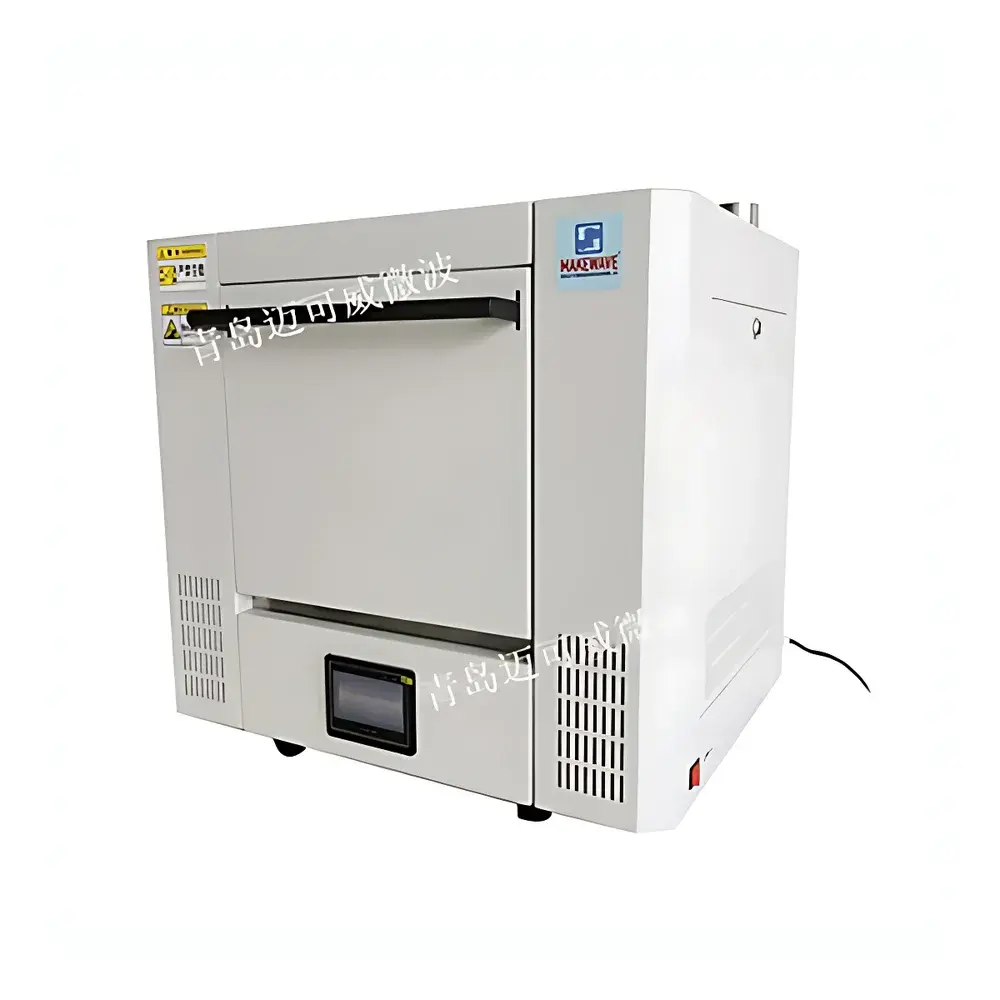
MakeWave MKX-R2HB Microwave Rapid Ashing Furnace
| Brand | MakeWave |
|---|---|
| Origin | Shandong, China |
| Manufacturer Type | Direct Manufacturer |
| Product Category | Domestic |
| Model | MKX-R2HB |
| Instrument Type | Box-Type Muffle Furnace |
| Maximum Temperature | 1200 °C |
| Temperature Control Accuracy | ±1 °C |
| Rated Microwave Power | 1600 W at 2450 MHz |
| Heating Method | Microwave Dielectric Heating |
| Internal Cavity Dimensions | 180 × 250 × 120 mm (W × D × H) |
| Approximate Cavity Volume | 5.4 L |
| Ramp Time to Max Temperature | ≤10 min |
| Power Supply | 220 V AC / 50 Hz |
| Total System Power Consumption | 3000 W |
| Net Weight | 90 kg |
Overview
The MakeWave MKX-R2HB Microwave Rapid Ashing Furnace is an engineered solution for high-efficiency thermal sample preparation in regulated laboratory and industrial quality control environments. Unlike conventional resistive muffle furnaces, the MKX-R2HB employs 2450 MHz continuous non-pulsed microwave energy to induce volumetric dielectric heating directly within the sample matrix. This mechanism enables rapid, uniform thermal processing—reducing ashing cycle times by up to 70% compared to resistance-heated equivalents—while minimizing thermal gradients and improving reproducibility across replicate analyses. Designed for compliance-critical workflows, the furnace supports controlled-atmosphere operation (oxidizing, inert, reducing, or vacuum-compatible configurations), making it suitable for ASTM D3174 (ash in coal and coke), ISO 1171 (ash in solid mineral fuels), USP & EP methods for residual inorganic impurities, and AOAC 942.05 (ash in food and feed). Its robust 304 stainless steel cavity, quartz-lined interior, and multi-layer low-εr ceramic fiber insulation ensure minimal contamination risk and thermal loss (<0.226 W/m·K conductivity), supporting GLP/GMP-aligned documentation requirements.
Key Features
- Continuous-wave 1600 W microwave source operating at 2450 MHz with fully adjustable power output (0–100%), enabling precise energy dosing for sensitive or heterogeneous samples.
- Hermetically sealed 5.4 L cavity constructed from welded 304 stainless steel, rated for micro-positive pressure operation and compatible with multi-gas inlet systems (N2, O2, Ar, air mixtures) via configurable mass flow controllers.
- Quartz-lined inner chamber prevents metallic leaching and particulate shedding, preserving analytical integrity—critical for trace-element ash analysis per EPA Method 3050B or ICP-MS sample prep.
- Downward-sliding door with λ/4 choke structure limits microwave leakage to <5 mW/cm² (exceeding IEC 61000-3-2 and GB 4706.21 safety standards) and provides stable high-temperature sample handling platform.
- Integrated K-type thermocouple feedback loop with PID-controlled temperature regulation across 0–1000 °C (extendable to 1200 °C), achieving ±1 °C stability over time and position.
- PLC-based control system with 7-inch capacitive touchscreen interface, real-time graphing of temperature/power/time profiles, and on-device data logging (CSV export via USB).
Sample Compatibility & Compliance
The MKX-R2HB accommodates standard crucible formats—including 12×50 mm cylindrical alumina or quartz crucibles—as well as user-defined configurations (e.g., 15 mL, 50 mL, or 70 mL vessels) for parallel processing of food, pharmaceutical excipients, polymer composites, catalysts, or geological matrices. Its programmable atmosphere management supports standardized ashing protocols under oxidizing (fast ash), low-oxygen (slow ash), or inert conditions (char yield determination). The system meets ISO 9001:2015 quality management certification and is designed for alignment with FDA 21 CFR Part 11 (when paired with optional audit-trail-enabled software), ASTM E2913 (thermal analysis terminology), and EN 61000-6-3 (EMC emission compliance). Optional exhaust coupling allows integration with activated carbon scrubbers or catalytic oxidizers for volatile organic compound (VOC) abatement during pyrolysis.
Software & Data Management
The embedded control firmware supports up to 99 programmable method sequences, each storing ramp rates, hold durations, power setpoints, gas flow parameters, and cooling profiles. All operational data—including timestamped temperature curves, microwave power modulation history, and door status logs—are stored internally with automatic overwrite protection. USB export enables post-run analysis in Excel or LIMS-compatible formats. For enterprise deployment, optional Ethernet connectivity permits remote monitoring via Modbus TCP or OPC UA protocols, facilitating integration into centralized lab automation platforms and electronic lab notebook (ELN) systems. Audit trail functionality—including user login tracking, parameter change logs, and electronic signature prompts—is available upon configuration for 21 CFR Part 11 compliance.
Applications
- Routine ash content determination in feedstuffs, cereals, dairy powders, and dietary supplements per AOAC 942.05 and ISO 5984.
- Residual inorganic residue testing of APIs, excipients, and finished dosage forms in accordance with USP and Ph. Eur. 2.4.15.
- Thermal decomposition studies of synthetic rubbers, carbon fibers, and flame-retardant polymers under controlled oxidative atmospheres.
- Preparation of certified reference materials (CRMs) requiring ultra-low background contamination—enabled by quartz-lined cavity and absence of heating element volatilization.
- Volatile matter quantification in coal, coke, and biomass pellets using ASTM D3175 and ISO 562 methodologies.
FAQ
Can the MKX-R2HB operate under vacuum or reduced-pressure conditions?
Yes—the cavity is structurally rated for micro-vacuum operation (down to 10 mbar absolute) when equipped with a vacuum-rated door seal and external pump interface; consult technical support for pressure-rated accessory compatibility.
Is calibration traceable to national standards?
Factory calibration uses NIST-traceable thermocouples; users may perform in-house verification using calibrated reference thermometers per ISO/IEC 17025 guidelines.
What maintenance is required for long-term reliability?
Annual inspection of waveguide integrity, door choke performance, and thermocouple drift is recommended; ceramic fiber insulation requires no scheduled replacement under normal use.
Does the system support automated sample loading/unloading?
While the base model features manual operation, robotic arm integration kits and motorized crucible trays are available as OEM-configurable options.
How is electromagnetic compatibility ensured in shared lab environments?
The unit incorporates dual-stage EMI filtering, grounded RF shielding, and conforms to CISPR 11 Group 2 Class A emissions limits—verified via third-party EMC testing reports.



