
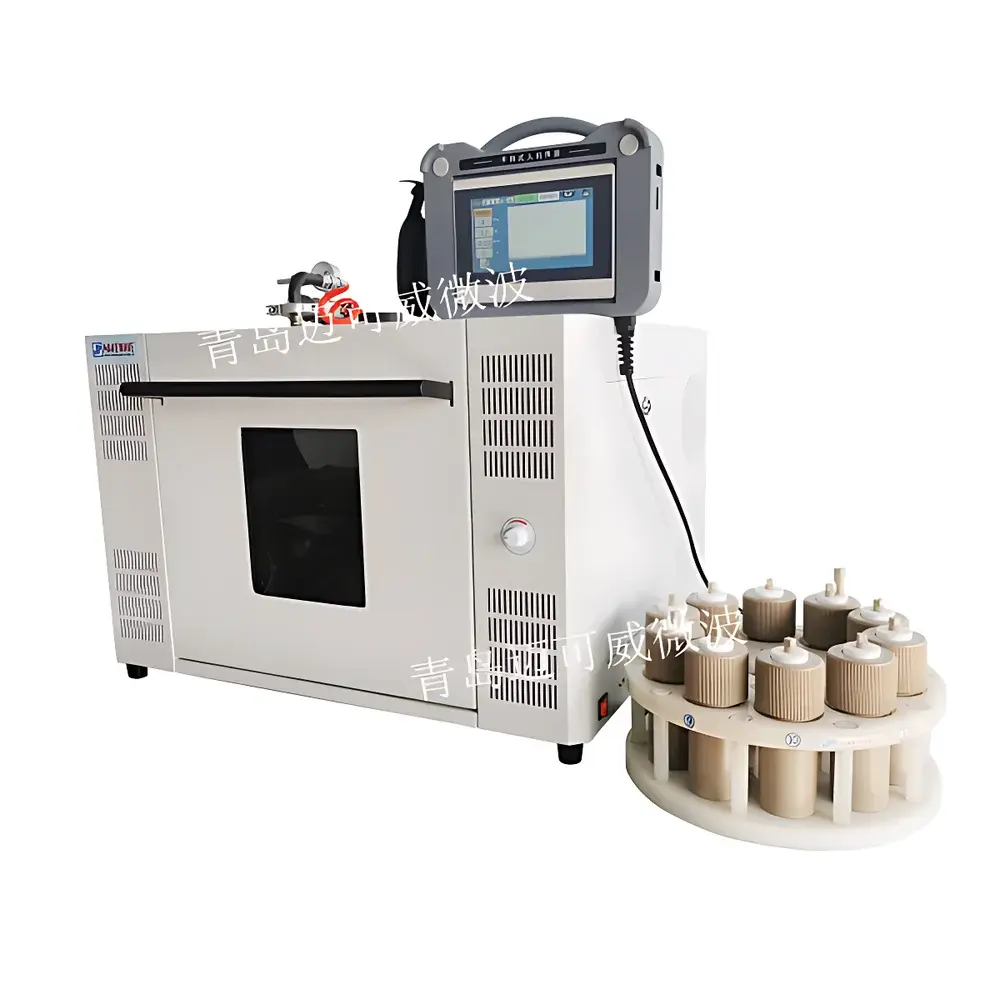
MakeWave MKX-X2G10A Microwave Digestion and Extraction System
| Brand | MakeWave |
|---|---|
| Origin | Shandong, China |
| Manufacturer Type | Original Equipment Manufacturer (OEM) |
| Product Category | Domestic |
| Model | MKX-X2G10A |
| Microwave Power | 1600 W (continuous, non-pulsed) |
| Frequency | 2450 MHz |
| Temperature Range | 0–300 °C |
| Temperature Control Accuracy | ±1 °C |
| Cavity Material | 304 Stainless Steel with Multi-Layer PTFE (Teflon®) Coating |
Overview
The MakeWave MKX-X2G10A Microwave Digestion and Extraction System is an integrated, closed-vessel platform engineered for high-efficiency sample preparation in analytical laboratories. It operates on the principle of microwave-assisted digestion—utilizing controlled 2450 MHz electromagnetic energy to rapidly heat reaction mixtures under elevated temperature and pressure conditions. Unlike conventional hotplate or block digestion, microwave energy couples directly with polar molecules (e.g., H₂O, HNO₃, HCl), inducing rapid molecular rotation and dielectric heating. This mechanism enhances mass transfer, disrupts matrix structures, and accelerates oxidative decomposition—particularly effective for refractory organic matrices and silicate-rich inorganic samples. Designed for trace elemental analysis, the system supports standardized workflows aligned with EPA Method 3051A/3052, ISO 11466, and GB/T 5009.12–2017 for heavy metal determination (e.g., Pb, Cd, Hg, As, Cr) across environmental, food safety, and industrial quality control applications.
Key Features
- Closed-vessel digestion architecture rated for up to 220 °C and 3 MPa—validated for reproducible, high-yield acid digestion of complex matrices.
- 10-position rotor accommodating 80 mL PFA (perfluoroalkoxy) digestion vessels—chemically inert, low-background, and compatible with aggressive reagents (HF, aqua regia, H₂O₂).
- 360° reciprocating rotation mechanism ensures uniform microwave field distribution and eliminates cold spots—critical for inter-vessel precision (RSD < 3% for replicate digestions).
- Fiber-optic temperature sensing (insertion type) and contact-based pressure transducers provide real-time, independent feedback for closed-loop PID control of both parameters.
- 304 stainless steel cavity with multi-layer PTFE coating resists corrosion from fumes and condensates during prolonged use with nitric, hydrochloric, and hydrofluoric acids.
- Integrated LED illumination and optional real-time video monitoring enable visual verification of vessel integrity and reaction progress without interrupting the cycle.
Sample Compatibility & Compliance
The MKX-X2G10A processes solid, semi-solid, and liquid samples—including soils, sediments, biological tissues, food composites (dairy, cereals, beverages), polymers, catalysts, and metallurgical slags. Its design conforms to international safety and performance benchmarks: microwave leakage < 5 mW/cm² (IEC 61000-4-3 compliant; exceeds GB 4706.21 national standard); structural integrity validated per ASME BPVC Section VIII Div. 1 for pressure containment; and electrical safety certified to IEC 61010-1. The system supports GLP-compliant operation through audit-trail-capable data logging and user-access controls—facilitating alignment with ISO/IEC 17025 accreditation requirements for testing laboratories.
Software & Data Management
Control is executed via a PLC-based embedded system with a 7-inch resistive touchscreen interface. All operational parameters—including time, temperature, pressure, and microwave power—are displayed graphically in real time and stored with timestamped metadata. Up to 50 method protocols can be saved, edited, recalled, or deleted locally. Data export is supported via USB 2.0 (CSV format) for integration with LIMS or statistical analysis platforms. Optional Ethernet connectivity enables remote monitoring and centralized fleet management in multi-instrument lab environments. Firmware updates preserve backward compatibility and include calibration traceability logs required for regulatory audits.
Applications
This system serves as a primary sample preparation tool in accredited environmental labs conducting heavy metal screening in wastewater sludge (EPA 6010D), soil (ISO 11466), and airborne particulates. In food safety testing, it enables rapid digestion of infant formula, edible oils, and tea leaves prior to ICP-MS or AAS quantification. Industrial users apply it for RoHS-compliant screening of brominated flame retardants in plastics, lead content in pigments, and arsenic speciation in semiconductor-grade chemicals. Its robustness and repeatability also support R&D workflows in catalysis development and geochemical reference material certification.
FAQ
What safety certifications does the MKX-X2G10A hold?
It complies with IEC 61010-1 (electrical safety), IEC 61000-4-3 (EMC immunity), and meets national microwave leakage limits (<5 mW/cm²) per GB 4706.21. ISO 9001:2015 quality management system certification applies to manufacturing.
Can the system accommodate HF-containing digestion protocols?
Yes—PFA vessels and PTFE-coated cavity surfaces are fully resistant to hydrofluoric acid at concentrations ≤5% v/v and temperatures ≤200 °C, provided proper ventilation and neutralization protocols are followed.
Is method validation documentation available?
MakeWave provides a comprehensive validation package—including temperature/pressure calibration certificates, inter-vessel uniformity test reports, and spike recovery data for Pb/Cd/Hg/As in NIST SRM 2710a and 1566b—upon request.
What maintenance is required for long-term reliability?
Annual inspection of door seal integrity, fiber-optic probe calibration, and cavity coating adhesion assessment is recommended. No consumable parts require scheduled replacement under normal operating conditions.
Does the system support 21 CFR Part 11 compliance?
While the base configuration includes electronic signatures and audit trails, full 21 CFR Part 11 compliance requires deployment within a validated IT infrastructure—including secure network authentication, electronic record retention policies, and third-party software validation—managed by the end-user laboratory.



