
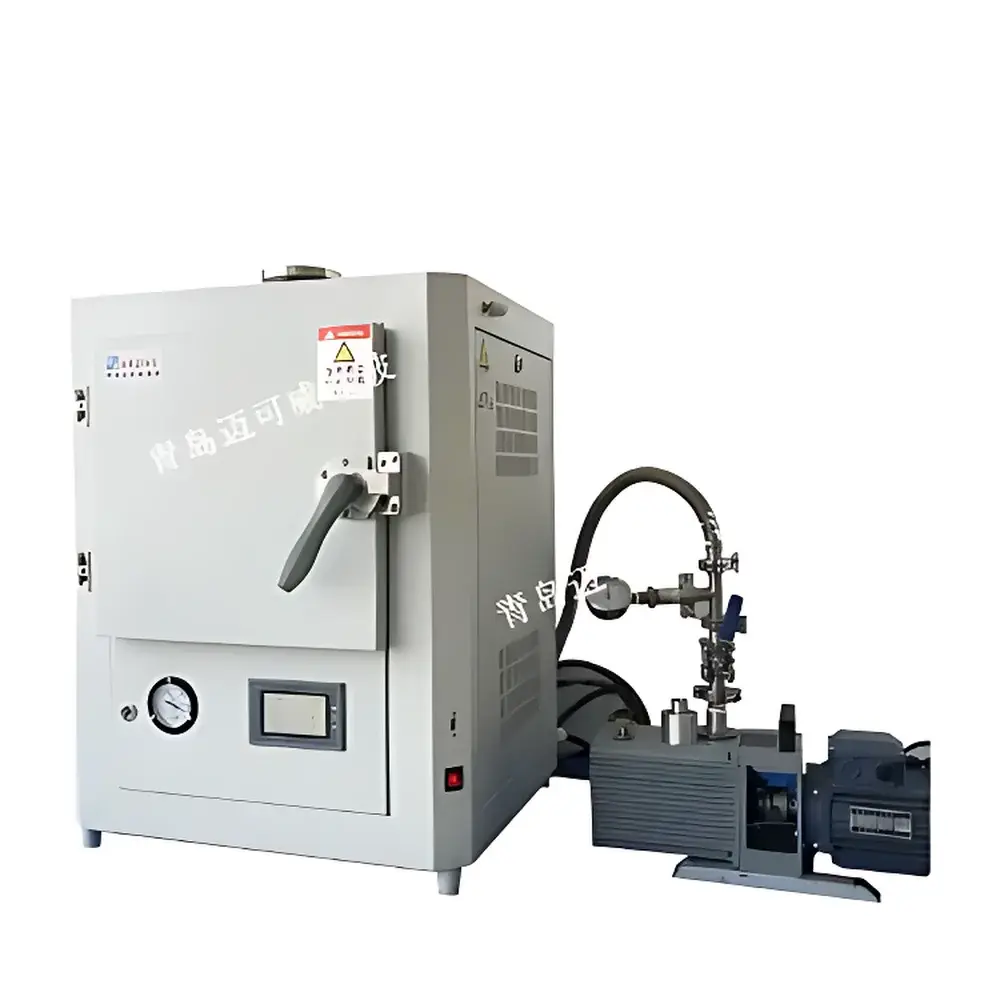
Makewave MKZ-M2B Microwave Vacuum High-Temperature Box Furnace
| Brand | Makewave |
|---|---|
| Origin | Shandong, China |
| Manufacturer Type | Direct Manufacturer |
| Product Category | Domestic |
| Model | MKZ-M2B |
| Instrument Type | Box-Type Furnace |
| Max Temperature | 1400 °C |
| Temperature Control Accuracy | ±1 °C |
| Rated Microwave Power | 1600 W |
| Operating Frequency | 2450 MHz |
| Internal Cavity Volume | 1.2 L |
| Heating Method | Continuous Non-Pulsed Microwave Heating |
| Vacuum Range | 0 to –0.099 MPa (absolute) |
| Power Supply | 220 V AC / 50 Hz |
| Total Power Consumption | 3500 W |
| Net Weight | 80 kg |
| External Dimensions (W×H×D) | 700×800×600 mm |
Overview
The Makewave MKZ-M2B Microwave Vacuum High-Temperature Box Furnace integrates microwave dielectric heating with high-vacuum thermal processing in a single, compact benchtop platform. Unlike conventional resistive furnaces that rely on conduction and convection for heat transfer, the MKZ-M2B employs 2450 MHz continuous-wave microwave energy to volumetrically excite polar molecules and conductive phases within materials—enabling rapid, uniform, and energy-efficient heating of ceramics, composites, and advanced functional oxides. Its fully sealed 304 stainless steel cavity supports sustained operation under vacuum (down to –0.099 MPa absolute) or controlled atmospheres (N₂, Ar, H₂, forming gas), making it suitable for oxidation-sensitive sintering, reduction annealing, and volatile-loss-critical synthesis protocols. The furnace is engineered for precision thermal management in R&D laboratories conducting materials science, solid-state chemistry, and ceramic engineering research where reproducible microstructural evolution under non-oxidizing conditions is essential.
Key Features
- Continuous non-pulsed 1600 W microwave source operating at 2450 MHz, delivering stable power output across the full temperature range (500–1400 °C)
- Vacuum-rated 304 stainless steel cavity with full-welded construction and λ/4 choke-based microwave suppression at the door interface—ensuring leakage <5 mW/cm² (IEC 61000-4-3 compliant)
- Integrated multi-layer insulation using low-dielectric-loss ceramic fiber modules (thermal conductivity ≈0.226 W/m·K), minimizing radial heat loss and improving energy efficiency
- Non-contact infrared pyrometry system calibrated for direct in-situ material surface temperature measurement—eliminating thermocouple-induced thermal lag or contamination
- PLC-based control architecture with 7-inch touchscreen HMI; real-time plotting of temperature, power, time, and vacuum level with CSV export capability
- Side-sliding vacuum-tight door with triple-function design: thermal insulation, vacuum integrity, and microwave containment
- Modular gas manifold option supporting up to three independent mass flow controllers for precise reactive or inert atmosphere blending
Sample Compatibility & Compliance
The MKZ-M2B accommodates standard 100 × 100 mm crucible systems—including alumina, silicon carbide, zirconia, and graphite variants—enabling compatibility with oxide ceramics, battery cathode precursors, MAX phases, and metal-organic frameworks. Its vacuum and atmosphere control architecture conforms to ASTM C1171 (standard practice for sintering ceramics under controlled environments) and supports GLP-compliant workflows when paired with audit-trail-enabled data logging (optional firmware upgrade). All electrical and mechanical safety systems meet IEC 61010-1 requirements for laboratory equipment, and the integrated vacuum pump interface allows connection to oil-free scroll pumps for ISO Class 5 cleanroom-compatible operation. The unit is certified to ISO 9001:2015 for design and manufacturing quality management.
Software & Data Management
The embedded control system records timestamped temperature, microwave power, vacuum pressure, and ramp/soak parameters at user-defined intervals (1–60 s resolution). Data is stored internally (≥10,000-point buffer) and exportable via USB to standard spreadsheet formats for post-processing in MATLAB, Origin, or Python-based analysis pipelines. Multi-step programmable profiles support up to 20 segments per recipe, with automatic hold-on-vacuum-trigger and power-throttling logic during pressure transients. Optional software add-ons provide remote monitoring via Ethernet (Modbus TCP), electronic signature-enabled SOP enforcement, and 21 CFR Part 11–compliant audit trail generation—including operator ID, parameter changes, and system event logs.
Applications
- Rapid densification of Si₃N₄, Al₂O₃, and ZrO₂ ceramics without grain coarsening
- Low-temperature sintering of nanoscale tungsten carbide–cobalt composites
- Controlled-reduction synthesis of NiFe₂O₄ spinel catalysts under H₂/N₂ mixtures
- Thermal decomposition studies of layered double hydroxides (LDHs) under dynamic vacuum
- Graphitization of polymer-derived ceramics with minimized off-gassing artifacts
- Pre-sintering of solid-state battery electrolytes (e.g., Li₇La₃Zr₂O₁₂) under argon to suppress lithium volatility
FAQ
What vacuum level can the MKZ-M2B achieve, and is a vacuum pump included?
The system achieves ≤–0.099 MPa (absolute) using an external two-stage rotary vane pump (not supplied). Optional oil-free scroll pumps are recommended for applications requiring hydrocarbon-free vacuum environments.
Can the furnace operate under inert or reactive gas flow while maintaining microwave coupling?
Yes—the integrated gas manifold supports continuous flow rates from 10–500 sccm per line, with pressure-compensated MFCs ensuring stable cavity impedance during microwave irradiation.
Is infrared temperature measurement validated against reference standards?
Yes—calibration traceability follows NIST-traceable blackbody sources across 500–1400 °C, with emissivity correction tables provided for common crucible and sample materials.
What safety interlocks prevent microwave emission during vacuum venting or door opening?
A hardware-enforced dual-channel safety circuit interrupts magnetron power within <10 ms upon door displacement or vacuum breach detection, independently verified by third-party EMC testing.
Are extended warranty or service plans available for academic institutions?
Yes—comprehensive 3-year extended service contracts include biannual preventive maintenance, calibration verification, and priority technical support with remote diagnostics access.
Related Products



