
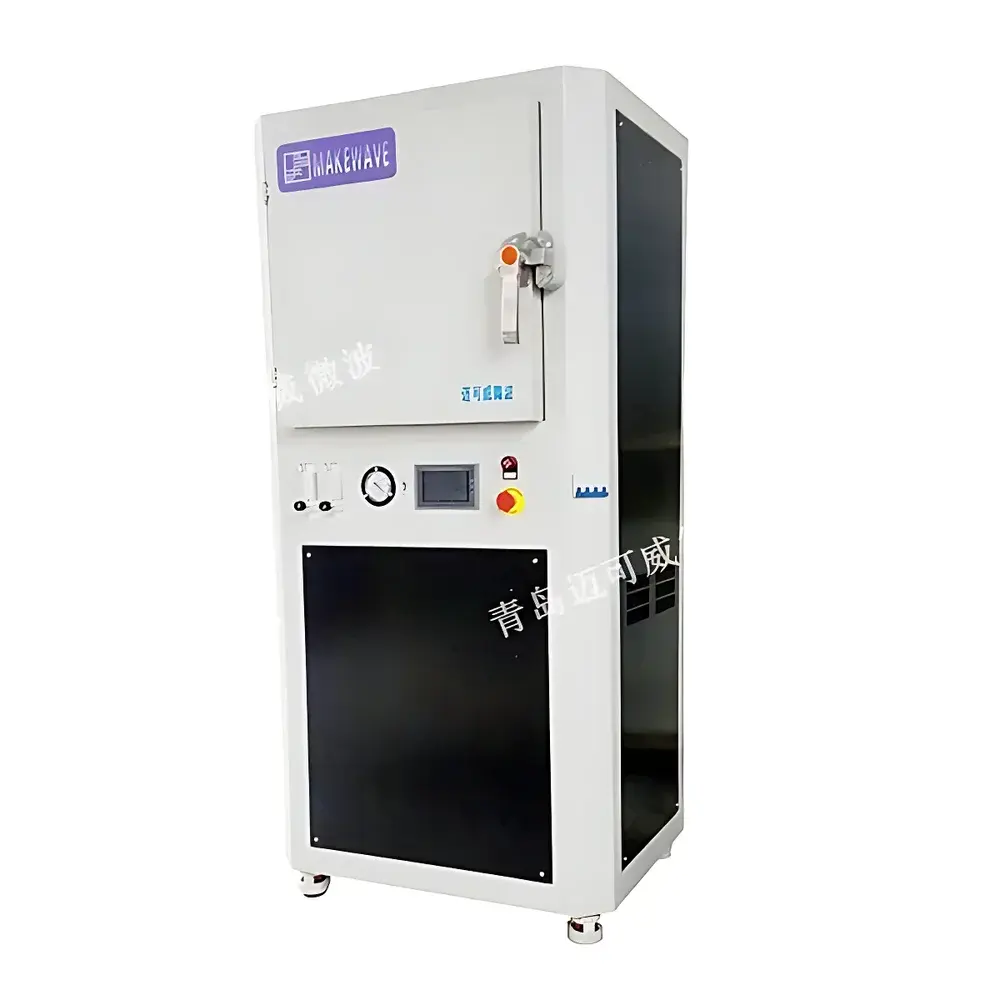
Makewave MKZ-T4B Microwave Vacuum High-Temperature Tube Furnace
| Brand | Makewave |
|---|---|
| Origin | Shandong, China |
| Manufacturer Type | Direct Manufacturer |
| Product Category | Domestic |
| Model | MKZ-T4B |
| Instrument Type | Tube Furnace |
| Maximum Temperature | 1400 °C |
| Temperature Control Accuracy | ±1 °C |
| Rated Microwave Power | 3200 W |
| Heating Rate to Max Temp | ~40 min |
| Heating Method | 2450 MHz Continuous Non-Pulsed Microwave |
| Internal Cavity Volume | ~8 L |
| Vacuum Range | 0 to –0.099 MPa (absolute) |
| Cooling System | Integrated Water-Circulation Cooling |
| Compliance | ISO 9001 Certified |
Overview
The Makewave MKZ-T4B is a purpose-engineered microwave vacuum high-temperature tube furnace designed for advanced materials synthesis and thermal processing under precisely controlled inert, reducing, or vacuum atmospheres. Unlike conventional resistance-heated tube furnaces, the MKZ-T4B employs 2450 MHz continuous non-pulsed microwave energy to induce volumetric heating within dielectric and semiconducting samples—enabling rapid, uniform temperature rise with minimal thermal lag. Its integrated ultra-high-vacuum-compatible cavity (rated to –0.099 MPa absolute) eliminates oxidation pathways and suppresses volatile byproduct accumulation, making it especially suitable for sintering oxide ceramics, nitride composites, carbide precursors, and air-sensitive battery cathode materials. The system operates across a validated working range of 500–1300 °C, with peak capability up to 1400 °C under optimized vacuum and crucible conditions. All thermal measurements are performed via non-contact infrared pyrometry calibrated to ASTM E2847, ensuring direct sample surface temperature feedback without thermocouple interference.
Key Features
- 3200 W water-cooled magnetron with fully adjustable, non-pulsed microwave output—engineered for stable power delivery during extended high-temperature cycles
- Vacuum-rated 304 stainless steel cavity with full hermetic welding and λ/4 choke joint design—microwave leakage <5 mW/cm² (per GB 10436 and ICNIRP 2020 guidelines)
- Integrated multi-layer insulation architecture: externally mounted low-εr ceramic fiber modules (thermal conductivity ≈0.226 W/m·K at 1000 °C) minimize radial heat loss and improve energy efficiency
- Side-sliding vacuum-tight door with triple-safety interlock: automatic microwave cutoff upon door actuation, combined with thermal and RF shielding functions
- Programmable PLC-based control system with 7-inch HMI touchscreen—supports up to 20 independent multi-step thermal profiles with real-time overlay of temperature, power, and vacuum curves
- Dual-mode atmosphere management: base configuration includes mechanical vacuum pump; optional multi-gas mixing module (N₂, Ar, H₂, NH₃) with mass flow controllers and back-pressure regulation
Sample Compatibility & Compliance
The MKZ-T4B accommodates standard high-purity crucibles (150 mm × 150 mm footprint) in Al₂O₃, SiC, ZrO₂, and graphite variants—each selected for optimal microwave coupling and thermal stability below 1400 °C. Crucible compatibility extends to sealed quartz ampoules for volatile precursor encapsulation. The furnace meets ISO 9001:2015 quality management requirements and supports GLP-compliant operation through audit-trail-enabled data logging (timestamped, user-ID tagged, tamper-resistant export in CSV/Excel format). Vacuum integrity conforms to ISO 2859-1 sampling plans for leak testing; optional cold trap + activated carbon filtration satisfies EPA Method 204B for condensable effluent capture during ceramic decomposition studies.
Software & Data Management
Embedded firmware implements dual-loop closed-control logic: infrared-derived sample temperature governs microwave power modulation, while vacuum pressure feedback regulates pump speed and gas injection rates. All operational parameters—including setpoints, actuals, alarms, and event timestamps—are logged at 1 Hz resolution. Data export supports both USB flash drive transfer and Ethernet-based SCADA integration (Modbus TCP). Optional software add-ons provide FDA 21 CFR Part 11 compliance features: electronic signatures, role-based access control, and immutable audit logs with cryptographic hash verification. Raw datasets include metadata on ambient barometric correction (calibrated to local elevation per Qingdao reference), enabling cross-laboratory reproducibility assessment.
Applications
- Fast sintering of ZnO varistors, BaTiO₃ multilayer capacitors, and Si₃N₄ structural ceramics with reduced grain growth and improved density homogeneity
- Vacuum-assisted carbothermal reduction of metal oxides (e.g., MoO₃ → Mo₂C, WO₃ → W) without external carbon contamination
- Controlled pyrolysis of MOF-derived catalysts under dynamic H₂/N₂ mixtures for PtNi nanoparticle synthesis
- Atmosphere-switched annealing of LiCoO₂ and NMC811 cathodes to stabilize oxygen sublattice ordering
- Inert-atmosphere graphitization of polymer-derived ceramics (PDCs) with minimized SiC phase segregation
FAQ
What vacuum level can the MKZ-T4B achieve, and is it compatible with turbomolecular pumping?
The base configuration achieves ≤10⁻² mbar using a two-stage rotary vane pump. With optional turbomolecular pump integration (model-specific retrofit), ultimate vacuum improves to ≤10⁻⁵ mbar—suitable for ultra-high-purity thin-film precursor treatments.
Can the infrared pyrometer be recalibrated in-house?
Yes—built-in blackbody reference cavity allows field calibration against NIST-traceable standards; procedure documented in the GLP-aligned Operations Manual (Rev. 4.2).
Is the 1400 °C rating sustainable for continuous operation?
Rated 1400 °C is achievable for ≤2 h cycles under vacuum with graphite crucibles; recommended long-term duty cycle is ≤1300 °C for >100 h service life.
Does the system support remote monitoring via Ethernet or Wi-Fi?
Standard Ethernet (RJ45) interface enables Modbus TCP readout and alarm forwarding; Wi-Fi requires external industrial gateway (not supplied).
What safety certifications does the MKZ-T4B hold beyond ISO 9001?
CE marking per 2014/35/EU (Low Voltage Directive) and 2014/30/EU (EMC Directive); full test reports available under NDA upon request.



