
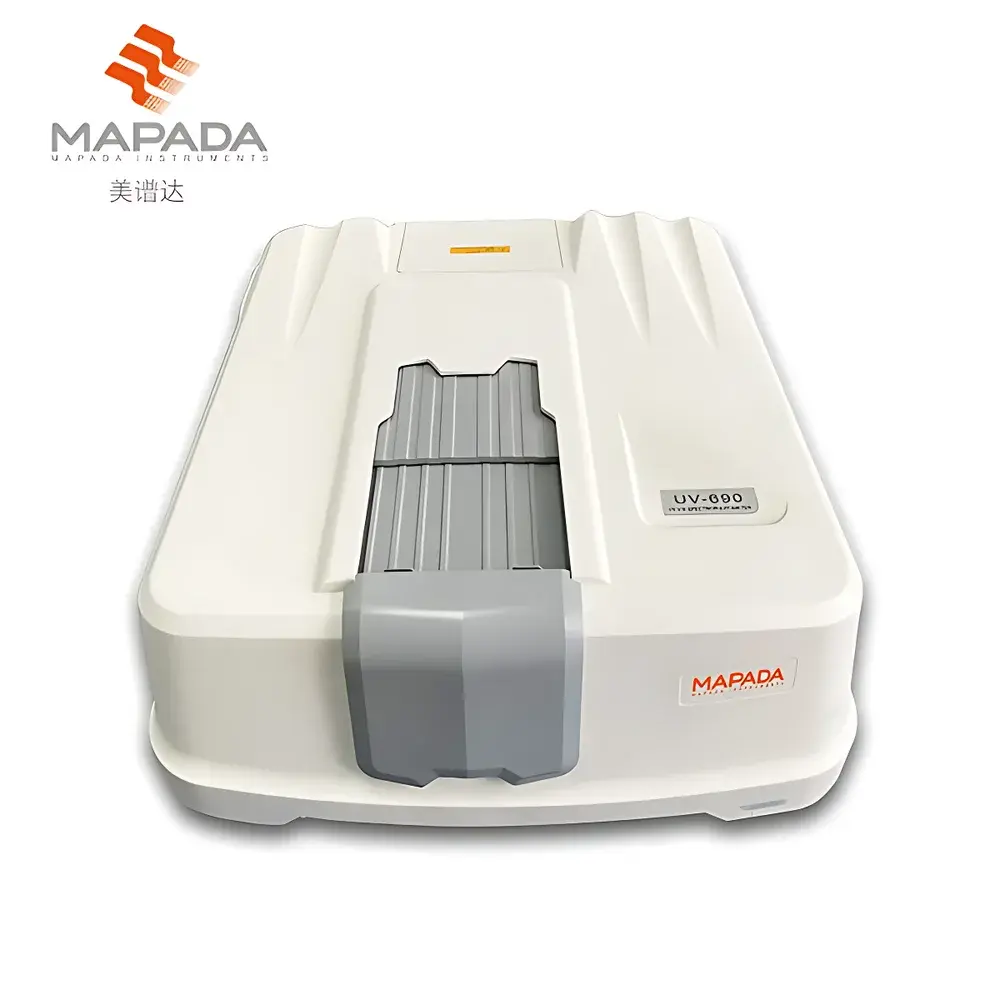
Mapada UV-690 Dual-Beam Ultraviolet-Visible Spectrophotometer
| Brand | Mapada |
|---|---|
| Origin | Shanghai, China |
| Manufacturer Type | Original Equipment Manufacturer (OEM) |
| Product Origin | Domestic (China) |
| Model | UV-690 |
| Price Range | USD 14,000–28,000 |
| Optical Design | Dual-beam |
| Detector | CCD Array Detector |
| Wavelength Range | 190–900 nm |
| Wavelength Scanning | Motorized Auto-Scanning |
| Spectral Bandwidth | Adjustable (0.1 / 0.2 / 0.5 / 1.0 / 2.0 / 4.0 nm) |
| Wavelength Accuracy | ±0.3 nm |
| Grating Density | 1800 lines/mm |
Overview
The Mapada UV-690 Dual-Beam Ultraviolet-Visible Spectrophotometer is a high-performance analytical instrument engineered for precision quantitative and qualitative analysis across research laboratories, quality control environments, and educational institutions. Operating on the fundamental principle of Beer–Lambert law-based absorbance measurement, the UV-690 employs a dual-beam optical architecture to simultaneously split incident light into sample and reference paths—enabling real-time correction of source intensity drift, lamp aging, and environmental fluctuations. Its broad spectral coverage from 190 nm to 900 nm supports diverse applications spanning UV absorption of nucleic acids and proteins, visible-range colorimetric assays (e.g., iron, phosphate, nitrate), and near-IR characterization of organic dyes and nanomaterials. The core monochromator integrates a high-efficiency 1800-line/mm holographic grating, ensuring high dispersion and resolution across the full range, while the CCD array detector delivers rapid, noise-resistant spectral acquisition with excellent linearity and dynamic range.
Key Features
- Dual-beam optical configuration with real-time background compensation for enhanced baseline stability and long-term measurement reproducibility
- Motorized, fully automated wavelength scanning and slit-width selection—eliminating manual adjustments and reducing operator-induced variability
- Adjustable spectral bandwidth (0.1–4.0 nm in six discrete steps) to optimize resolution vs. signal-to-noise ratio per application requirement
- High-precision wavelength drive system calibrated to ±0.3 nm accuracy (verified against NIST-traceable holmium oxide and didymium filters)
- CCD array detector providing full-spectrum acquisition in <1 second, supporting kinetic studies, multi-component analysis, and spectral library matching
- Robust mechanical design with temperature-stabilized optics housing and anti-vibration base plate to minimize thermal drift and mechanical perturbation
Sample Compatibility & Compliance
The UV-690 accommodates standard 10-mm rectangular quartz or glass cuvettes (pathlengths: 1, 2, 5, and 10 mm), as well as microvolume adapters (down to 0.5 µL) and fiber-optic probes for non-contact or in-situ measurements. It supports both transmission and reflectance modes via optional accessories. The instrument meets key international performance standards including ISO 9001:2015 (quality management), ASTM E275–22 (standard practices for ultraviolet and visible spectrophotometry), and complies with GLP documentation requirements through audit-trail-enabled software logging. While not FDA 21 CFR Part 11–certified out-of-the-box, its data export formats (CSV, ASCII, XML) and metadata tagging support integration into validated LIMS and electronic lab notebook (ELN) systems under GxP frameworks.
Software & Data Management
The UV-690 operates with Mapada SpectraPro v3.2—a Windows-based application offering intuitive method development, multi-wavelength quantitation, kinetics modeling, spectral subtraction, and derivative spectroscopy. All measurement parameters—including date/time stamp, operator ID, instrument serial number, calibration history, and raw spectral files—are automatically embedded in each data set. Audit trail functionality records user actions (e.g., method edits, calibration events, result overrides) with timestamps and login identifiers. Data exports conform to ASTM E1382–21 (standard format for spectral data exchange) and are compatible with third-party chemometric tools (e.g., MATLAB, Unscrambler, Python SciPy). Remote monitoring and firmware updates are supported via secure Ethernet or USB interface.
Applications
- Pharmaceutical QC: Assay of active pharmaceutical ingredients (APIs), excipient identification, dissolution testing, and stability-indicating methods per USP
- Environmental analysis: Quantification of heavy metals (e.g., Cr(VI), Cd²⁺) via complexometric colorimetry; NO₂⁻, PO₄³⁻, and COD determination in wastewater
- Life sciences: DNA/RNA purity assessment (A260/A280, A260/A230), protein concentration (Bradford, BCA), enzyme kinetics (e.g., LDH, ALP), and cell culture density monitoring
- Materials science: Bandgap estimation of semiconducting nanoparticles (TiO₂, ZnO), dye loading efficiency in DSSCs, and polymer degradation profiling
- Educational use: Teaching core spectroscopic concepts—including absorbance, transmittance, molar absorptivity, and spectral deconvolution—in undergraduate chemistry and physics labs
FAQ
What is the minimum detectable absorbance for the UV-690 at 260 nm?
The instrument achieves an absorbance noise level of ≤0.0004 AU (RMS) at 260 nm with a 1.0 nm bandwidth and 1-second integration time, corresponding to a typical detection limit of ~0.001 AU for routine measurements.
Can the UV-690 perform photometric titrations?
Yes—SpectraPro software includes a dedicated titration module that enables real-time absorbance monitoring during reagent addition, with automatic endpoint detection based on first-derivative maxima or inflection points.
Is external calibration verification required before regulatory submissions?
While factory calibration uses NIST-traceable standards, users must perform periodic verification using certified reference materials (e.g., potassium dichromate in 0.005 M H₂SO₄ per USP ) as part of their laboratory’s documented calibration schedule.
Does the instrument support compliance with ISO/IEC 17025 for accredited testing labs?
Yes—the UV-690’s documented uncertainty budget, traceable calibration procedures, and comprehensive software audit trails align with ISO/IEC 17025:2017 Clause 7.7 (Measurement Uncertainty) and Clause 7.8 (Reporting of Results), provided the lab implements appropriate SOPs and staff training.





