
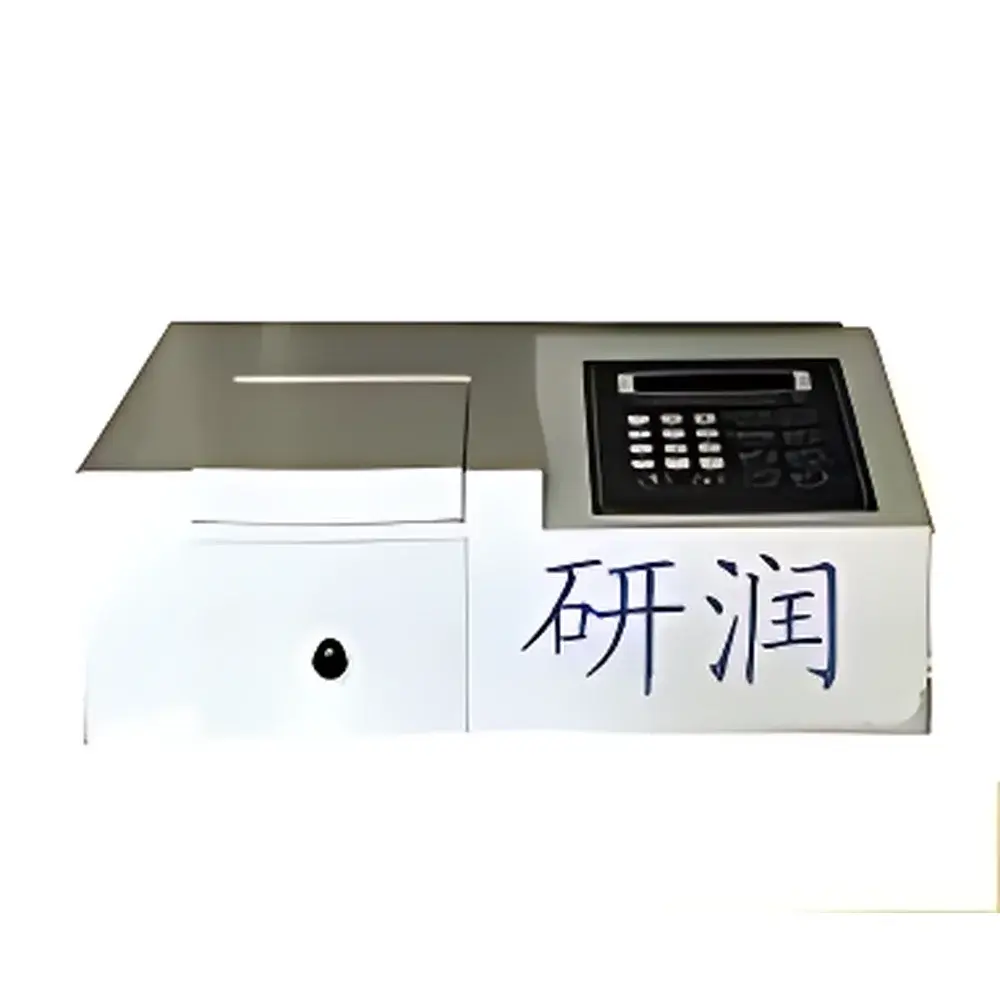
MC016-754PC(UV-2100 Export Model) Single-Beam Ultraviolet-Visible Spectrophotometer
| Origin | Shanghai, China |
|---|---|
| Manufacturer Type | Authorized Distributor |
| Origin Category | Domestic (PRC) |
| Model | MC016-754PC(UV-2100 Export Model) |
| Pricing | Available Upon Request |
| Wavelength Range | 200–1000 nm |
| Wavelength Accuracy | ±2 nm |
| Wavelength Repeatability | 1 nm |
| Spectral Bandwidth | 4 nm |
| Photometric Accuracy (Transmittance) | ±0.5%T |
| Photometric Repeatability (Transmittance) | 0.2%T |
| Transmittance Range | 0.0–125%T |
| Absorbance Range | –0.097 to 2.5 A |
| Concentration Display Range | 0–99999 |
| Stray Light | ≤0.5%T at 220 nm and 360 nm |
| Baseline Stability | ±0.002 A/h |
| Interface | RS-232 Bidirectional Serial Port |
| Software | SPD Application Suite for Windows |
| Printer Support | Integrated Thermal or Dot-Matrix via RS-232 |
Overview
The MC016-754PC (UV-2100 Export Model) is a precision-engineered single-beam ultraviolet-visible (UV-Vis) spectrophotometer designed for routine quantitative and qualitative analysis in regulated and research laboratory environments. It operates on the fundamental principle of Beer–Lambert law-based absorption spectroscopy: monochromatic light generated by a diffraction grating optical system passes sequentially through a reference blank (e.g., solvent or air) and then the sample, enabling measurement of transmittance (T%) and conversion to absorbance (A) or concentration (C). Its single-beam architecture—featuring a low-stray-light Czerny–Turner monochromator with a fixed 4 nm spectral bandwidth—ensures high photometric linearity, reproducibility, and baseline stability (±0.002 A/h), making it suitable for extended kinetic or multi-sample batch measurements where instrument consistency is critical.
Key Features
- Optimized single-beam optical path incorporating a high-efficiency holographic grating and precision stepper-motor-driven wavelength scanning mechanism.
- Automated 0%T and 100%T calibration routines with real-time digital feedback, minimizing operator-induced variability.
- Multi-mode measurement capability: Transmittance (T%), Absorbance (A), Concentration (C), and Factor (F) modes—all accessible via intuitive front-panel navigation.
- Bright, high-contrast 3½-digit LED display showing simultaneous readouts of T%, A, and C values with automatic decimal-point positioning.
- RS-232 bidirectional serial interface compliant with EIA/TIA-232-E standards, supporting direct connection to serial printers and host PCs running the SPD application software under Windows 10/11.
- Robust mechanical design with temperature-compensated photodetector and stabilized tungsten-halogen (visible) and deuterium (UV) dual light sources.
Sample Compatibility & Compliance
The MC016-754PC accommodates standard 10 mm square quartz or optical glass cuvettes (pathlength: 10 mm) and supports optional variable-pathlength cells (5–50 mm) via adapter kits. It complies with core performance benchmarks defined in ISO 6223:2021 (spectrophotometers for chemical analysis) and meets essential requirements referenced in USP , EP 2.2.25, and ASTM E275–22 for UV-Vis instrument verification. While not pre-certified for 21 CFR Part 11, its RS-232 data export functionality enables full audit-trail generation when integrated into validated LIMS or ELN workflows under GLP/GMP conditions. The instrument’s ±2 nm wavelength accuracy and ≤0.5%T stray light specification satisfy method validation criteria for pharmacopeial assays including assay of paracetamol, caffeine, and riboflavin.
Software & Data Management
The bundled SPD (Spectrophotometer Data Processing) software provides a native Windows GUI for instrument control, data acquisition, and post-processing. Key functions include time-scan kinetics (up to 999 data points per run), multi-wavelength quantitative analysis with up to 20 calibration standards, and polynomial or linear regression fitting for standard curves. All raw absorbance/time/wavelength datasets are saved in ASCII-delimited (.txt) and Excel-compatible (.csv) formats. Audit-ready metadata—including date/time stamps, operator ID fields (configurable), instrument serial number, and calibration history—is embedded in exported files. Software logs retain timestamps for every 100%T/0%T adjustment and wavelength initialization event.
Applications
This spectrophotometer serves as a foundational analytical tool across academic, industrial, and clinical settings. In pharmaceutical QC labs, it performs dissolution testing, excipient interference screening, and content uniformity checks per ICH Q2(R2). Environmental laboratories use it for COD, nitrate, phosphate, and heavy metal (e.g., Cr(VI), Fe²⁺) quantification following APHA Standard Methods. Food & beverage labs apply it to colorimetric determination of anthocyanins, carotenoids, and sulfites. In academic research, it supports enzyme kinetics (e.g., NADH oxidation at 340 nm), DNA/RNA purity assessment (A260/A280), and ligand-binding studies requiring precise A-value tracking over time.
FAQ
What is the difference between single-beam and double-beam UV-Vis instruments?
Single-beam systems like the MC016-754PC measure reference and sample sequentially using one optical path, offering higher optical throughput and lower cost—ideal for stable ambient conditions and non-time-critical assays. Double-beam instruments split light simultaneously, compensating for source drift in real time but at reduced signal intensity.
Can this instrument be used for GMP-compliant testing?
Yes—when operated within a documented procedure, with calibrated traceable standards, and with SPD software data exports incorporated into a validated electronic record system, it fulfills ALCOA+ data integrity principles required under FDA and EMA guidance.
Is the deuterium lamp user-replaceable?
Yes—the D₂ lamp module is field-serviceable with alignment-free mounting and factory-set focus; replacement requires only basic torque-controlled screwdriver tools and takes under 10 minutes.
Does the instrument support wavelength scanning beyond 1000 nm?
No—the optical design and detector response are optimized for 200–1000 nm; operation above 1000 nm requires NIR-specific instrumentation with InGaAs detectors.
How often should wavelength accuracy be verified?
Per ISO/IEC 17025 recommendations, verify at least daily before first use using holmium oxide or didymium filters traceable to NIST SRM 2034 or equivalent national standards.




