
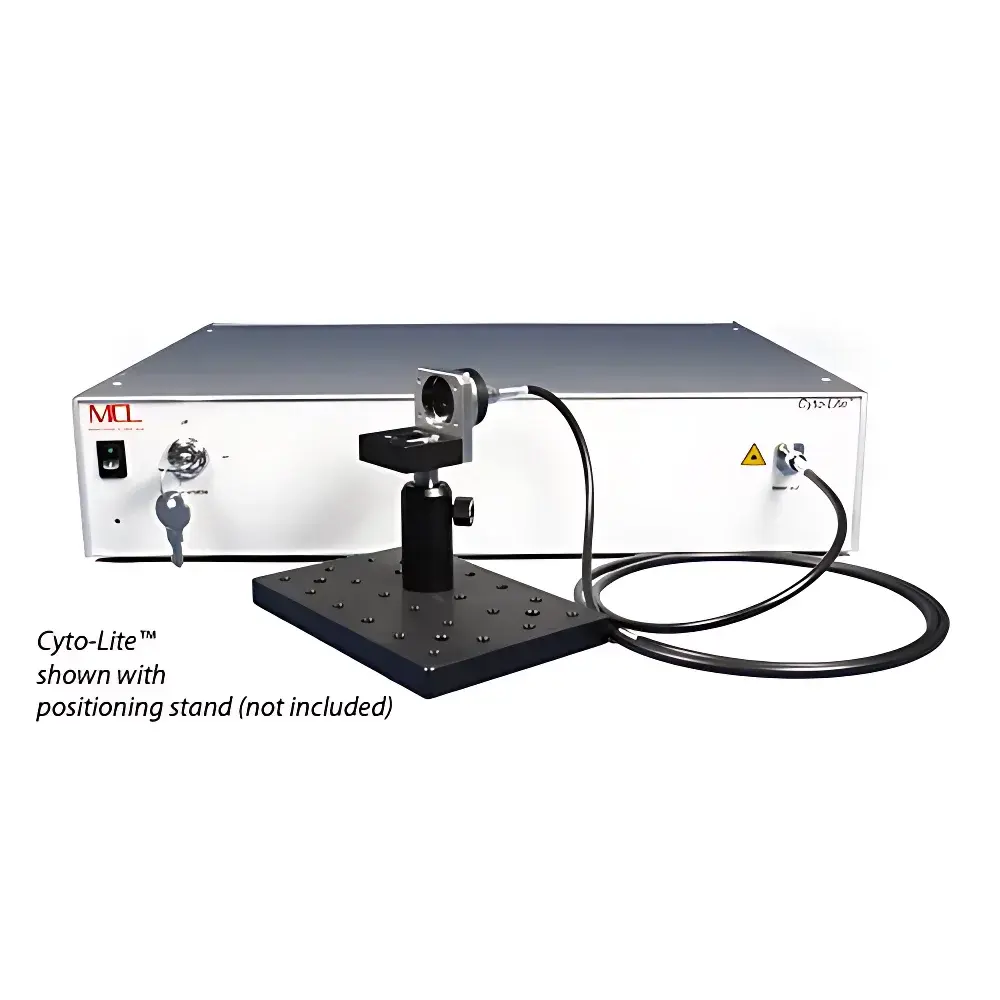
MCL Think Nano Cyto-Lite™ Multi-Wavelength Laser Engine
| Brand | MCL Think Nano |
|---|---|
| Origin | USA |
| Model | Cyto-Lite™ |
| Laser Wavelengths | 405 nm, 532 nm, 640 nm |
| Output Power | 10 mW (405 nm & 640 nm), 20 mW (532 nm) |
| Control Interface | USB 2.0 |
| Modulation | Onboard DDS sine-wave generator + 16-bit DAC per channel |
| Feedback Modes | Constant current or constant optical power |
| Power Supply | Three independent linear regulators with ESD and overcurrent protection |
| Fiber Delivery | Single-mode PM fiber, collimated free-space option available |
| Compliance | CE, RoHS, FDA 21 CFR Part 11–ready software architecture |
Overview
The MCL Think Nano Cyto-Lite™ is a compact, integrated multi-wavelength laser engine engineered for precision single-molecule imaging, fluorescence microscopy, and quantitative live-cell optical assays. Unlike conventional multi-laser setups requiring discrete sources, beam combiners, shutters, and alignment-intensive optical paths, the Cyto-Lite™ delivers three spectrally distinct excitation lines—405 nm (violet), 532 nm (green), and 640 nm (red)—through a single polarization-maintaining (PM) optical fiber. This co-aligned, diffraction-limited output eliminates spatial registration drift between channels, a critical requirement for colocalization studies, Förster resonance energy transfer (FRET), and super-resolution modalities such as STORM and PALM. The system operates on a unified control architecture: all laser parameters—including intensity, modulation waveform, feedback mode, and on/off state—are managed via a single USB 2.0 interface and the vendor-supplied Cyto-Lite™ software suite. Its design prioritizes stability, low electronic noise, and long-term repeatability—attributes essential for time-lapse single-molecule tracking and quantitative intensity-based assays under GLP- or GMP-aligned laboratory environments.
Key Features
- Single-fiber tri-wavelength output: Simultaneous or sequential delivery of 405 nm, 532 nm, and 640 nm through one PM fiber—reducing alignment complexity and improving channel-to-channel registration accuracy.
- Dual feedback control per channel: Selectable constant-current or constant-optical-power operation, enabling stable intensity output across thermal and aging variations in diode performance.
- High-fidelity analog modulation: Integrated direct digital synthesis (DDS) sine-wave generator and 16-bit DAC per channel support precise amplitude and frequency modulation (up to 100 kHz bandwidth), suitable for lock-in detection, optogenetic stimulation timing, and fluorescence lifetime excitation gating.
- Ultra-low-noise power architecture: Three independent linear regulator power supplies—each dedicated to one laser diode—minimize cross-talk and ripple-induced intensity noise; spectral filtering further suppresses high-frequency switching artifacts.
- Hardware-level safety and fault resilience: Per-channel overcurrent protection, watchdog circuitry for supply voltage monitoring, and ESD-hardened input stages ensure robust operation in shared lab environments with variable grounding conditions.
- FDA 21 CFR Part 11–ready software framework: Audit-trail-enabled logging, user-access controls, and electronic signature support align with regulated QC/QA workflows in pharmaceutical and diagnostic development labs.
Sample Compatibility & Compliance
The Cyto-Lite™ is compatible with standard inverted and upright epifluorescence microscopes, TIRF systems, and custom-built single-molecule platforms utilizing objective-type or prism-based illumination. It supports common fluorophores including DAPI (405 nm), FITC/GFP (532 nm), and Cy5/Alexa Fluor 647 (640 nm). All optical components meet ISO 10110 surface quality standards; laser housing conforms to IEC 60825-1:2014 Class 3B safety requirements. The controller firmware and software comply with RoHS 3 and CE directives. When deployed with validated protocols, the system supports data integrity requirements outlined in USP , ISO/IEC 17025, and ASTM E2500 for instrument qualification in analytical method development.
Software & Data Management
The Cyto-Lite™ software provides a deterministic, deterministic-latency interface for laser control and synchronization. It supports scripting via Python API (pyCytoLite), enabling integration into automated acquisition pipelines using Micro-Manager, MetaMorph, or custom LabVIEW applications. All parameter changes—including power setpoints, modulation profiles, and feedback modes—are timestamped and logged with operator ID, session metadata, and checksum-verified configuration snapshots. Raw modulation waveforms and real-time optical power telemetry can be exported in HDF5 or CSV format for post-acquisition correlation analysis. Software updates are delivered via signed firmware packages, with version rollback capability and SHA-256 integrity verification.
Applications
- Single-molecule fluorescence resonance energy transfer (smFRET) experiments requiring precise ratiometric excitation control.
- Multi-color total internal reflection fluorescence (TIRF) imaging of dynamic protein assemblies at plasma membranes.
- Quantitative live-cell calcium imaging using genetically encoded indicators (e.g., GCaMP, jRGECO) with dual-excitation ratiometry.
- Optogenetic stimulation synchronized with high-speed confocal or light-sheet acquisition.
- Calibration-grade light source for photodetector linearity testing and quantum yield measurements.
- Embedded excitation module in OEM diagnostic instruments requiring regulatory-compliant optical subsystems.
FAQ
Is the Cyto-Lite™ compatible with third-party microscope control software?
Yes—it provides native drivers for Micro-Manager 2.0+, MATLAB Instrument Control Toolbox, and LabVIEW via DLL and Python bindings.
Can individual laser lines be modulated independently at different frequencies?
Yes—each channel features its own DDS generator and 16-bit DAC, supporting asynchronous waveform generation up to 100 kHz bandwidth.
What safety certifications does the system hold?
CE-marked, RoHS 3 compliant, and certified to IEC 60825-1:2014 Class 3B laser product safety standard.
Does the software support audit trails for regulated environments?
Yes—the Cyto-Lite™ software implements electronic signatures, role-based access control, and immutable audit logs meeting FDA 21 CFR Part 11 requirements.
Is fiber coupling included, or must it be purchased separately?
A standard PM980 fiber pigtail with FC/APC connector is factory-installed; free-space collimation optics and custom fiber lengths are available as optional accessories.





