
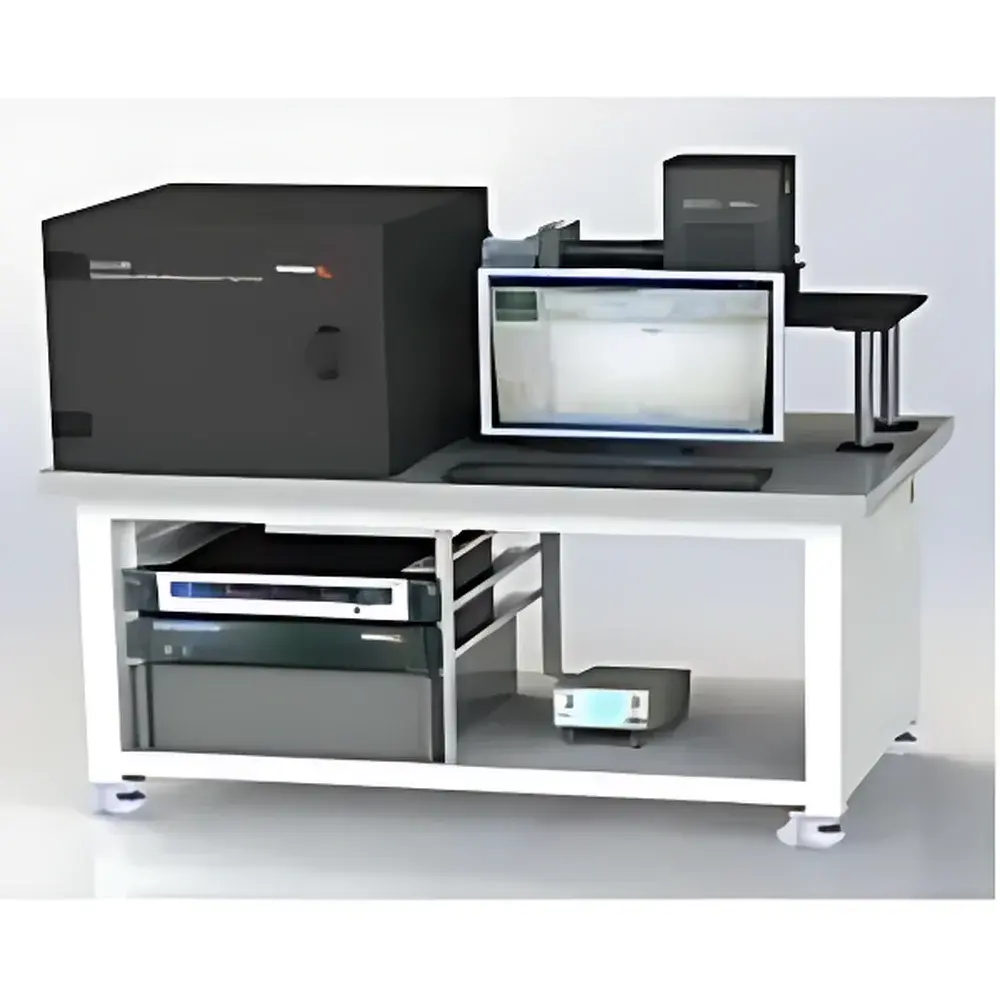
McScience K3100 OPD Photodiode Characterization System
| Brand | McScience |
|---|---|
| Origin | South Korea |
| Model | K3100 OPD |
| Type | Imported Instrument |
| Distribution Channel | Authorized Distributor |
| Application Domain | Lithium Battery Industry — Optical Sensor & Photodetector Evaluation |
Overview
The McScience K3100 OPD Photodiode Characterization System is a precision-engineered platform designed for comprehensive electrical and optoelectronic parameter extraction of photodetectors used in high-speed optical communication, battery management sensor interfaces, and advanced optoelectronic quality control workflows. Built upon a modular source-measure architecture, the system implements simultaneous bias-controlled illumination, low-noise current-voltage (I-V) sweep, capacitance-voltage (C-V), spectral responsivity mapping, and angular sensitivity profiling. Its core measurement principle integrates calibrated broadband or monochromatic light stimulation (via integrated or external sources) with sub-picoampere current resolution and millivolt-level voltage accuracy—enabling traceable characterization of quantum efficiency, dark current, junction capacitance, linearity, and spatial response uniformity. The K3100 OPD is specifically configured to support photodiode evaluation in lithium-ion battery manufacturing environments where optical isolation sensors, UV-curable coating monitors, and laser-based electrode alignment systems require rigorous photodetector validation per internal QA protocols and IEC 61215/IEC 62109–aligned test practices.
Key Features
- Integrated dual-channel SMU (Source Measure Unit) architecture supporting independent voltage sourcing and current measurement with <100 fA noise floor and ±0.02% basic accuracy
- Automated spectral responsivity testing across 200–1700 nm range using optional monochromator-coupled calibration-grade light sources (NIST-traceable reference detectors available)
- Programmable angular incidence stage (±90° rotation, 0.1° resolution) for incident-angle-dependent responsivity (θ-R) and field-of-view (FOV) characterization
- Capacitance-voltage (C-V) profiling from 1 kHz to 1 MHz with built-in bias-T for junction depletion width and doping profile estimation
- DIV (Dark Current vs. Illumination Voltage) sweep mode with real-time leakage current stabilization algorithms to suppress thermal drift during extended measurements
- Rack-mountable 19″ chassis with GPIB, USB 2.0, and Ethernet (LXI-compliant) interfaces for integration into automated test benches and MES-linked production lines
Sample Compatibility & Compliance
The K3100 OPD accommodates standard TO-can, surface-mount (SMD), chip-on-board (COB), and bare-die photodetectors—including Si, Ge, InGaAs, GaP, and organic photodiodes (OPDs)—via interchangeable probe stations and vacuum chuck fixtures. It supports wafer-level probing (with optional micro-manipulator add-on) and packaged device testing without reconfiguration. All measurement routines comply with fundamental metrological requirements defined in ISO/IEC 17025 for calibration laboratories and align with key industry standards including JEDEC JESD22-A114 (ESD sensitivity), IEC 60747-5-2 (optocoupler photodetector testing), and ASTM E1021 (spectral responsivity measurement). For regulated battery production environments, audit-ready data logs include full timestamping, operator ID, environmental condition tags (optional temperature/humidity sensor input), and electronic signature support compatible with FDA 21 CFR Part 11 and EU Annex 11 compliance frameworks.
Software & Data Management
The system ships with McScience’s OPD-Studio v3.2—a Windows-based application developed under GLP/GMP design principles. It provides scriptable test sequencing (Python API included), real-time parameter visualization (including dynamic LIV, C-V, and spectral overlay plots), and automated report generation in PDF/XLSX formats compliant with internal SOPs. Raw datasets are stored in HDF5 format with embedded metadata (instrument configuration, calibration IDs, uncertainty budgets). Audit trail functionality records all user actions, parameter changes, and calibration events with immutable timestamps. Export modules support direct upload to enterprise LIMS or MES platforms via RESTful API or OPC UA interface. Software validation documentation (IQ/OQ/PQ templates) and 21 CFR Part 11 configuration packages are provided as standard deliverables.
Applications
- Characterization of photodiodes embedded in BMS optical isolation circuits for high-voltage battery packs
- Responsivity uniformity mapping of large-area Si photodiodes used in UV-curing process monitoring during electrode coating
- Dark current stability assessment of InGaAs detectors in fiber-optic temperature sensing arrays for thermal runaway detection
- C-V profiling of GaP photodiodes employed in laser alignment systems for precision anode/cathode stacking
- Angle-resolved quantum efficiency validation for organic photodiodes integrated into flexible battery health indicator displays
- Pre-shipment qualification testing of phototransistors and photo-FETs used in contactless current sensing modules
FAQ
Does the K3100 OPD support pulsed illumination testing for high-speed photodiode transient response analysis?
Yes—when paired with McScience’s optional Pulsed Light Source Module (PLS-M2), the system enables ns-scale rise/fall time measurement, impulse response acquisition, and bandwidth estimation up to 10 GHz via de-embedded S-parameter modeling.
Can the system perform automated pass/fail grading based on user-defined specification limits?
Yes—OPD-Studio includes configurable limit tables and statistical process control (SPC) dashboards that auto-classify devices as Pass/Reject/Review and generate summary statistics (Cp/Cpk, defect ppm) per lot or wafer map.
Is NIST-traceable calibration documentation included with the base system?
A factory calibration certificate (ISO/IEC 17025 accredited) is supplied; NIST-traceable reference detector kits and annual recalibration services are available as optional accessories.
What level of technical support is provided for integration into existing battery manufacturing QA infrastructure?
McScience offers on-site integration engineering, MES/LIMS interface development support, and custom SOP adaptation workshops—delivered by application engineers with domain experience in lithium battery production and photonic sensor validation.





