
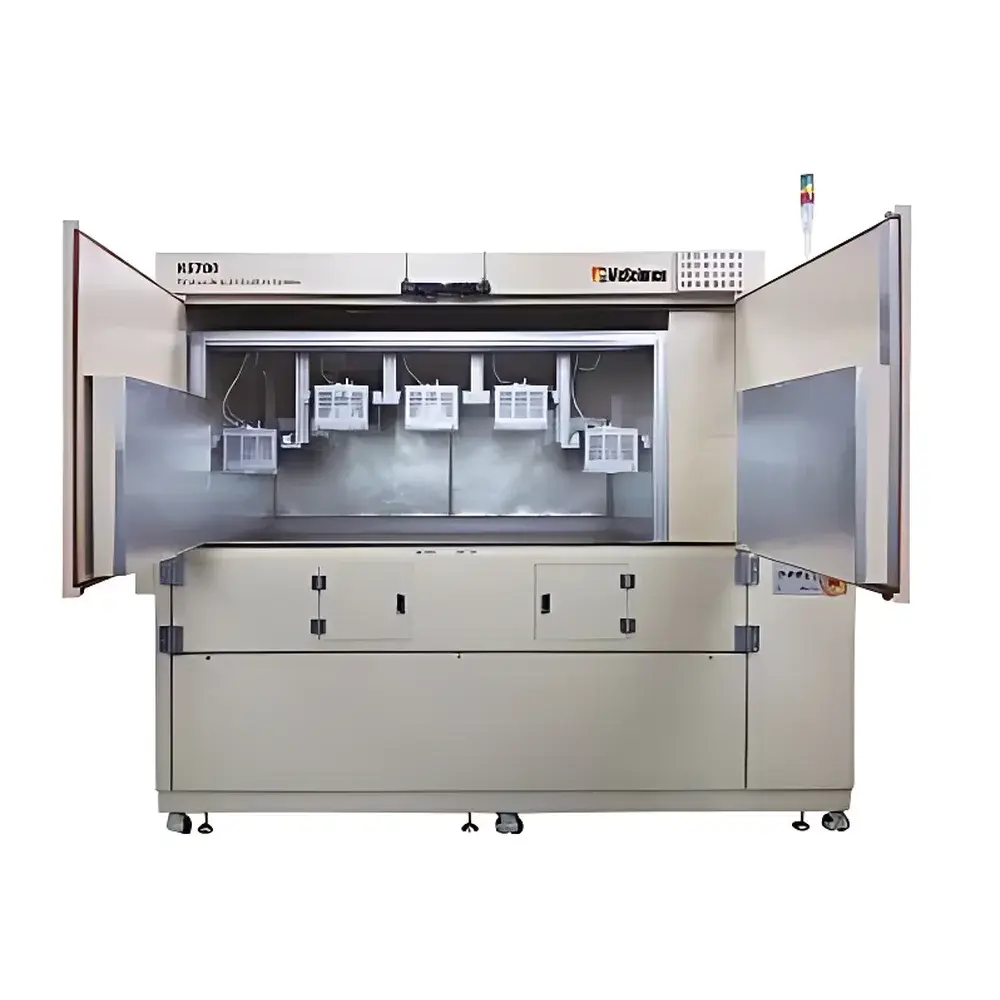
McScience K5700 Light Soaking System for Photovoltaic Modules
| Brand | McScience |
|---|---|
| Origin | South Korea |
| Model | K5700 |
| Operating Mode | Steady-State |
| Application | Light Soaking Treatment of PV Modules |
| Category | Solar Simulator (Industry-Specific Instrument) |
| Import Status | Imported |
Overview
The McScience K5700 Light Soaking System is a purpose-built, steady-state solar simulation platform engineered to deliver controlled, uniform, and spectrally stable illumination for light soaking treatment of photovoltaic (PV) modules—particularly thin-film technologies such as CIGS, CdTe, and amorphous silicon (a-Si). Light soaking is a critical preconditioning step in PV reliability assessment and performance stabilization, where extended exposure to simulated AM1.5G illumination induces beneficial defect passivation and interface state relaxation, thereby reducing initial power degradation (e.g., light-induced degradation, LID, or metastable defect formation). Unlike transient or pulsed irradiation systems, the K5700 operates exclusively in steady-state mode, ensuring continuous, thermally stable irradiance conditions required for reproducible soak durations ranging from minutes to hundreds of hours—fully aligned with IEC 61215-2 (MQT 18), IEC 61646, and JEDEC JESD230 standards for thin-film module qualification.
Key Features
- Steady-state illumination architecture with active thermal management to maintain <±0.5 °C module backsheet temperature stability during prolonged exposure—critical for eliminating thermal drift artifacts in Voc, Isc, and FF evolution monitoring.
- Class AAA solar simulator classification per IEC 60904-9:2020, featuring spectral match (A), spatial uniformity (A), and temporal stability (A) across a 1.5 m × 1.0 m effective irradiation area—sufficient for full-size commercial PV modules up to 2.4 m × 1.3 m via programmable scanning or multi-lamp array configuration.
- Integrated 3000 W xenon-arc source with precision optical collimation and secondary reflector system, delivering calibrated irradiance from 0.5 to 1.5 suns (500–1500 W/m²) with real-time feedback via NIST-traceable reference cell and pyranometer.
- Programmable soak protocols with time-resolved data logging (1 Hz sampling) of irradiance, chamber ambient temperature, relative humidity, and optional external IV tracer inputs—enabling synchronized correlation between soak duration and electroluminescence (EL), photoluminescence (PL), or quantum efficiency (QE) shifts.
- Robust stainless-steel frame and modular lamp housing designed for cleanroom-compatible operation and long-term maintenance intervals (>2000 h lamp life under rated output).
Sample Compatibility & Compliance
The K5700 accommodates rigid and flexible PV modules—including glass-glass, glass-backsheet, and polymer-based substrates—with adjustable mounting rails and non-contact thermal sensing. It supports standard test coupons (e.g., 10 cm × 10 cm mini-modules) as well as full-size production units. All optical and electrical safety interlocks comply with IEC 61000-6-3 (EMC emission), IEC 61000-6-4 (EMC immunity), and IEC 62109-1/-2 (PV inverter safety). The system is fully compatible with GLP-compliant laboratories and supports audit-ready documentation packages including calibration certificates (traceable to KRISS), irradiance mapping reports, and SOP templates aligned with ISO/IEC 17025 requirements.
Software & Data Management
Control and data acquisition are managed via McScience’s proprietary LightSoakPro™ software (v4.2+), running on Windows 10 IoT Enterprise. The interface provides real-time irradiance heatmaps, soak timeline visualization, and automated report generation in PDF/XML formats compliant with FDA 21 CFR Part 11 (electronic signatures, audit trails, user role permissions). Raw datasets are stored in HDF5 format with embedded metadata (timestamp, lamp hours, spectral calibration ID, operator ID), enabling seamless integration into LIMS environments or MATLAB/Python-based degradation modeling workflows.
Applications
- Pre-conditioning of thin-film PV modules prior to STC (Standard Test Conditions) rating and energy yield modeling.
- Accelerated stability testing under controlled light-soak stress for qualification per IEC 61215-2 MQT 18 and UL 1703 Annex H.
- Correlation studies between light-soak duration and metastable defect kinetics using in-situ dark I-V, capacitance-voltage (C-V), or drive-level capacitance profiling (DLCP).
- Process development support for deposition and annealing optimization in R&D labs targeting reduced light-induced degradation.
- Third-party certification lab use for accredited PV module testing under EN 61215 and IEC 61646 revision cycles.
FAQ
What is the maximum module size supported without beam scanning?
The standard K5700 configuration provides uniform illumination over 1.5 m × 1.0 m; larger modules require optional motorized XY scanning stage (sold separately) to ensure full-area coverage at ±2% uniformity.
Does the system include spectral recalibration capability?
Yes—integrated spectroradiometer (350–1100 nm, ±0.5 nm resolution) enables on-site spectral verification and auto-compensation via firmware updates aligned with latest ASTM G173-03 reference spectra.
Can the K5700 be integrated with an environmental chamber?
The system features RS485 and EtherCAT interfaces for synchronized control with external climate chambers (e.g., Weiss, Binder), supporting combined light-soak + temperature/humidity stress protocols per IEC 61215-2 MQT 11.
Is NIST-traceable calibration included at delivery?
Each unit ships with a KRISS-accredited calibration certificate covering irradiance, spatial uniformity, and spectral match—valid for 12 months under normal operating conditions.
What lamp lifetime and replacement protocol does McScience specify?
Xenon lamps are rated for 2000 hours at 100% power; McScience recommends scheduled replacement at 1800 hours to maintain Class AAA compliance, with full lamp alignment and recalibration services available through authorized service centers.





