
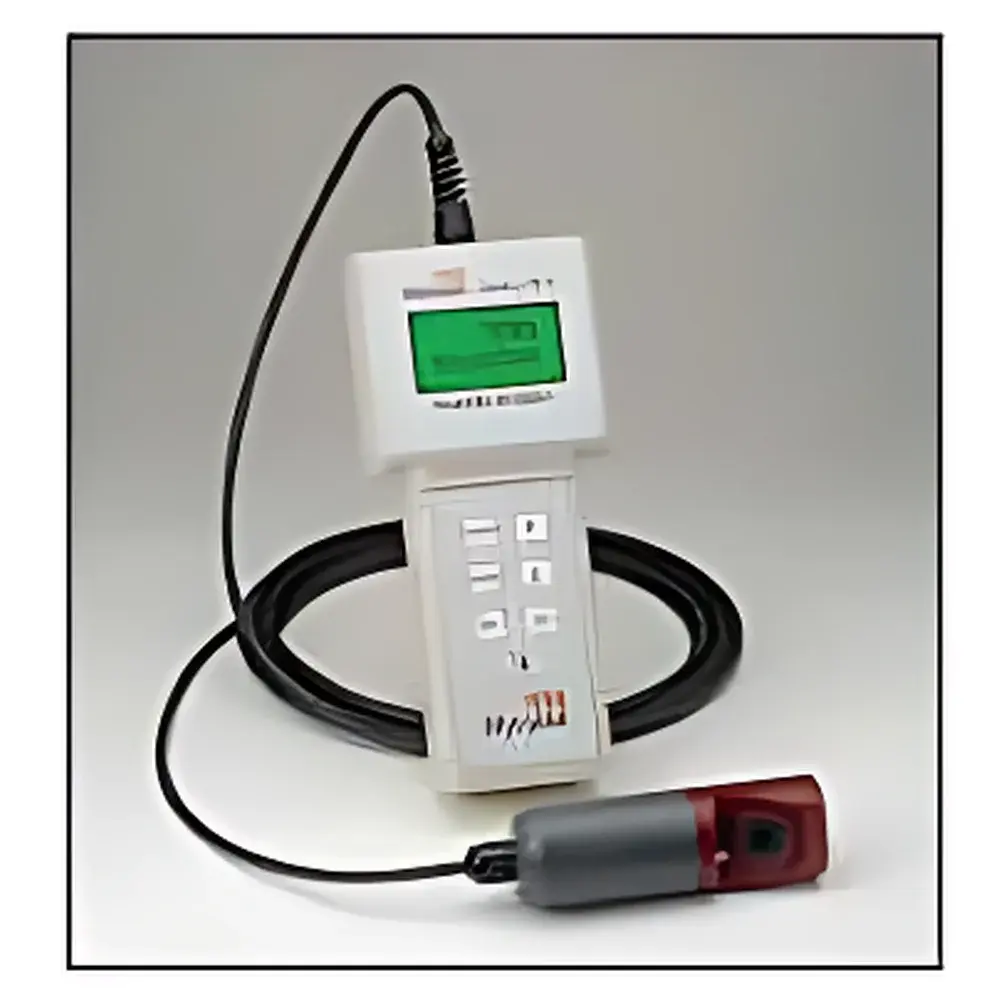
MDO-2 Portable Fluorescence-Based Dissolved Oxygen Meter
| Origin | USA |
|---|---|
| Manufacturer Type | Authorized Distributor |
| Origin Category | Imported |
| Model | MDO-2 |
| Instrument Type | Portable |
| Measurement Range | 0–25 mg/L |
| Accuracy | ±1% of reading or ±0.02 mg/L (whichever is greater) |
| Resolution | 0.01 mg/L (≤4.00 mg/L), 0.1 mg/L (>4.00 mg/L) |
| Stability | ±0.01 mg/L |
| Repeatability | ±0.01 mg/L |
| Drift | <1% per year |
| Temperature Range (Sample) | 0–60°C |
| Response Time (t₉₅) | <60 s |
| Operating Environment | −20 to +70°C, 0–100% RH |
| IP Rating | IP66 |
| Sensor Cable Length | 6.0 m |
| Maximum Pressure Rating | 100 PSI |
| Sensor Lifetime | 7–10 years |
| Display | Backlit graphical LCD with UV-resistant housing and adjustable contrast |
| Data Storage | 50 measurement records |
| Interface | RS-232 serial output |
| Diagnostic Function | Built-in probe self-test |
| Power | Rechargeable battery |
Overview
The MDO-2 Portable Fluorescence-Based Dissolved Oxygen Meter is an engineered solution for field-deployable, high-fidelity dissolved oxygen (DO) quantification in aqueous environments. Unlike conventional electrochemical DO sensors that rely on oxygen-permeable membranes, electrolyte gels, and cathodic reduction reactions, the MDO-2 employs solid-state optical fluorescence quenching technology. At its core lies a ruthenium-based luminophore immobilized within a sol-gel matrix. When excited by blue light (typically ~470 nm), the ruthenium complex emits red-shifted fluorescence (~600 nm). Molecular oxygen acts as a dynamic quencher of this emission—its concentration inversely correlates with both fluorescence intensity and lifetime. The MDO-2 precisely measures phase shift or intensity decay kinetics, converting them into calibrated DO concentrations (mg/L or % saturation) without membrane degradation, electrolyte depletion, or polarization lag. This principle delivers inherent long-term stability, minimal drift, and immunity to flow rate, hydrogen sulfide, or chloride interference—making it especially suitable for wastewater effluent monitoring, aquaculture management, river basin surveys, and regulatory compliance sampling under GLP-aligned protocols.
Key Features
- Optical fluorescence sensing platform—no oxygen-permeable membrane, no liquid electrolyte, no photodissolvable cap
- Probe requires no hydration maintenance prior to or between measurements
- Factory-calibrated at time of manufacture; ready for immediate deployment without user calibration
- Backlit, UV-stabilized graphical LCD with user-adjustable contrast for readability in variable ambient lighting
- IP66-rated enclosure constructed from epoxy resin, polyurethane, and PVC—resistant to corrosion, abrasion, and immersion splash
- Integrated rechargeable battery enabling extended field operation without external power sources
- Real-time display of DO concentration, temperature, date, and timestamp—critical for chain-of-custody documentation
- Built-in self-diagnostic routine verifying optical path integrity, LED excitation output, and photodetector response
Sample Compatibility & Compliance
The MDO-2 is validated for use across freshwater, seawater, brackish water, activated sludge, and industrial process streams—with demonstrated performance across salinities up to 35 ppt and turbidities ≤400 NTU. Its optical design eliminates zero-point drift caused by membrane fouling or electrolyte leakage, supporting consistent data acquisition in high-solids or biofilm-prone environments. The instrument complies with ASTM D888-22 (Standard Test Methods for Dissolved Oxygen in Water) for field-use verification and supports traceable measurement reporting aligned with ISO/IEC 17025:2017 requirements for environmental testing laboratories. While not FDA 21 CFR Part 11–certified out-of-the-box, audit-ready data logs—including timestamps, operator ID fields (via manual entry), and probe diagnostic flags—facilitate integration into GxP-compliant workflows when paired with validated data transfer software.
Software & Data Management
Data acquisition and export are facilitated via RS-232 serial interface to Windows-based PCs using vendor-supplied terminal emulation software. Each stored record includes DO value (mg/L), temperature (°C), date, time, and internal probe health status. The onboard memory retains up to 50 discrete measurements with automatic overwrite logic. Exported CSV files are structured for direct import into LIMS platforms or statistical analysis tools (e.g., JMP, R, Python pandas). No proprietary drivers or cloud dependencies are required—ensuring full data sovereignty and compatibility with air-gapped laboratory networks. Firmware updates are delivered via ASCII-based command protocol, preserving backward compatibility with legacy data formats.
Applications
- Regulatory surface water and groundwater quality monitoring per EPA Method 360.1 and EU WFD Annex V
- In situ DO profiling in aquaculture ponds, hatcheries, and recirculating aquaculture systems (RAS)
- Wastewater treatment plant (WWTP) process control—especially in aeration basins, clarifiers, and anaerobic zones
- Environmental impact assessments (EIAs) requiring rapid, repeatable field DO verification
- Educational field labs where robustness, low maintenance, and conceptual clarity of optical sensing principles are pedagogically advantageous
FAQ
Does the MDO-2 require periodic recalibration in the field?
No—factory calibration is stable for the sensor’s operational lifetime (7–10 years); only verification against a certified Winkler titration standard is recommended annually for QA/QC.
Can the probe be used in pressurized pipelines or submerged housings?
Yes—the sensor housing is rated to 100 PSI and compatible with NEMA 4X-rated submersible enclosures for continuous online deployment.
Is temperature compensation automatic?
Yes—integrated Pt1000 thermistor provides real-time thermal correction per the Stern-Volmer equation, eliminating manual input errors.
How is data integrity ensured during RS-232 transmission?
All serial packets include CRC-16 checksums; transmission errors trigger automatic retransmission requests in the host software.
What maintenance does the optical sensor require?
Only periodic cleaning of the quartz window with isopropyl alcohol and lint-free wipes—no consumables, no recalibration kits, no membrane replacements.
Related Products







